How the Yule Log began
In 1966, WPIX in New York aired The Yule Log on Christmas Eve: a film of a fire burning in a fireplace, set to Christmas music, with no adverts. The idea was credited to the station's president, Fred Thrower, who wanted to give apartment dwellers without a fireplace something of one - and to give the station's staff the evening off.
The first version was filmed at Gracie Mansion, the official residence of the Mayor of New York, and was a loop only seconds long, so the same log could be seen burning over and over. A longer version was filmed a few years later. The broadcast became a fixture of New York Christmases, was dropped at the end of the 1980s, and returned by popular demand in 2001.
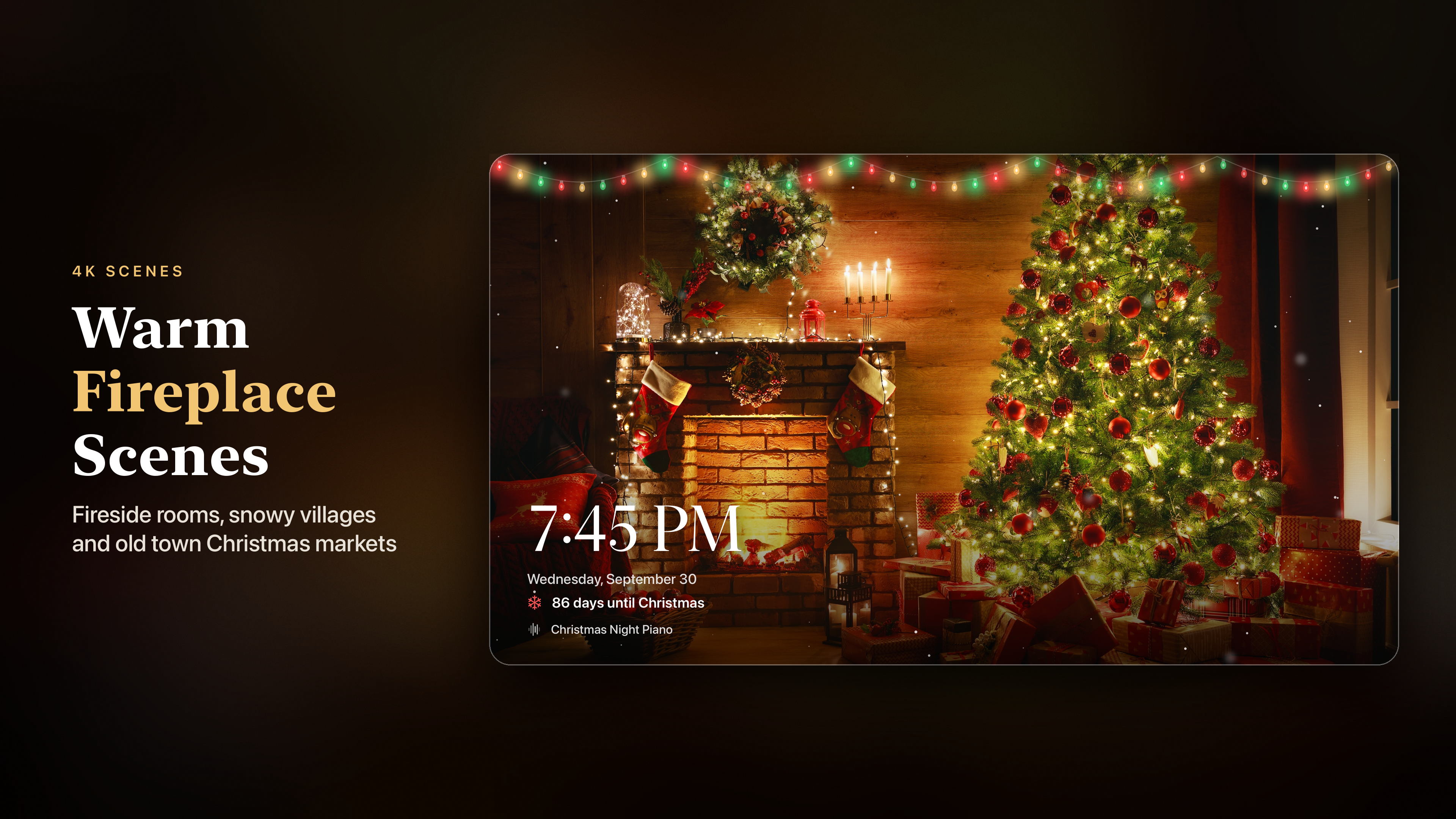
Since then the idea has spread everywhere: fireplace videos, streaming channels of crackling logs, and apps that turn any television into a hearth.
What makes a good Christmas background
The Yule Log works for a simple reason: nothing happens. There is no story to follow and nothing you can miss, so it can stay on for hours while people talk. A good background has the same qualities:
- Slow movement. Flames, falling snow, gently drifting light. Enough to look alive, not enough to watch.
- Warm, low light. A dark scene with points of warm light suits an evening room far better than a bright, colourful one.
- No loop you can spot. A short loop is fine for a minute and irritating after ten. Long or changing scenes avoid the moment when everyone notices the same log falling again.
- Music that does not need attention. Instrumental carols are familiar enough to feel like Christmas and quiet enough to talk over.
Matching the scene to the moment
Christmas dinner. A fireside room or a lit tree. Keep it calm and dim; the table is the focus.
A party. More life works here: a Christmas market at night, a carousel, a village with lights in every window. A clock on screen helps everyone keep track of the evening.
Decorating the tree. Brighter scenes and livelier carols. This is the moment for Jingle Bells.
Opening presents. Something cheerful but not distracting - the presents are the show.
Late evening. Snowy villages and quiet piano. Lower the brightness and let a sleep timer end the night.

Beyond the fireplace
The fireplace is the classic, but it is not the only option. Alpine villages under snow, old-town markets, a lakeside lodge or a single candle on a windowsill all do the same job. Rotating through several over an evening keeps the room from feeling static, and changes the mood as the night goes on without anyone choosing anything.
If the scene changes on its own and the music runs from the device rather than a stream, the result is close to what WPIX was aiming for in 1966: a television that gives the room a feeling and lets everyone get on with Christmas.