Scored on the device • iPhone & iPad

IELTS Speaking Test: AI Score

Practise IELTS and TOEFL Speaking out loud, get a band score, and see exactly which words cost you marks.

It records your answer, turns it into text on the phone, and scores it against the official criteria. Nothing is uploaded, there is no account to create, and no connection is needed.

Download on the App Store
iPhone & iPad IELTS and TOEFL Works offline Recordings stay local
IELTS Speaking Test app icon

How a practice answer works

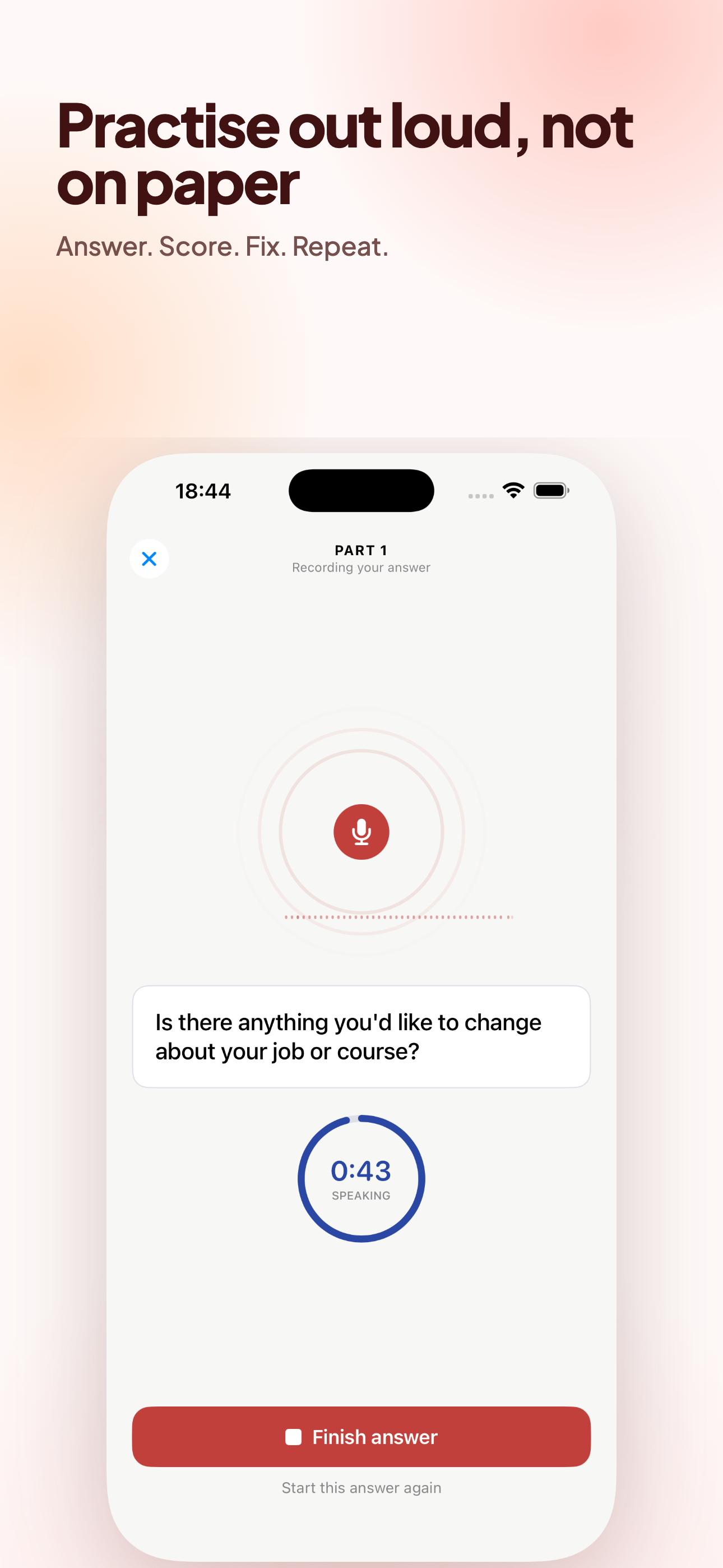
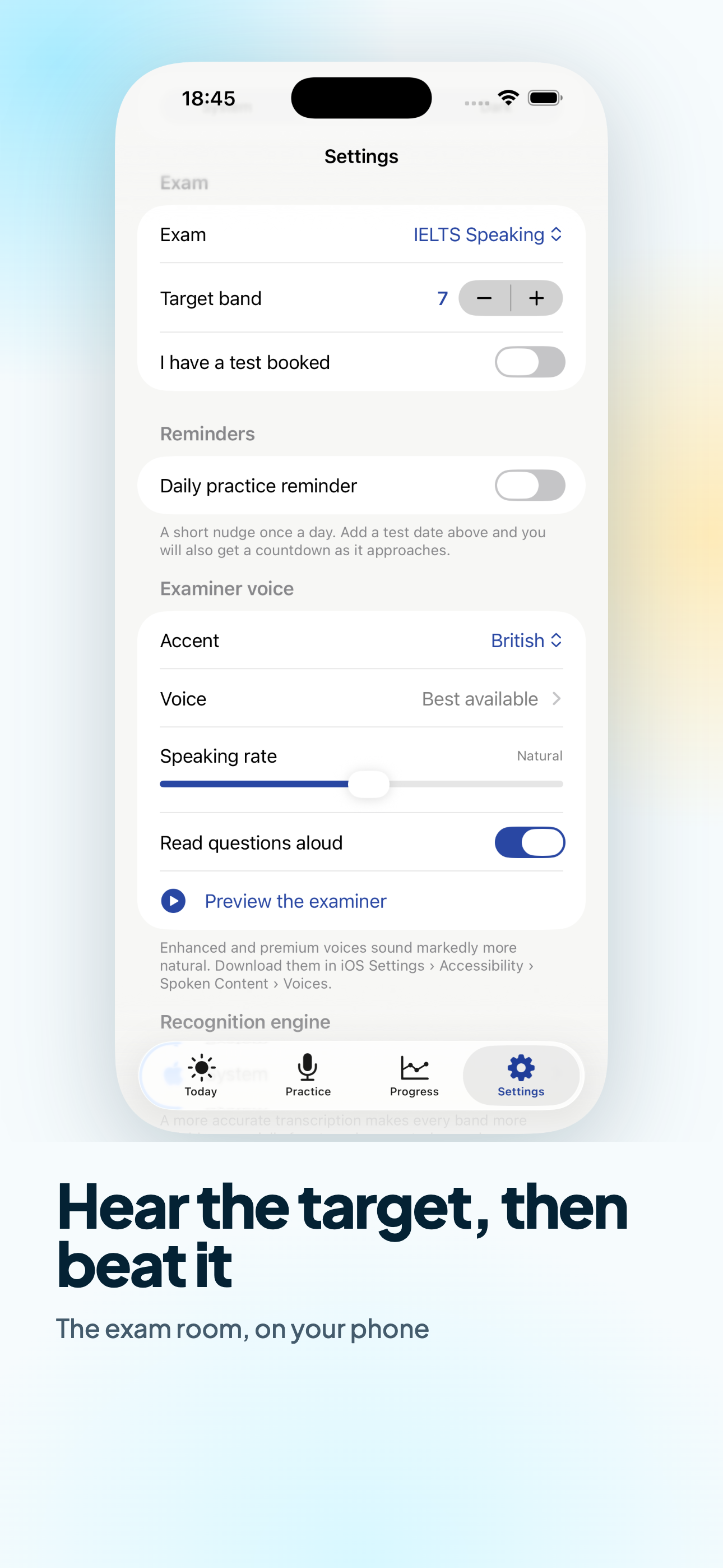
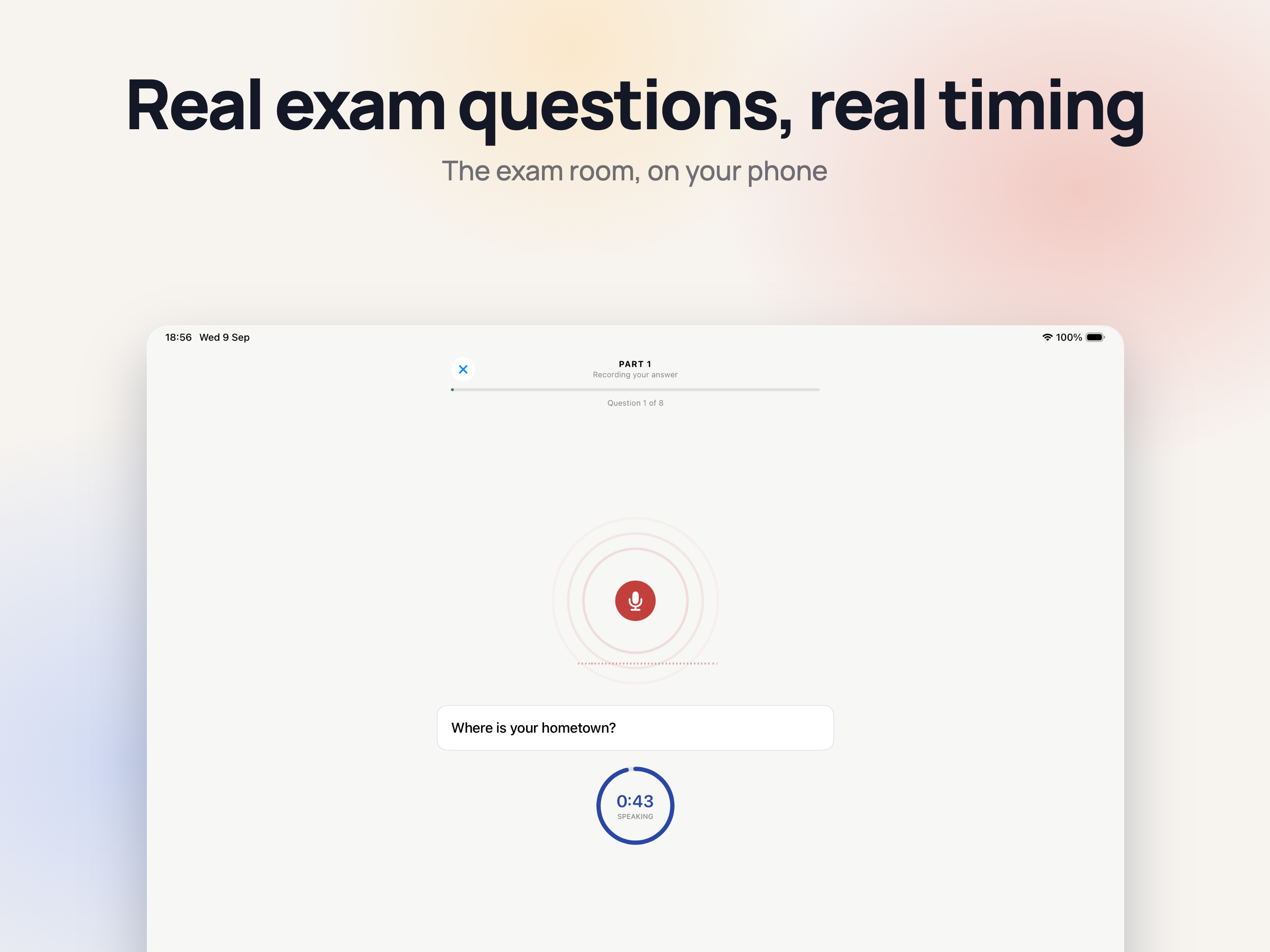
Pick a question or sit a full mock test. The examiner reads it aloud in the accent you choose, a timer runs the way it does in the real exam, and when you stop talking you get a score, a breakdown, and your own words marked up.

British examiner American examiner Australian examiner Indian examiner Irish examiner

Every score comes with the measurement behind it

A band on its own tells you where you are and nothing about why. Each of the four official criteria is broken down into the things that were actually counted in your answer.

Fluency and Coherence

Speech rate, words per run, hesitation pauses, fillers, self-repairs and total talking time. Long silences and restarts are counted separately, because they cost different things.

Lexical Resource

Lexical diversity, the share of words beyond the everyday core, collocations, idioms, and how often you recycle the same word instead of reaching for another.

Grammatical Range and Accuracy

Which complex structures you actually used, the range of tenses, how much subordination, and the proportion of clauses that came out error-free.

Pronunciation

Intelligibility, intonation range, stress contrast, rhythm and whether you group words into sense units rather than reading word by word.

Transcript X-ray

Your answer, word by word. This is the part that turns a score into something you can act on, because the marks are attached to specific moments rather than to the answer as a whole.

  • Fillers, long pauses and self-repairs marked where they happened.
  • Grammar slips flagged in place, with the correction.
  • Strong vocabulary and linking words highlighted, so you can see what worked.
  • Tap any highlight to read why it was marked.
  • Play the recording back and follow along with the transcript.
4
Official criteria scored
5
Examiner accents
36
Part 2 cue cards
0
Recordings uploaded

IELTS Speaking

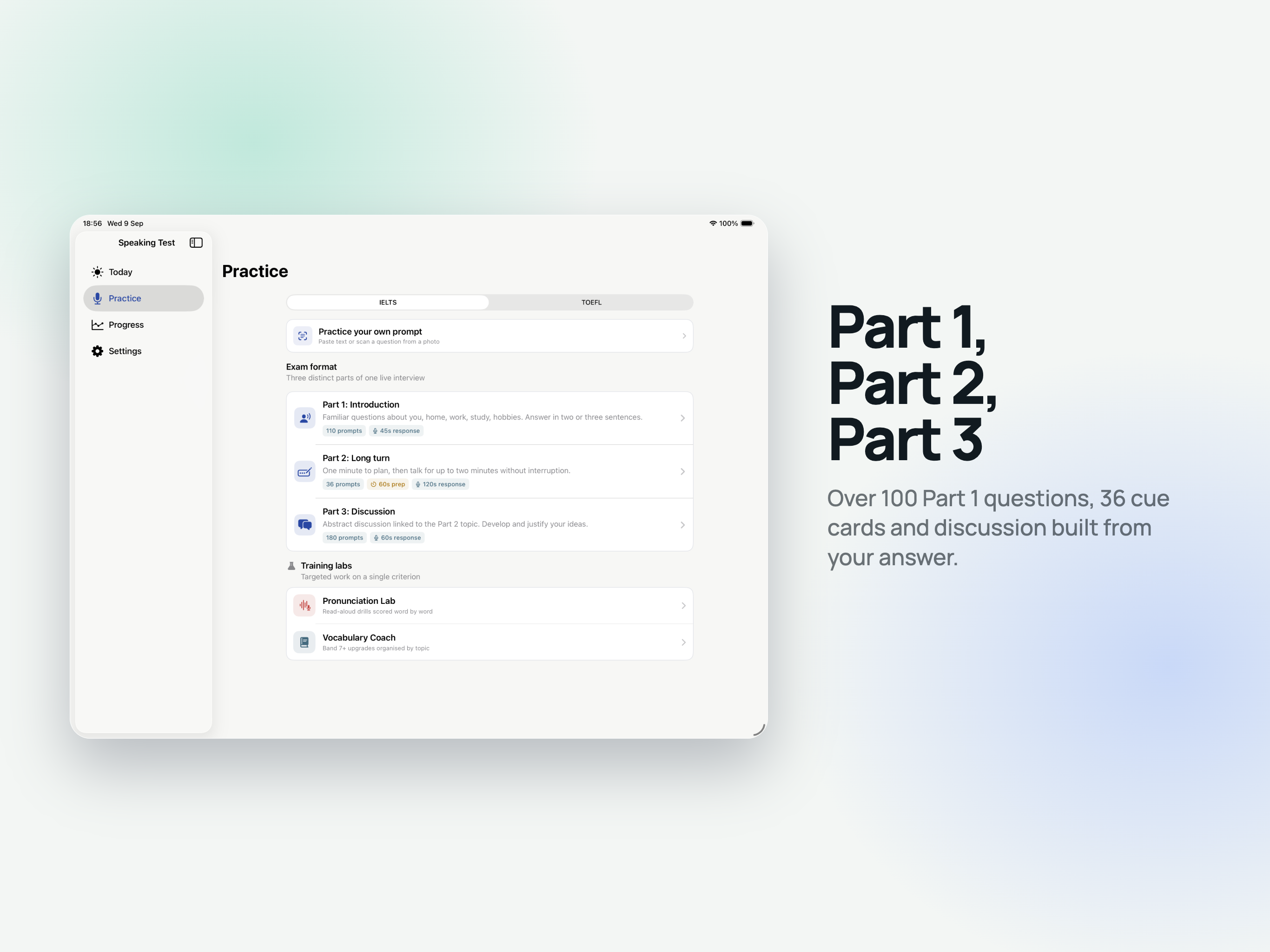
All three parts, with the timings the real test uses.

  • Part 1, Part 2 and Part 3.
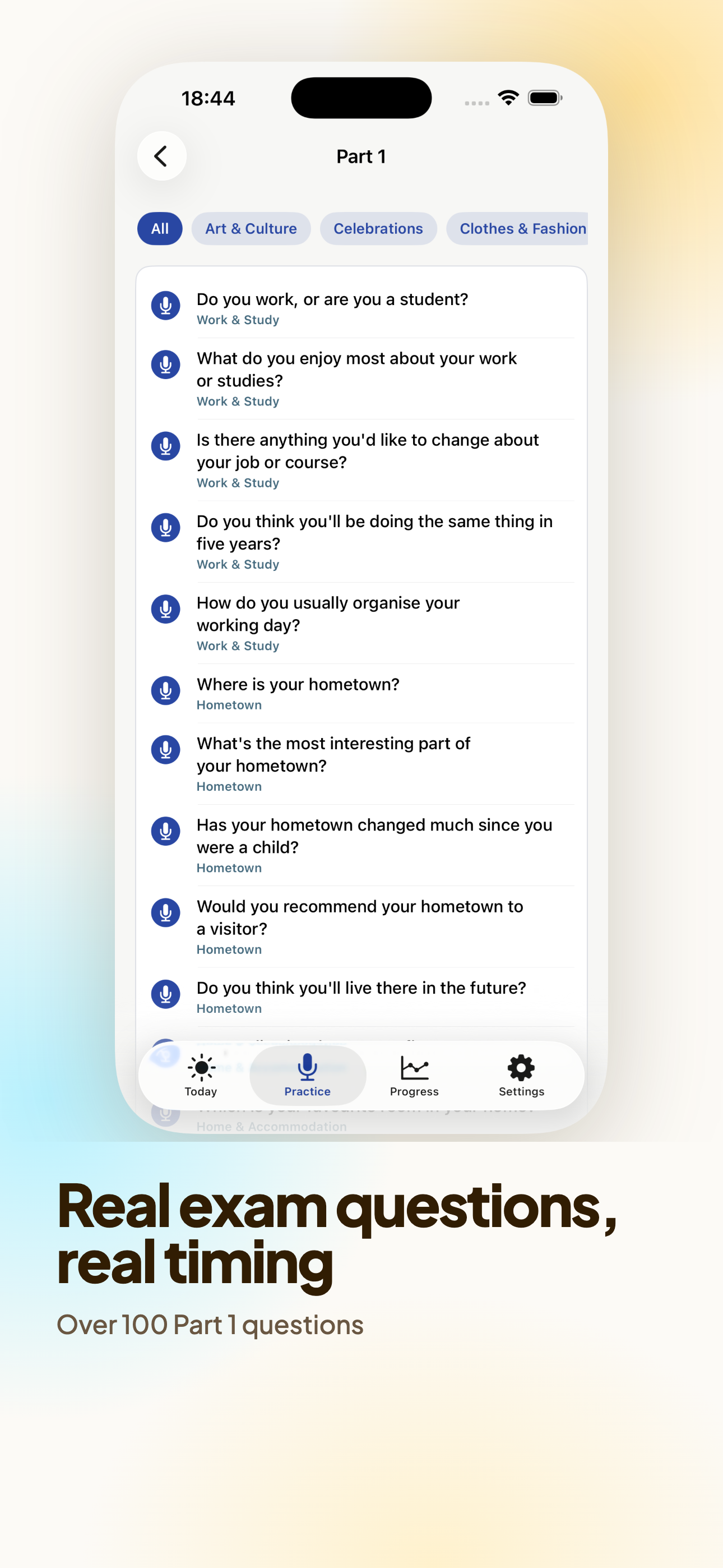
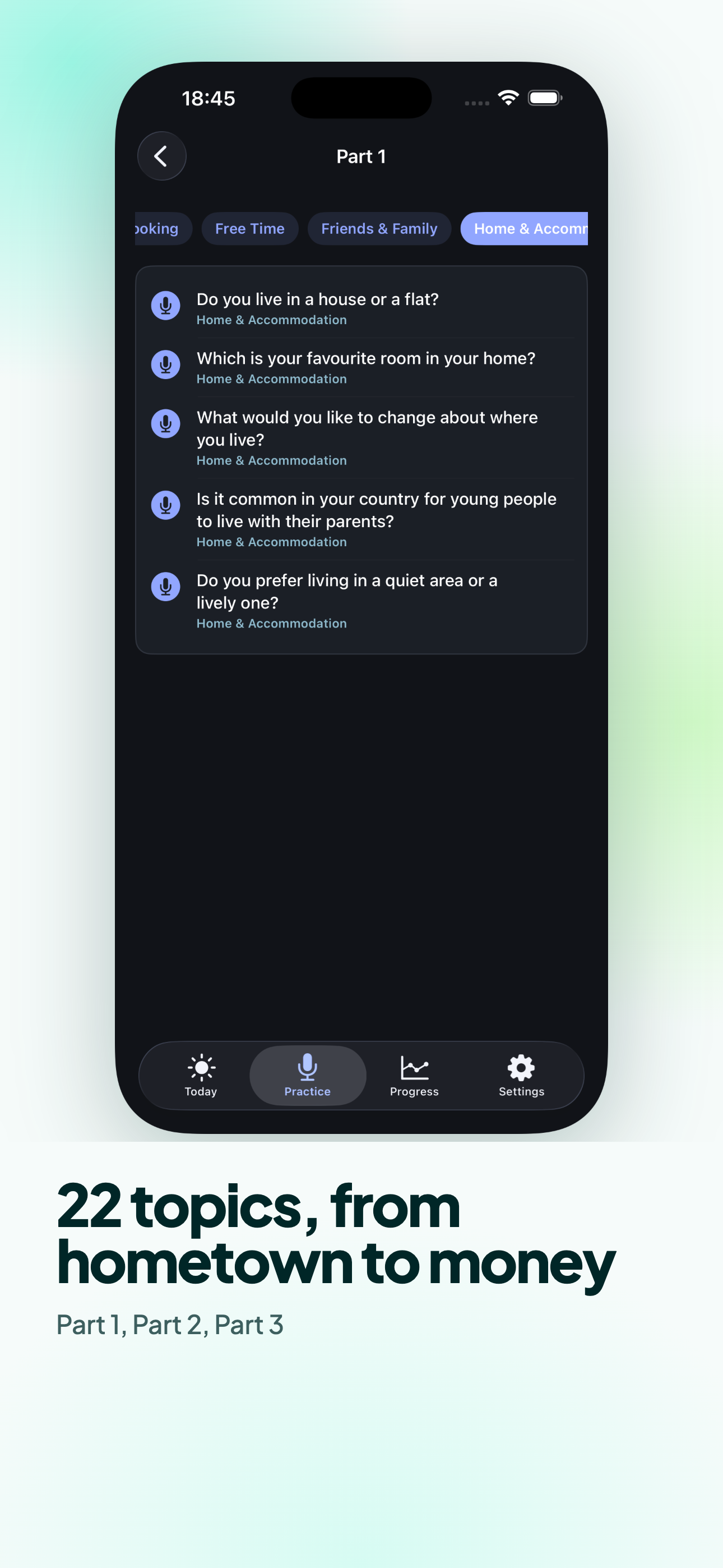
  • Over 100 Part 1 questions across 22 topics.
  • 36 cue cards, each followed by the Part 3 discussion that belongs to it.
  • One minute of silent preparation before the long turn, exactly as in the test.

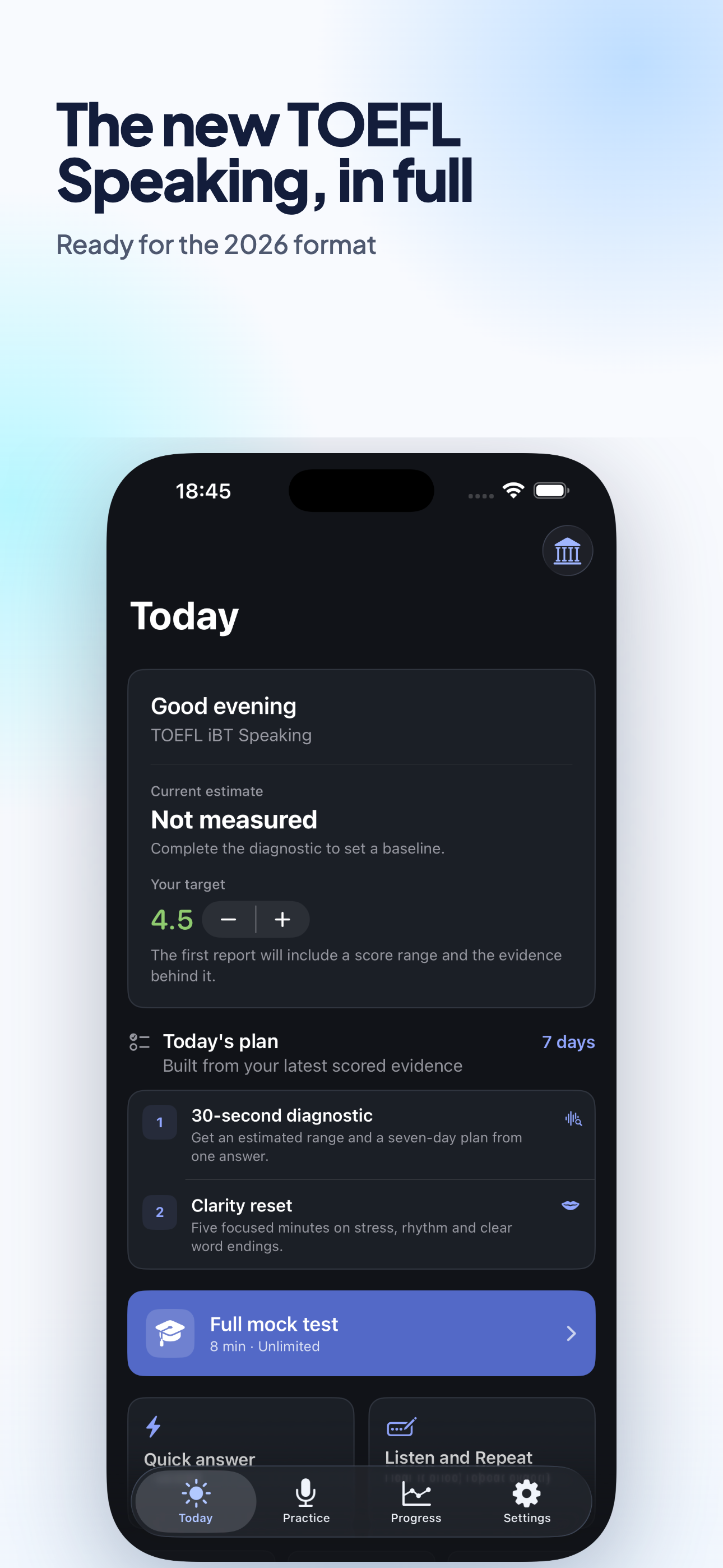
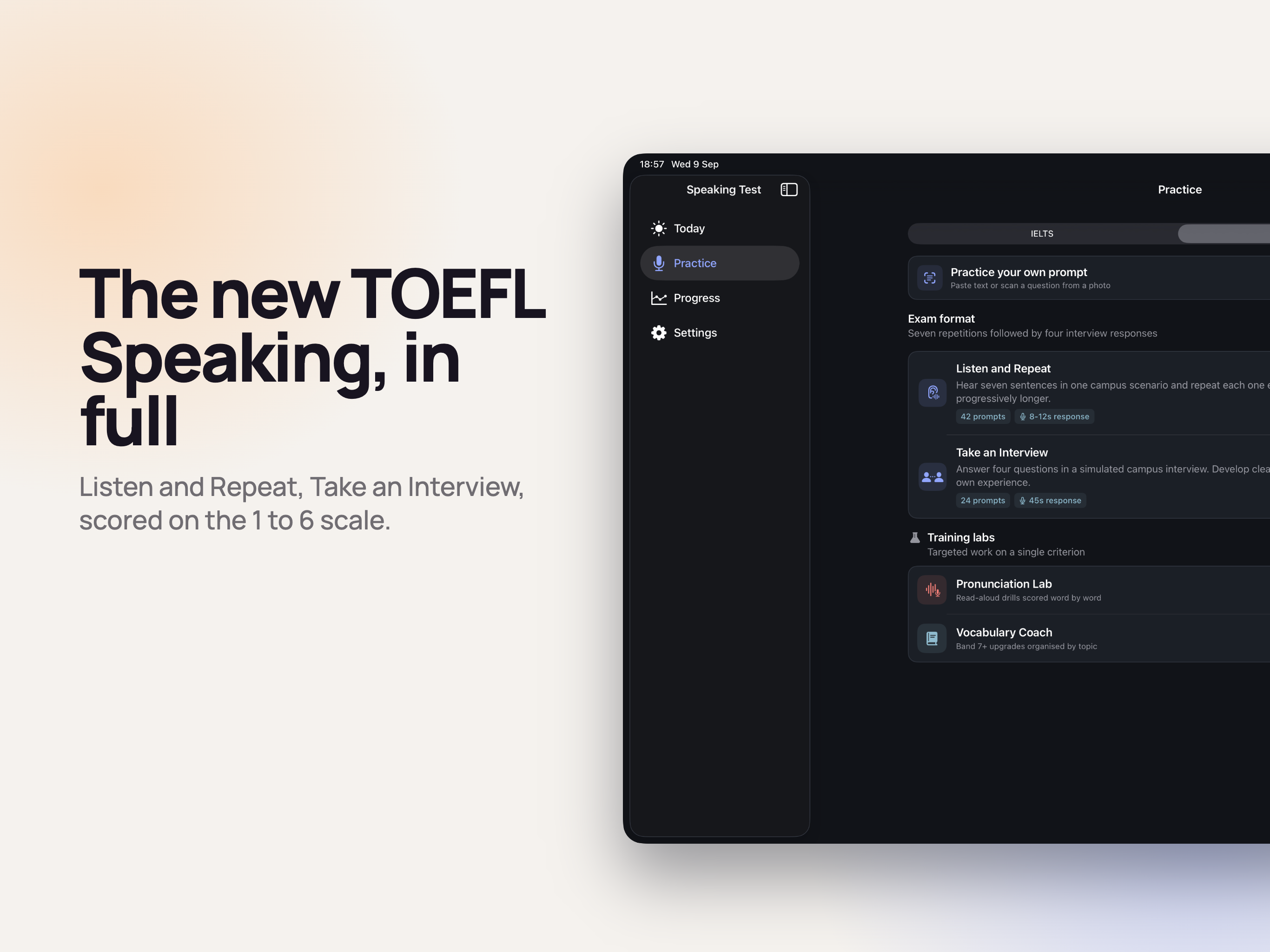
TOEFL Speaking, 2026 format

The current format in full, not the previous one relabelled.

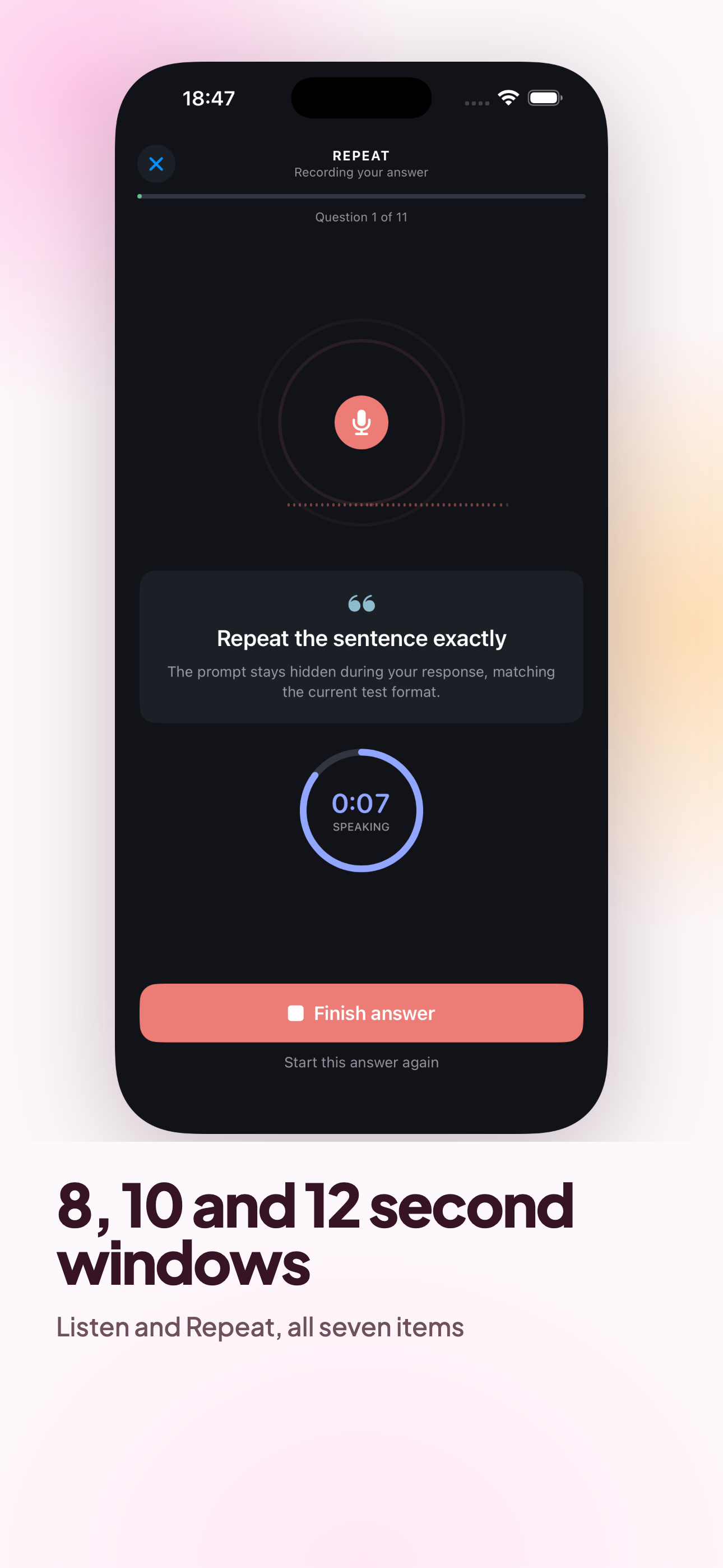
  • Seven Listen and Repeat sentences drawn from one campus scenario.
  • Response windows of 8, 10 and 12 seconds, as specified.
  • Four Take an Interview questions, 45 seconds each, with no preparation time.
  • Reported on the 1 to 6 scale.

What turns practice into progress

Sitting more mock tests is not the same as improving. These are the parts aimed at the gap between the two.

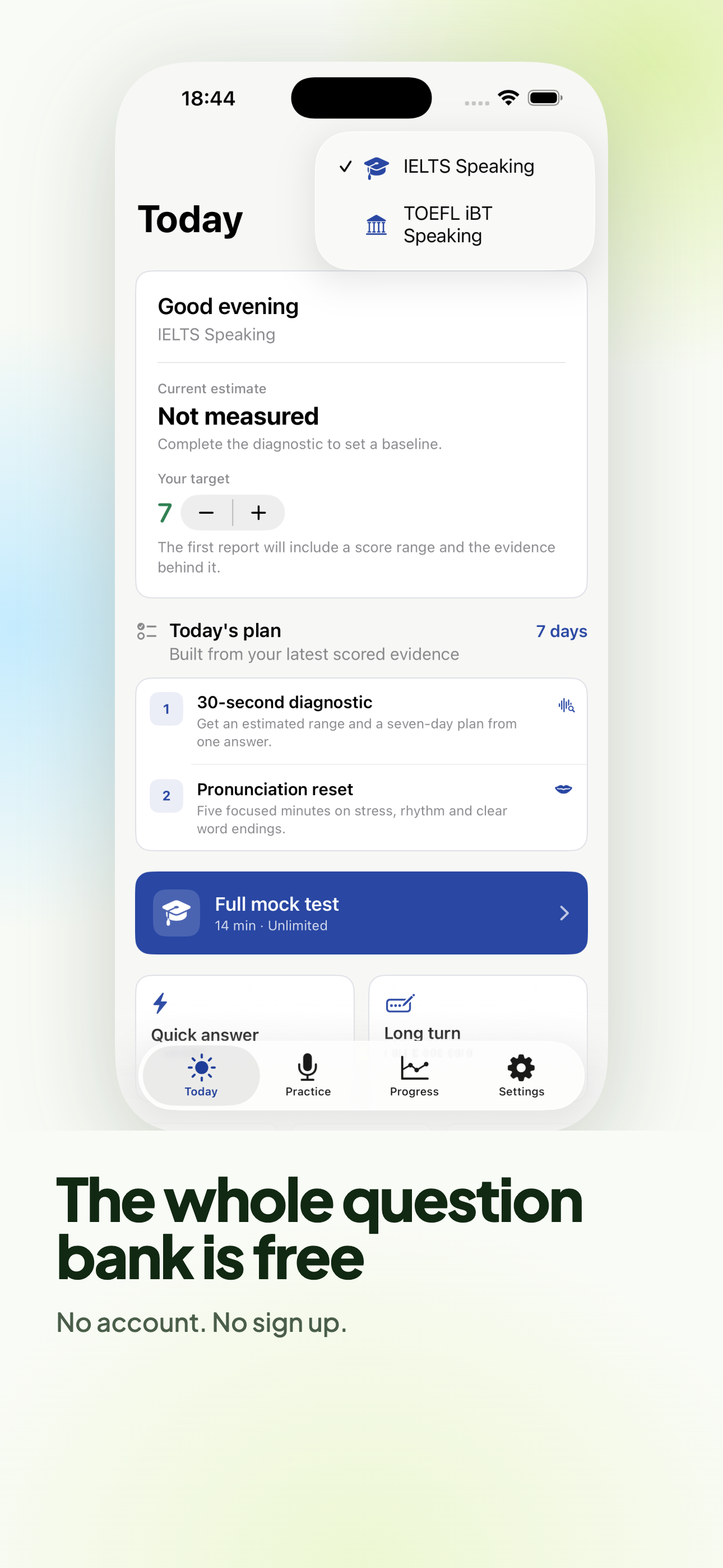
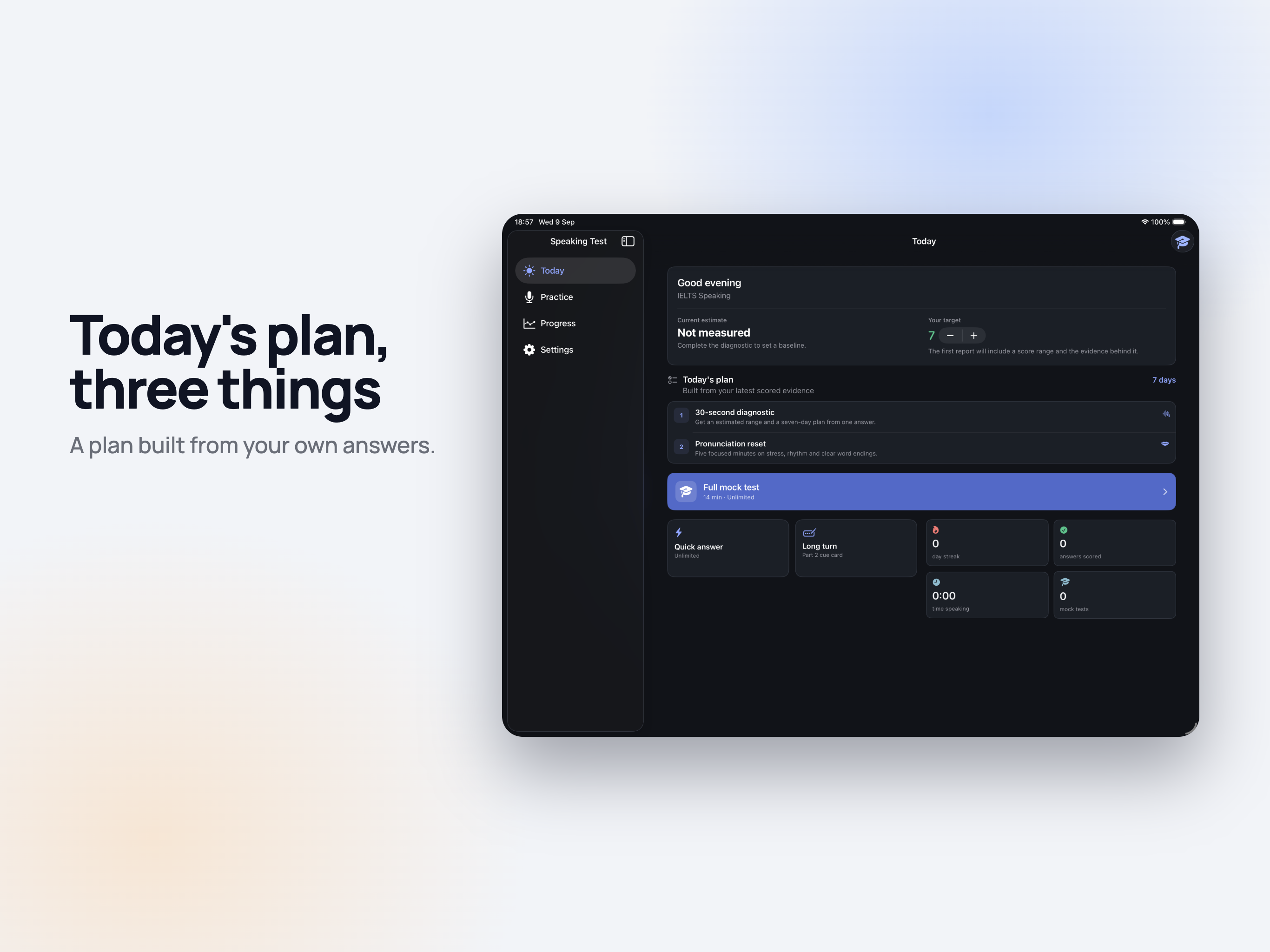
A plan built from your own answers

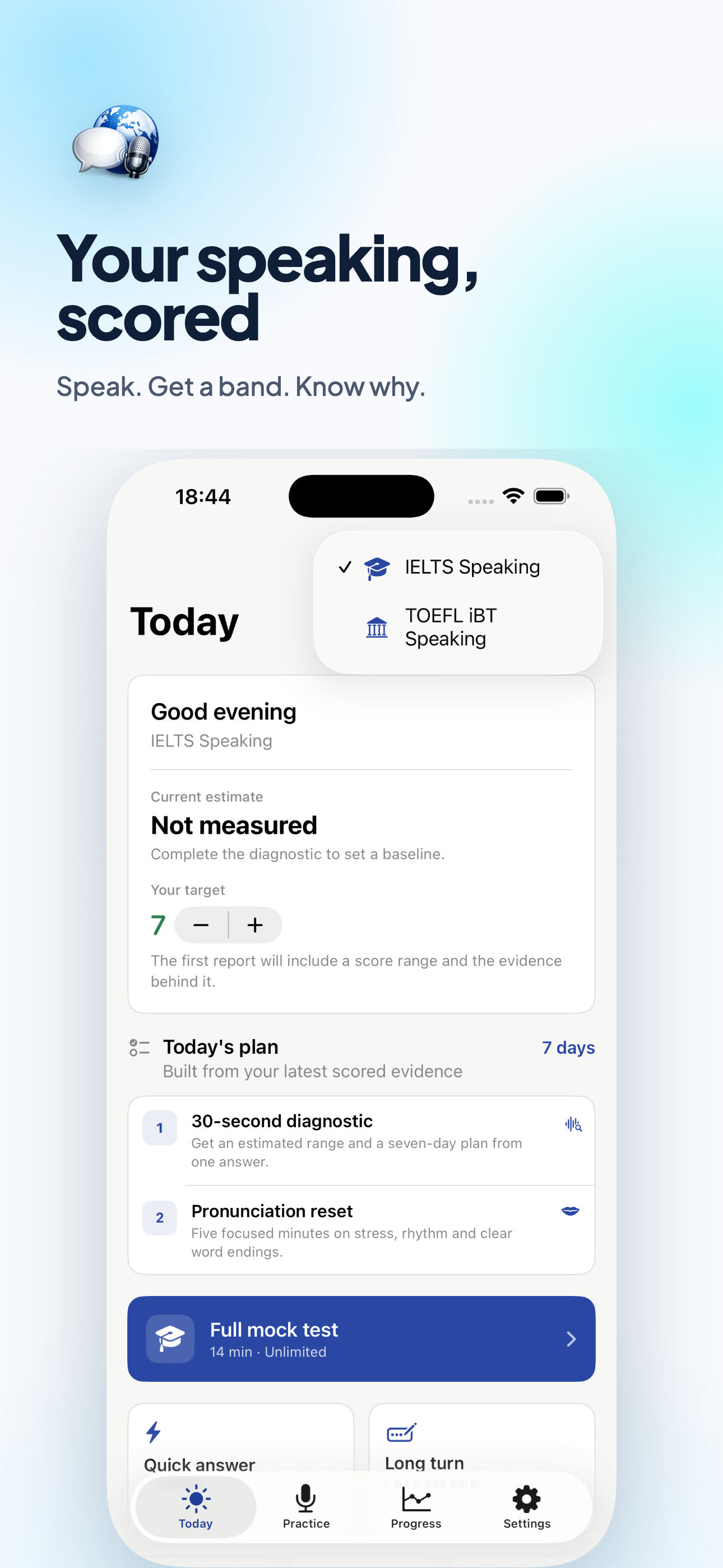
The daily plan is assembled from what your last scored answers actually showed, so the thing you practise is the thing that lost you marks.

A correction loop with spacing

A phrase you got wrong comes back after 1, 3, 7, 14 and 30 days. Spaced repetition, applied to your own errors rather than to a generic word list.

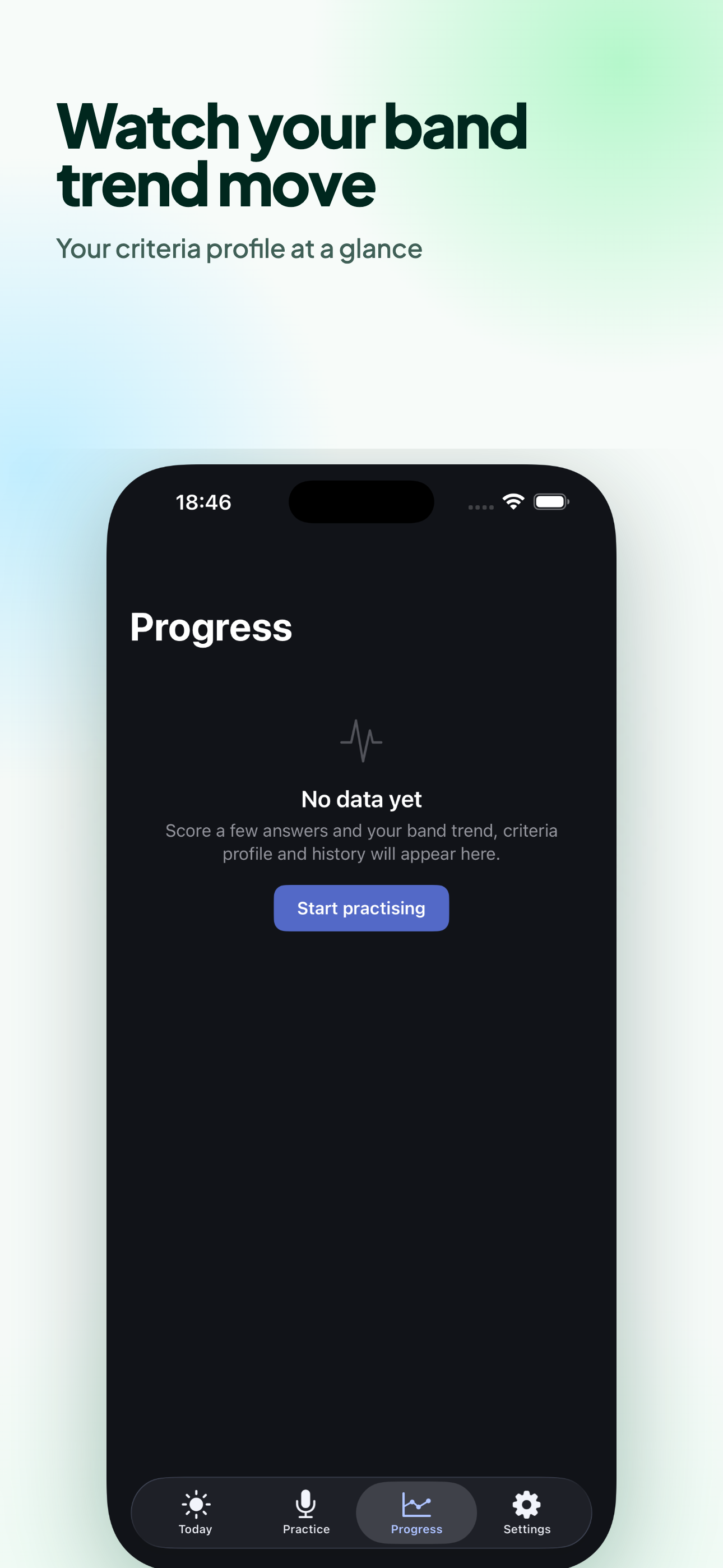
Band trend and criteria radar

Watch the four criteria move separately. Most people improve on one and stall on another, and an overall band hides that completely.

Vocabulary Coach

Band 7 alternatives organised by topic, so the upgrade is available at the moment you need the word.

Your own question

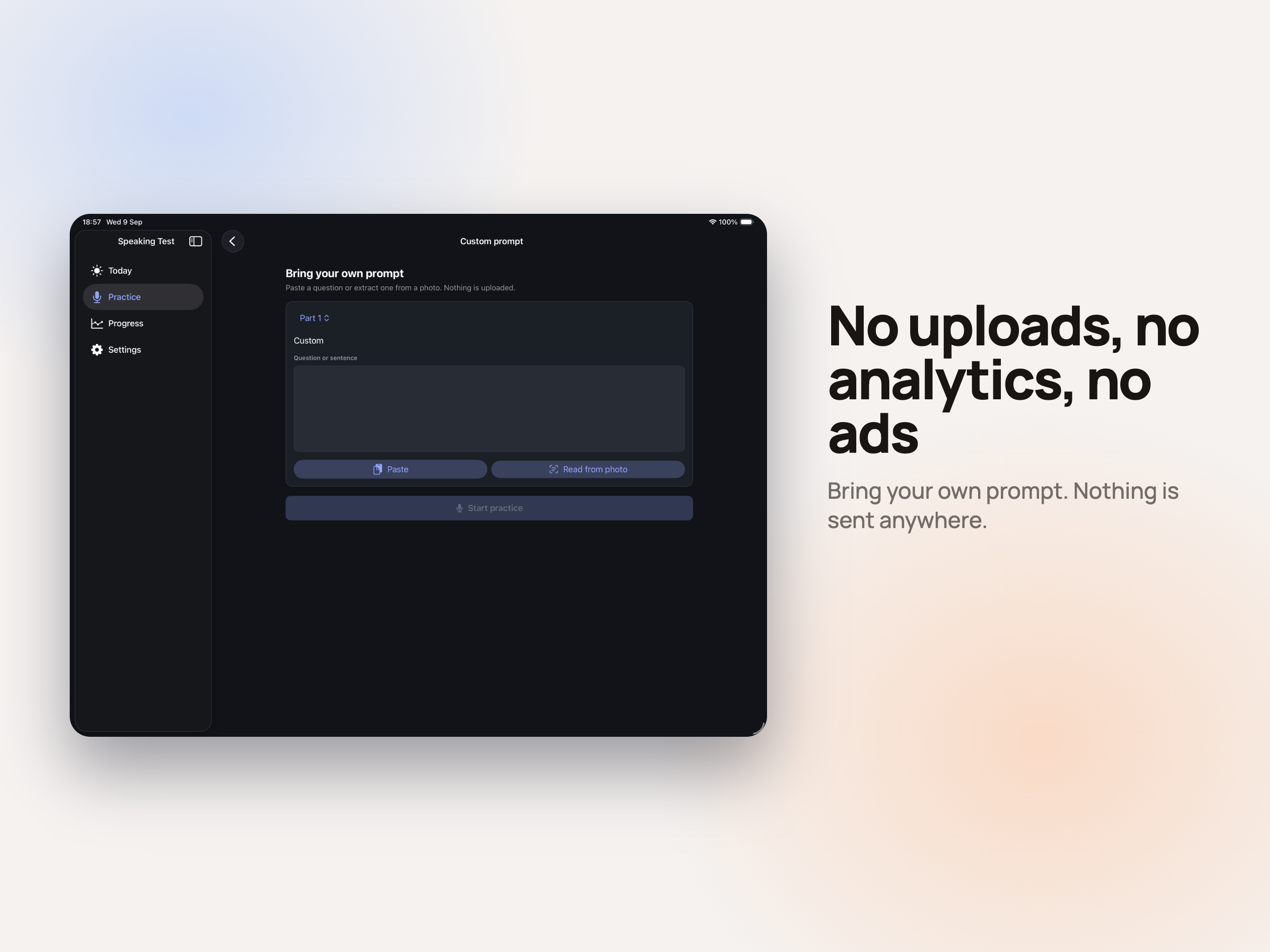
Paste a prompt, or point the camera at a question in a book. Useful when your teacher or your course sets the material.

A report you can hand over

Share a PDF with the audio attached, or a score card on its own. Tutors get the evidence rather than a claim.

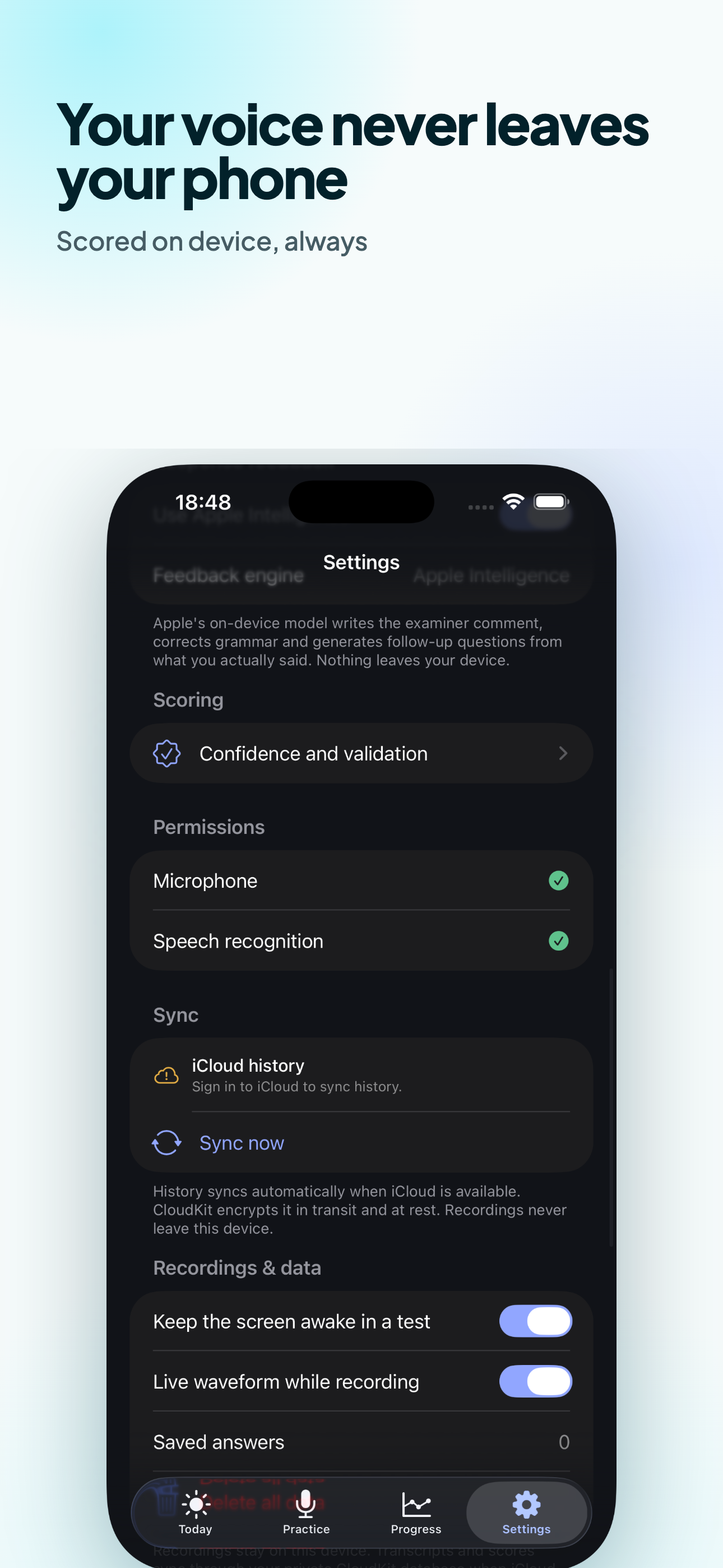
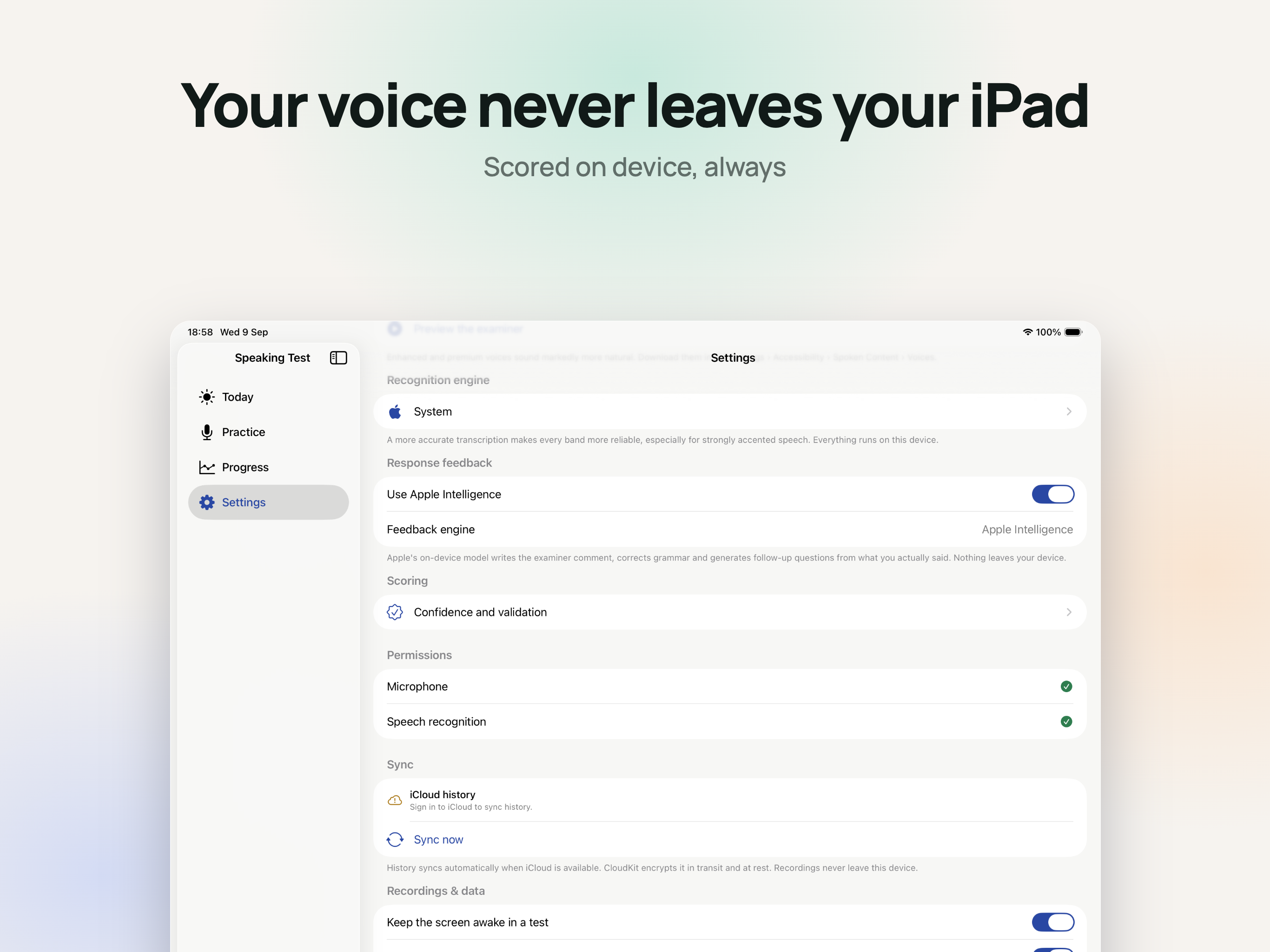
Your voice does not leave the phone

A recording of someone speaking is biometric data under a fair number of legal frameworks, and an exam answer is often a candid account of your own life. Neither is something to post to a server for marking.

  • Speech becomes text on the device, and the scoring runs there too.
  • No account to create, and no connection needed to sit a test.
  • History syncs through your own private iCloud, so a new phone picks up where the old one left off without anyone else holding the data.
  • If a call arrives mid-answer, you carry on with the time that was left rather than starting the question again.

Free and Pro

The free app is a working practice tool rather than a preview of one.

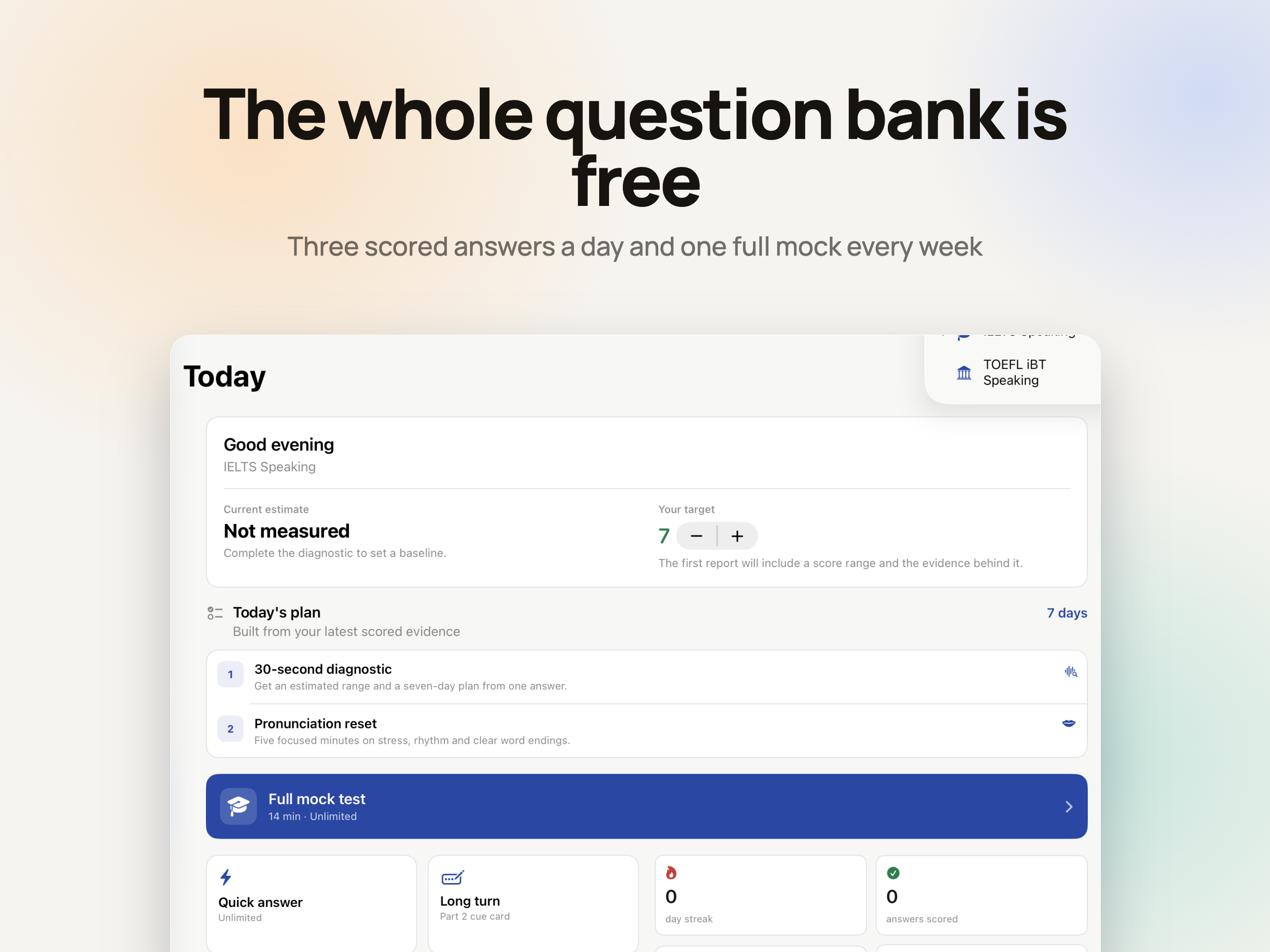
  • Free: three scored answers a day and one full mock test a week. The question bank, recording, playback, transcript markup, progress, study plan and PDF export are not capped at all.
  • Pro: no cap on scored answers or mock tests.
  • Pronunciation Lab: read-aloud drills scored word by word, with minimal pairs, stress and intonation.
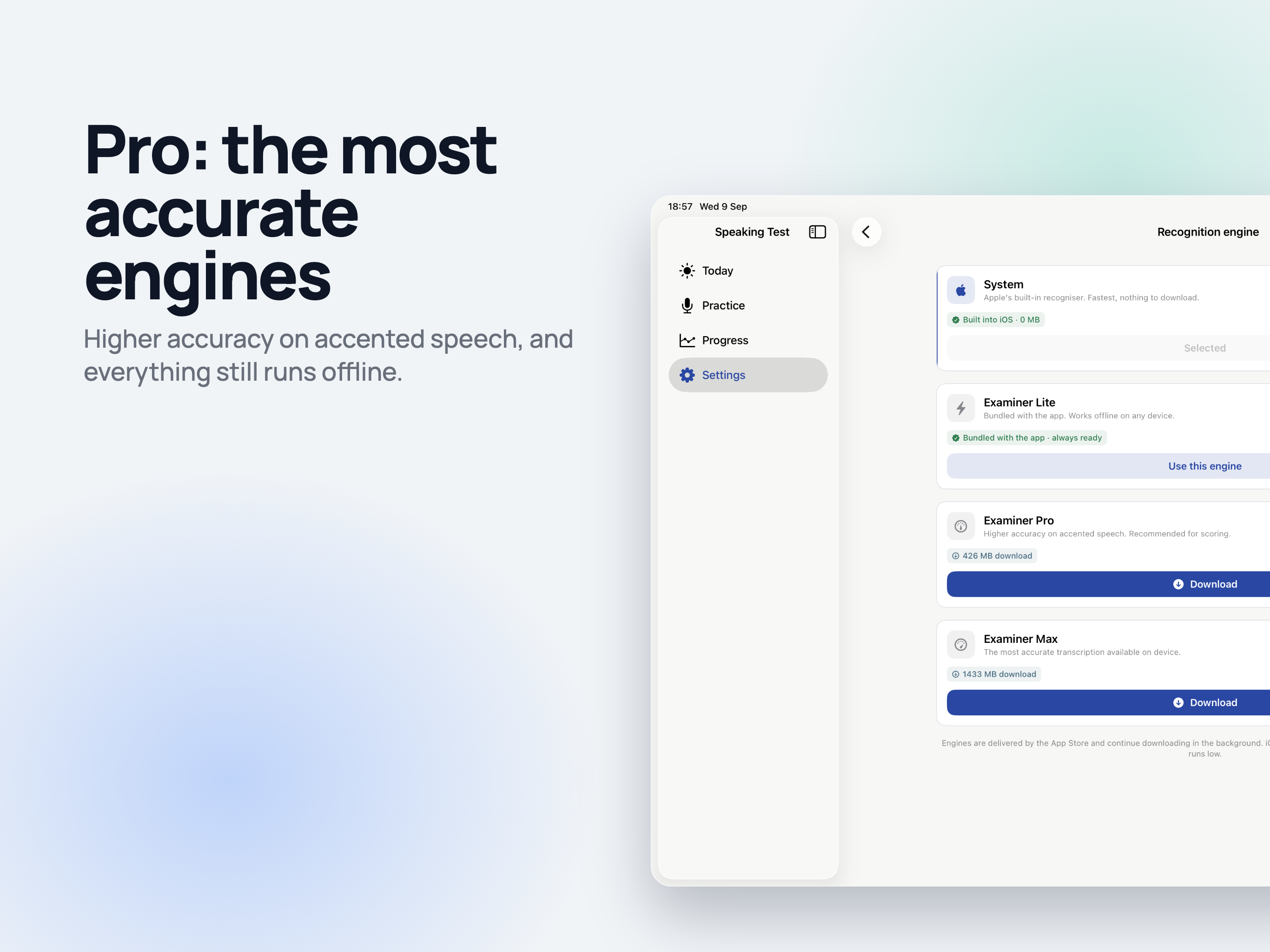
  • Examiner Pro and Max engines: larger models that handle strongly accented speech far better.
  • Band 8 model answers written on the device for the exact question you attempted. Needs a device with Apple Intelligence.
On iPhone

Where the practice actually happens: a question, a timer, and a score before you have put the phone down.

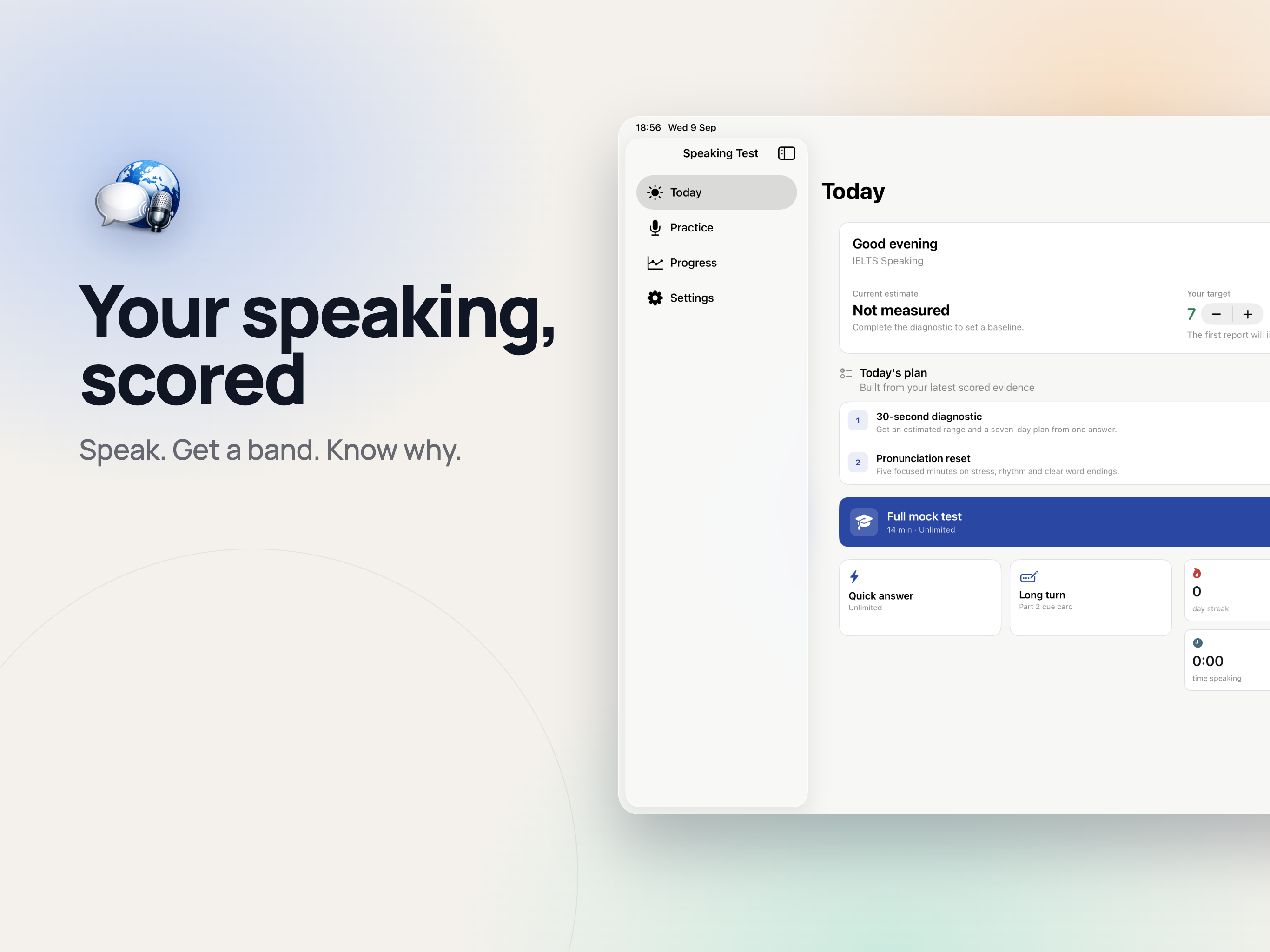
On iPad

The transcript and the criteria breakdown side by side, which is the layout for reviewing an answer rather than producing one.

Who it suits

Speaking is the part of the exam people practise least, because it needs someone to talk to and someone to judge the result.

Candidates with a date booked

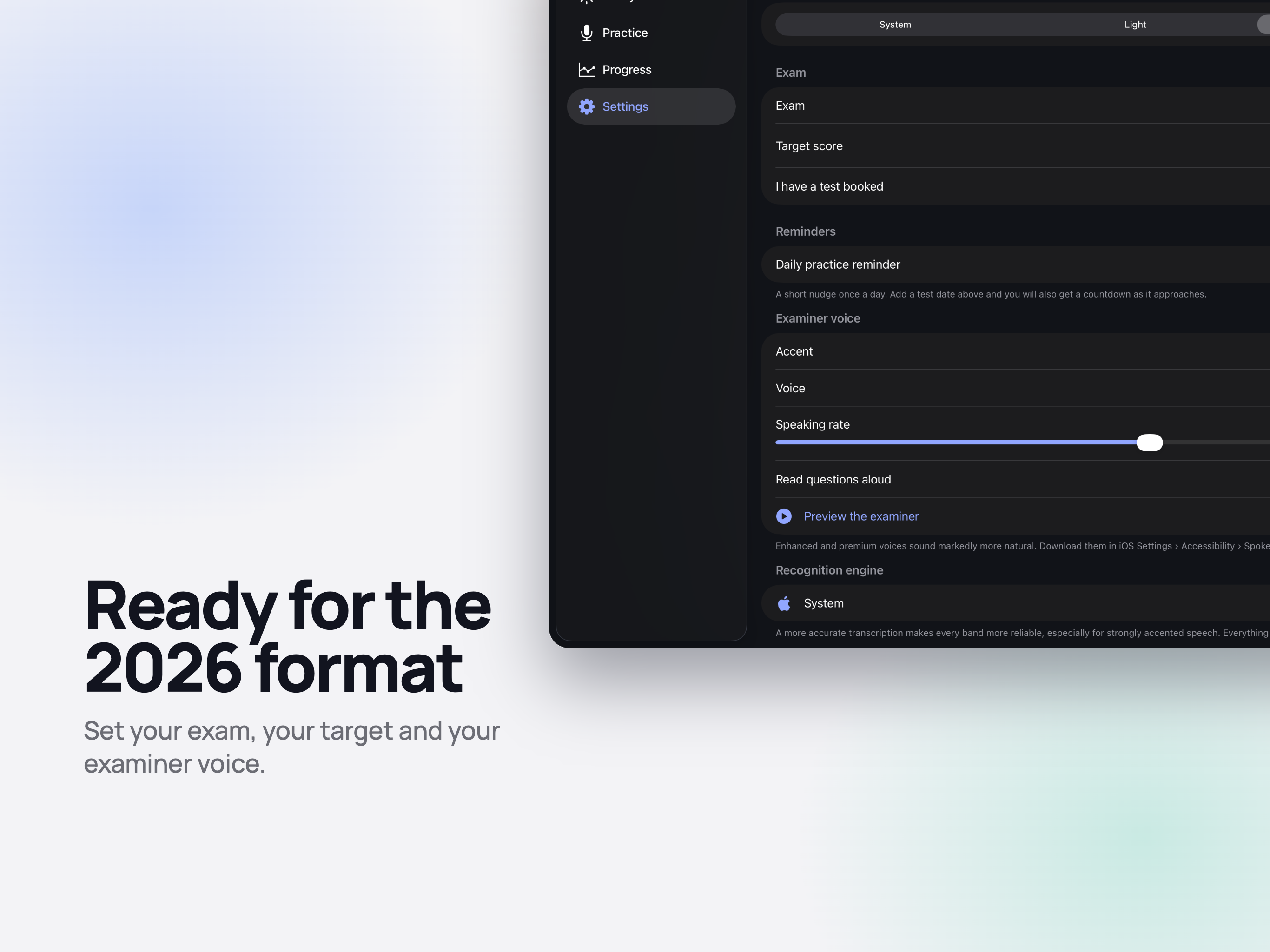
Daily practice under the real timings, with reminders that tighten as the test approaches.

Migration and university applicants

A specific band to hit, and a breakdown showing which criterion is holding the overall down.

Teachers and tutors

Set a question, get a PDF back with the audio and the markup, and spend the lesson on the diagnosis rather than on producing it.

Anyone practising without a partner

The examiner reads the question aloud and the timer is unforgiving, which is closer to the exam than reading prompts off a page.

Scores are an estimate produced on your device against the published criteria. They are practice feedback, not an official result, and no app can issue one - only a test centre can.

Available On

Requires iOS 17 or iPadOS 17 and later.

iPhone

iOS 17.0 or later

iPad

iPadOS 17.0 or later

Frequently asked questions

Is this an official IELTS score?

No - only a test centre can issue a result. You get an estimate produced on your device against the published criteria, shown with the measurements behind it, so you can track movement and find the criterion holding your overall down.

Does it cover TOEFL as well?

Yes, the current 2026 TOEFL Speaking format in full: seven Listen and Repeat sentences from one campus scenario with 8, 10 and 12 second windows, then four Take an Interview questions at 45 seconds each, reported on the 1 to 6 scale.

Are my recordings uploaded?

No. Speech becomes text on the device and the scoring runs there, so a full test works with the network off. History syncs through your own private iCloud rather than anyone else's server.

What do I actually get back after an answer?

A band with the four criteria broken out, the measurements each one used - speech rate, pauses, lexical diversity, error-free clauses and so on - and your transcript marked up word by word. Tap a highlight to read why. See the Speaking Test help page.

How much can I do without paying?

Three scored answers a day and one full mock test a week. The question bank, recording, playback, transcript markup, progress, study plan and PDF export are not capped.

Which devices does it run on?

iPhone and iPad, on iOS 17 or iPadOS 17 and later. Band 8 model answers additionally need a device with Apple Intelligence.