A television spends most of its life switched off, being a black rectangle. The idea behind an ambient display is that this is a waste of a large, bright, high-resolution surface - and that the right content turns it from furniture into something closer to a window.
Apple's aerials made the case. Drone footage of Hong Kong at night, the Great Wall, whales off Hawaii, all in genuine 4K and all beautifully graded. The limitation is simply that the set is finite and you have watched it.
What makes ambient content work
Not everything long and pretty succeeds at this. The ones that do share three properties.
Movement without events. The eye wants motion; attention does not want a story. Fish crossing a tank, flames, waves, drifting stars - all move continuously and none of them ever make you look up. A timelapse with hard cuts fails this immediately, and so does anything with a narrative.
No hard-cut transitions. Cuts read as "something happened" from the corner of your vision. Content that dissolves or simply continues sits in the background properly.
Consistent brightness. Content that swings between bright and dark makes a room feel like it has a strobe in it. This is the most common reason a nature loop feels wrong in the evening.
The categories that work, by room
Aquarium
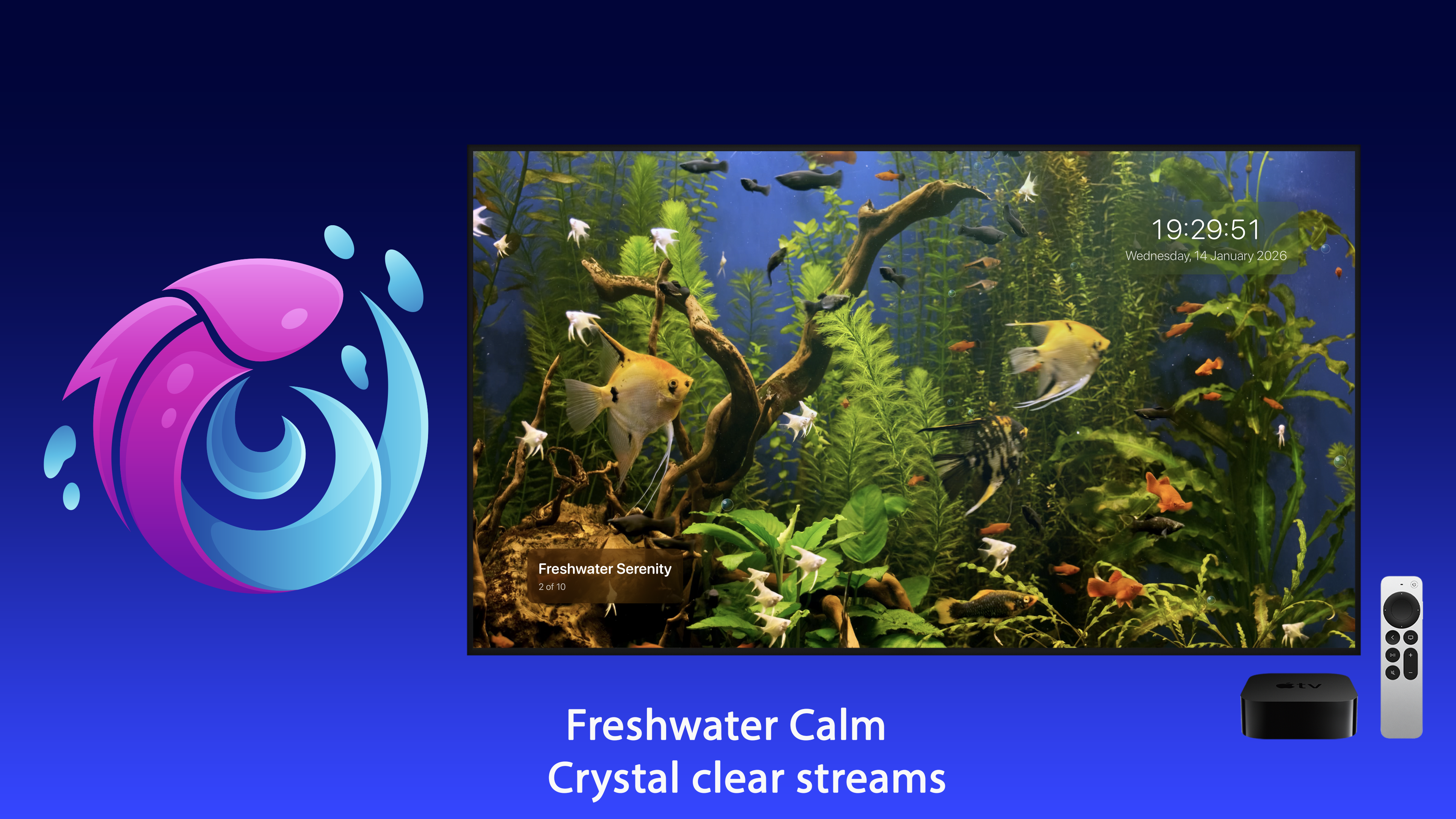
The strongest general choice, and the reason fish tanks were in dentists' waiting rooms for a century. Continuous slow motion, stable brightness, and a subject people watch without effort. Works in a living room, works in an office, works with people talking over it.
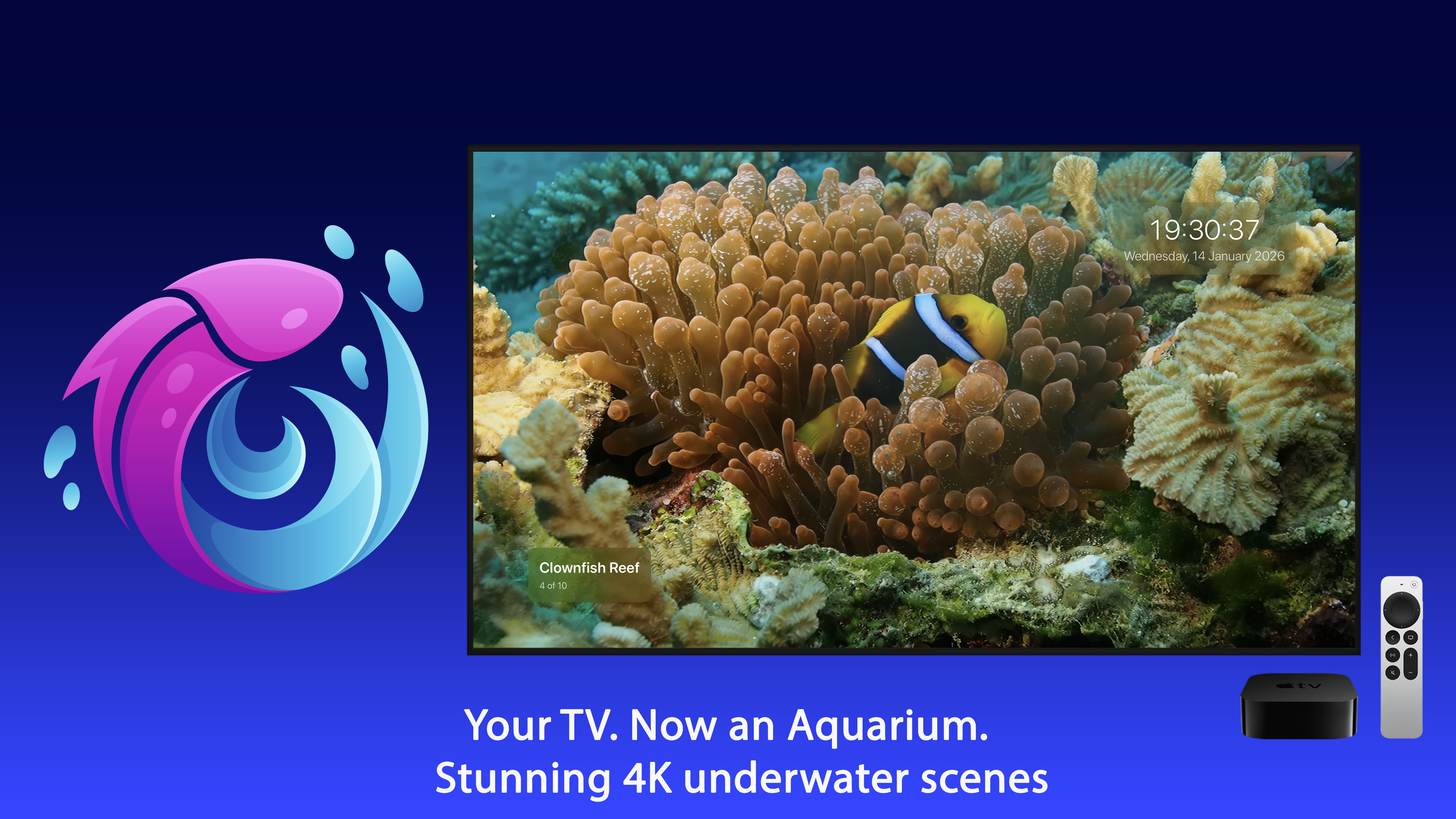
Practical advantage over a real tank: no water changes. Live Aquarium is the version of this we make for Apple TV, in 4K.
Fireplace
Seasonal and unbeatable in winter. Flames are the ideal ambient subject - constant motion, no events, warm colour. The failure mode is a short loop: fires do not repeat, and a four-minute clip becomes obvious quickly.
Night sky and space
Dark, slow, and the correct answer for an evening room where a bright display would be intrusive. Also the safest for OLED, for reasons below.
Art
A different proposition - a television pretending to be a picture frame. Works well in a room where a screen looks out of place, and works badly if the transitions are quick. The pace you want is one work every several minutes, not a slideshow.
Landscape and weather
Aurora forecasts, sunsets, coastlines. The distinguishing feature of the good ones is that they carry information as well as scenery - if the display tells you the aurora forecast is high tonight, it has earned its place beyond decoration.
The burn-in question, honestly
If your set is OLED, permanent image retention is a real physical phenomenon and not marketing. It is also widely overestimated.
What actually causes it is a bright static element in the same pixels for hundreds of hours - a news channel logo, a game HUD, a broadcaster's ticker. Full-screen video with continuous motion is close to the ideal case, because no pixel stays at maximum brightness.
Three sensible precautions:
- Avoid anything with a fixed overlay. A permanent clock in the corner is exactly the pattern that causes trouble. If a display shows time or weather, it should move.
- Run it at moderate brightness. Ambient content does not need the panel at maximum, and brightness is the main driver of wear.
- Let the set do its maintenance. Modern OLEDs run a compensation cycle in standby. Never fully powering off defeats it.
On LED and QLED panels this is not a concern at all.
The things people get wrong
Sound. Ambient video with an audio track is a conversation problem. Most of these are better silent, with your own music if you want any.
Loop length. A ten-minute loop is noticeable within an hour. This matters more than resolution and is rarely stated on a product page - if a listing does not say how much footage there is, assume the answer is "not much".
Actual 4K. Plenty of "4K" ambient content is upscaled 1080p, which on a large panel is visible as soft foliage and mushy water. Detail-heavy subjects like coral and fire are where this shows first.
Choosing in one line
- Living room, people present, daytime: aquarium.
- Living room, evening, low light: night sky.
- Winter, with company: fireplace.
- A room where a TV looks wrong: art.
- Kitchen or hallway, where a glance should tell you something: weather or forecast.
We wrote about the wider setup in using Apple TV as an ambient display - including how to stop it sleeping, and how to keep it from annoying everyone in the room.