Starlink satellites are launched in batches of dozens at a time. What you see as a "train" is that batch in the days after release, before its members have gone their separate ways.
Why they start together
A launch vehicle delivers the whole stack to the same orbit at the same moment. When the satellites are released, they have nearly identical positions and velocities, so they follow one another around the same path, separated by small amounts.
From the ground that looks like beads on a string: a line of evenly spaced lights, all moving at the same speed in the same direction.
Why they start low
Batches are deployed at a lower altitude than the one they will work at, a few hundred kilometres up, and then climb using their own electric thrusters. There is a practical reason: if a satellite fails its checkout, it is already low enough that the atmosphere drags it down and burns it up quickly instead of leaving a dead object in a working shell.
The low deployment has a cost. In February 2022 a geomagnetic storm swelled the upper atmosphere just after a launch, drag rose sharply, and most of that batch - 38 of 49 satellites - never made it up. It was a vivid demonstration of how sensitive low orbits are to space weather.
Why the train breaks up
Over the following days and weeks, each satellite raises its orbit on its own schedule and moves towards its assigned slot in the constellation. The spacing grows, the line stretches and thins, and eventually they are spread through their orbital plane like the thousands before them.
At the same time they climb higher and turn to their operating orientation. Both make them fainter from the ground. A batch that was a striking string of lights on day two can be hard to spot at all two weeks later.
Why operational Starlinks are hard to see
After early complaints from astronomers, the satellites were redesigned to reflect less sunlight towards the ground. Combined with the higher altitude, a working Starlink satellite is usually faint, and scattered rather than grouped.
You can still see individual ones on a dark night shortly after dusk, as faint moving points. Long-exposure photographs catch far more than the eye does, which is why the streaks in astronomical images are a real problem even when the sky looks clean to a person standing outside.
How to catch a train
- Watch for a launch. The best viewing is typically in the first few days afterwards.
- Look for that specific batch rather than for "Starlink" in general - there are thousands.
- Aim for shortly after dusk or before dawn, when the satellites are sunlit and your sky is dark.
- Face the rise direction a few minutes early. The train can take a minute or more to go past.
Seeing the whole picture
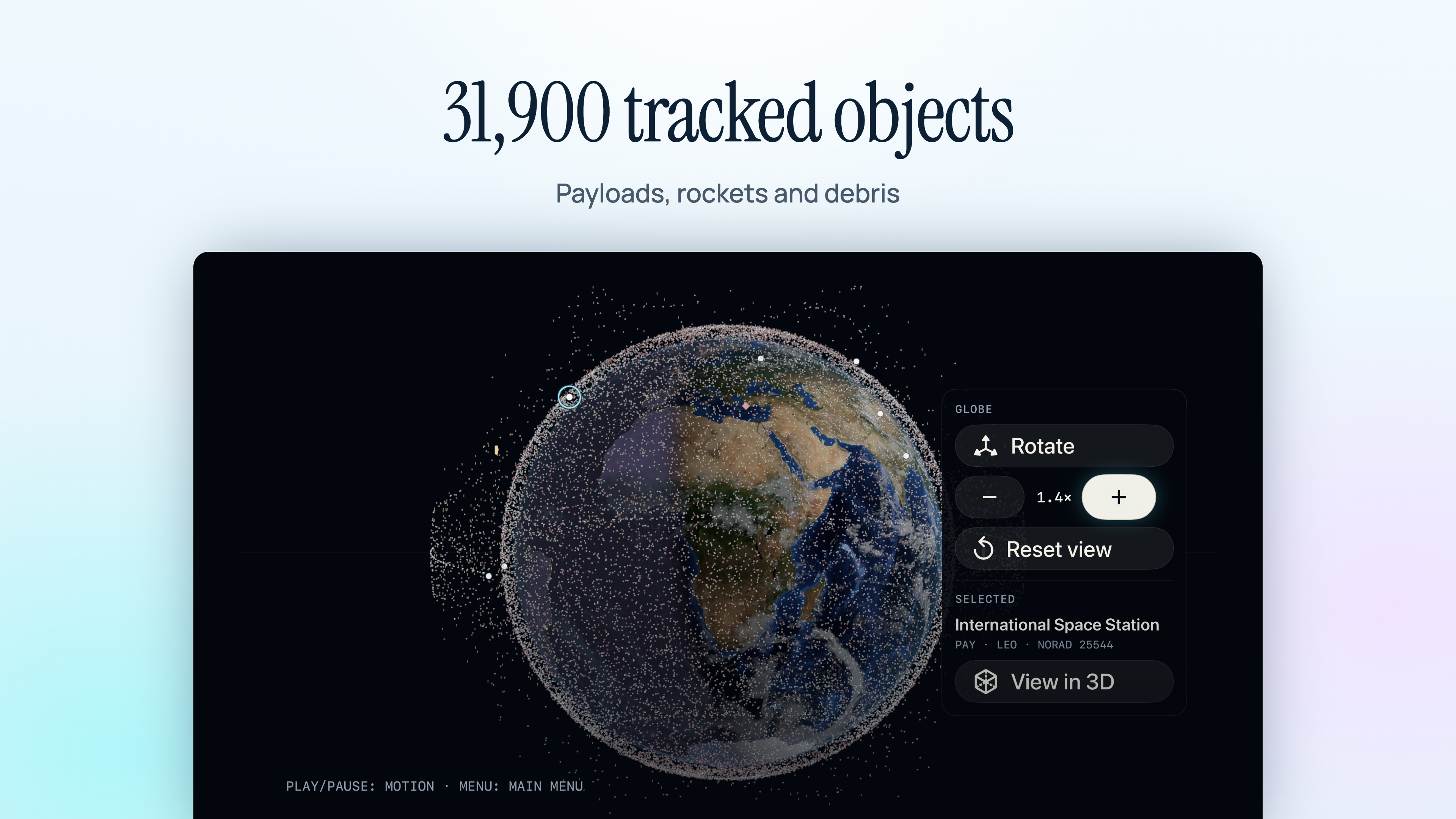
The train is the dramatic part, but the more striking thing is what it is joining. Light up the full constellation on a globe and the low shells turn into a mesh of thousands of objects, arranged in planes that wrap the planet. A line of lights in the sky is the moment one new strand is added to it.