Start with what is known for certain: the objects that ground-based radar and optical networks can see and follow. The public catalogue built from that tracking holds tens of thousands of objects - around 31,900 in the snapshot a tracker like Orbit Map works from.
Only a minority of those are working satellites.
What the catalogue actually contains
- Payloads. Satellites and spacecraft launched to do a job. Many of them stopped doing it long ago and simply remain in orbit.
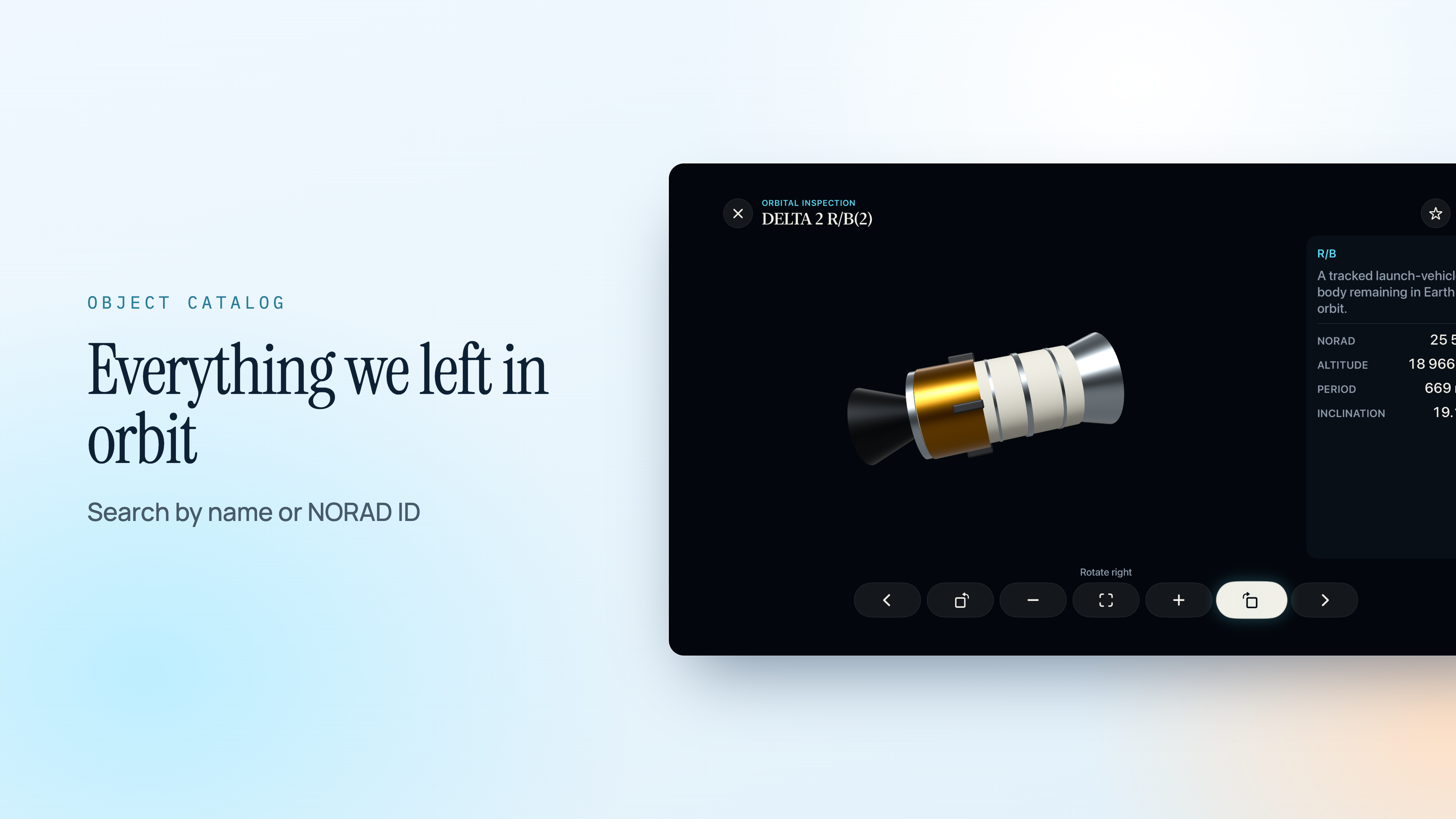
- Rocket bodies. Upper stages that delivered a payload and stayed up. They are large, and a big one is a serious hazard in its own right.
- Debris. Everything else that is tracked: fragments from explosions, collisions and weapons tests, plus hardware shed along the way.
Colour a globe by object type and the proportions are immediately clear. The working constellations you hear about sit inside a much larger cloud of things nobody controls.
The size limit on tracking
Public tracking in low orbit reliably follows objects down to about 10 cm. Further out, at geostationary height, the limit is closer to a metre, because everything is so far away.
Below that, debris is known statistically rather than individually. ESA's models put the number of objects larger than 10 cm at roughly 40,000, those between 1 and 10 cm at over a million, and fragments down to a millimetre at well over 100 million.
The small ones matter. At orbital speeds, collisions typically happen at several kilometres per second, and even a centimetre-sized fragment carries enough energy to disable an instrument or a whole spacecraft. A fleck of paint can crack a window.
A few events made a lot of it
Debris is not spread evenly across the history of spaceflight. A small number of events account for a large share of the tracked fragments.
- 2007, Fengyun-1C. China destroyed one of its own weather satellites in an anti-satellite test, creating more than 3,000 tracked fragments at an altitude where many of them will stay up for decades.
- 2009, Iridium 33 and Kosmos 2251. The first accidental collision between two intact satellites, a working communications satellite and a dead Russian one, produced around 2,000 tracked pieces.
- 2021, Kosmos 1408. Russia destroyed a defunct satellite in another anti-satellite test, producing over 1,500 tracked fragments and forcing the crew of the Space Station to shelter.
Rocket bodies left with fuel on board have also exploded years after launch, which is why passivating spent stages - venting leftover propellant - became standard practice.
Altitude decides how long it lasts
The atmosphere is the only clean-up crew, and it only works low down.
Around 400 km, where the Space Station flies, drag brings debris down within a few years. At 800 km it takes decades. Above 1,000 km, fragments can remain for centuries. That is why a breakup at high altitude is so much worse than one near the Station's height, and why the 2007 test in particular is still being felt.
The Kessler problem
In 1978, NASA scientists Donald Kessler and Burton Cour-Palais described a scenario in which the density of objects in some orbits becomes high enough that collisions create debris faster than the atmosphere removes it. Each collision creates fragments that cause further collisions.
It is not a sudden catastrophe. It is a slow, self-sustaining increase that could make certain orbital shells progressively more expensive and risky to use. Whether some bands are already on that path is an active research question, and it is the reason agencies now require satellites to be removed from low orbit within a set time after the end of their mission.
Looking at it yourself
The best way to understand debris is to see where it is. Colour the catalogue by object type, then by altitude, and look at the dense shells around 800 km. Pick a fragment, open it, and check its launch year. Many of the pieces crossing overhead tonight came from a single afternoon in 2007.