The Station goes round the Earth roughly every 93 minutes, so it passes near most inhabited places several times a day. Almost none of those passes are visible. Understanding why is the whole skill.
Two conditions at once
A satellite does not glow. You see it only because it reflects sunlight. So a visible pass needs two things simultaneously:
- The Station must be in sunlight.
- You must be in darkness, or close enough to it that the sky is dark.
In the middle of the day the second condition fails: the Station is lit, but so is your sky, and it vanishes against the blue. In the middle of the night the first usually fails: the Station is up there but inside Earth's shadow, invisible.
That leaves the hours after sunset and before sunrise, when the ground has gone dark but the Station, 400 km higher, can still see the Sun. Almost every visible pass happens in those windows.
There is one seasonal exception worth knowing. Around midsummer at mid to high latitudes, the Sun does not sink far enough below the horizon for Earth's shadow to swallow the Station, so it can stay sunlit all night and give a run of passes at unsocial hours.
Why there are weeks with nothing
The Station's orbit is tilted 51.6° to the equator and slowly swings round relative to the Sun. For a stretch of a week or two, its passes over your location fall in those dusk or dawn windows and you get sightings most evenings or mornings. Then the geometry drifts and passes move into daylight or deep night, and you get none.
If a pass app shows nothing for a fortnight, that is normal. Check again in a week.
Reading a pass
A pass prediction gives you three moments and two angles for each:
- Rise, peak and set - when it comes into view, when it is highest, when it leaves.
- Azimuth - the compass direction. 270° is due west, 180° due south.
- Elevation - how high above the horizon, from 0° at the horizon to 90° straight overhead.
The peak elevation matters most. A pass that tops out at 15° skims along just above the rooftops, through the thickest, haziest air, and is easily lost behind a building. A pass peaking above 40° or so clears most obstacles and looks noticeably brighter. If you only go out for some passes, go out for the high ones.
Many trackers, including Orbit Map, start counting a pass at 10° elevation rather than at the true horizon, because the bottom few degrees are almost never usable in practice.
On the night
- Be outside two or three minutes before the listed rise time.
- Face the rise azimuth. Most passes come up from a westerly direction.
- Keep bright screens away from your eyes for those minutes; dim the phone.
- Look for a steady, bright white light moving smoothly and unhurriedly.
- Follow it until it fades.
It will not blink. Aircraft do, and they carry red and green lights. A satellite is a single steady point that glides.
Why it disappears early
Often the Station fades out partway across the sky, well before the listed set time, sometimes over a few seconds. It has flown into Earth's shadow - the sunlight it was reflecting has been cut off. You have just watched the Station cross into orbital night, which is the most interesting part of the pass rather than a fault in the prediction.
When a listed pass shows nothing
The prediction is geometry: it knows where the Station is, where the Sun is and where you are. It does not know about:
- Cloud. The obvious one, and the most common.
- Haze near the horizon, which dims low passes dramatically.
- Your local obstacles - the block of flats to the west.
- Brightness. The Station is bright enough to beat city light. Hubble and Tiangong are fainter and often are not.
So a sunlit pass in a dark sky is an opportunity, not a guarantee. Treat it the way you would treat a good weather forecast for stargazing.
One more thing to try
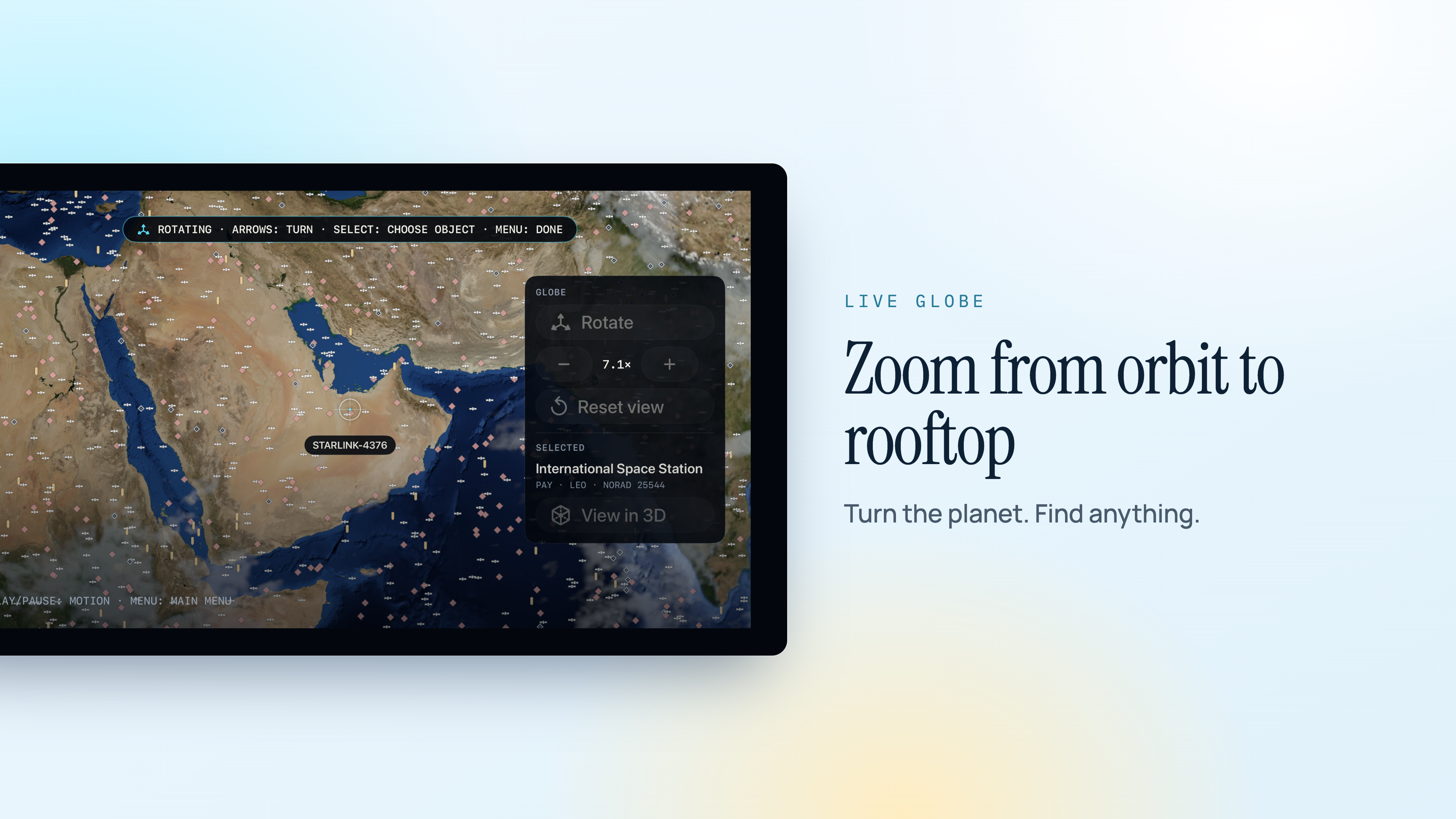
Once you have seen the Station, look up its orbit on a globe and watch where it goes next. It will be over the other side of the planet in about 45 minutes. Seeing the thing in the sky and then seeing the path it is on is what turns a bright dot into something you understand.