1. Turn everything face up, then sort
It feels slow, but it is the fastest start. Turn every piece picture-side up and make a few rough groups:
- Edge pieces.
- Pieces with something distinctive on them - a face, a letter, a strong colour.
- Everything else, roughly by colour.
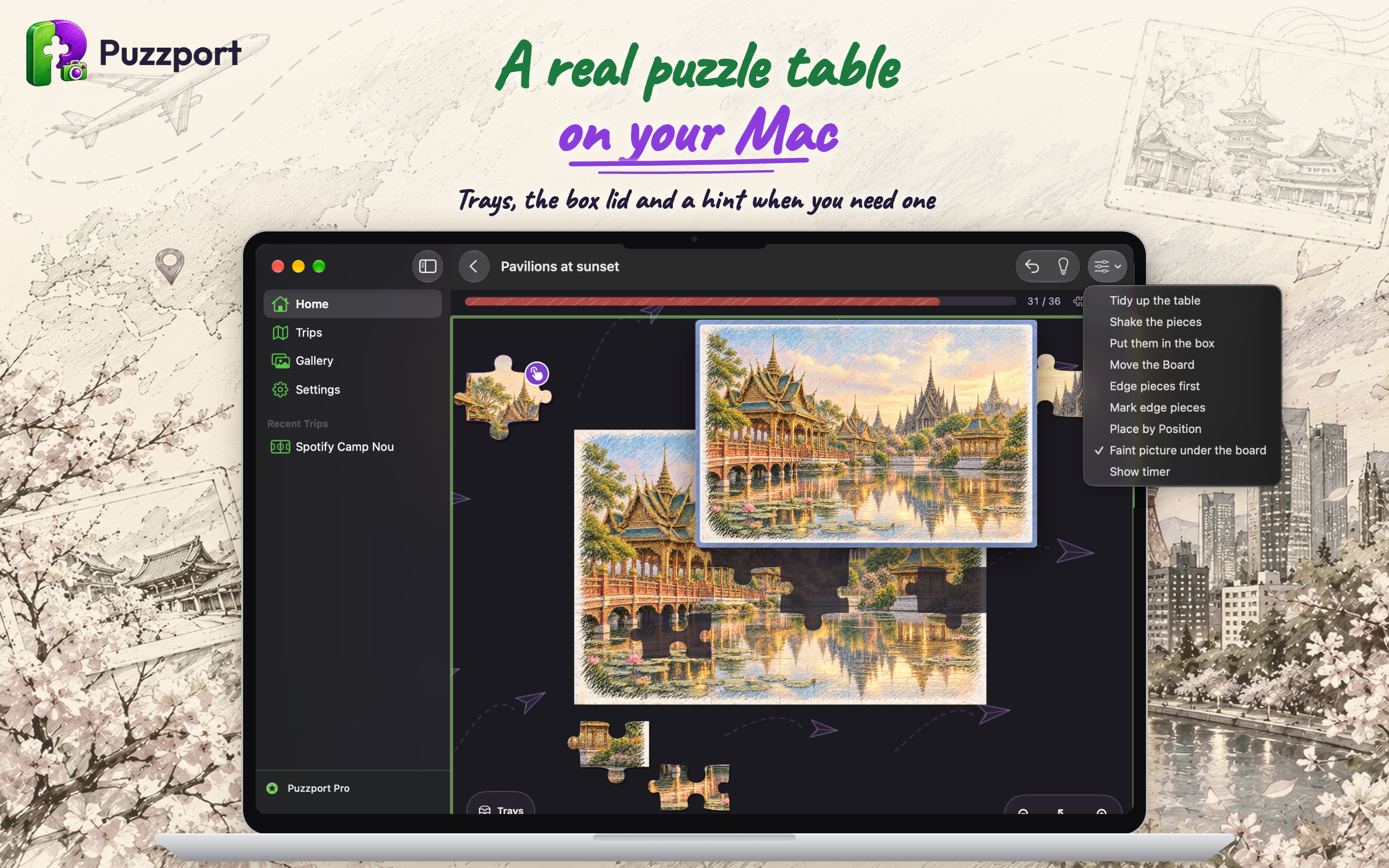
Trays, box lids or saucers make this much easier than a heap in the middle of the table.
2. Edges, then the easy islands
Build the frame - it tells you the size and gives every other piece something to aim at. Then go straight for the most distinctive areas: text, faces, a bright object, the line where two different areas meet. Build them as islands wherever they fall, and place them in the frame once they are big enough to locate.
Leave the sky for last. By the time you get there, the rest of the picture will have taken most of the pieces away.
3. When the colours run out, read the shapes
Large areas of sky, sea or snow are where puzzles stall. The picture stops helping, so switch to the shape of the pieces:
- Sort the remaining pieces by how many knobs ("tabs") and holes ("blanks") they have.
- Look at the gap you are trying to fill and count what it needs.
- Try only the pieces with the right pattern, row by row.
- Look closely at the colour anyway. Skies are rarely one colour - they shade from top to bottom, and the shading gives each piece a row.
4. Change your view
When nothing fits for ten minutes, stop staring at the same corner. Stand up, look at the whole table from another side, or switch to a different area. Fresh eyes find pieces that were in plain sight. On a screen, zooming out does the same thing.
5. Use the box lid without guilt
Looking at the picture is not cheating. It is how you find out that the dark blue at the bottom is a boat and not more sea. If you want more challenge later, hide the picture or let the pieces rotate - but do that once a puzzle feels too easy, not on one that is already hard.
6. Stop before you are frustrated
A puzzle is meant to be relaxing. Walk away while you are still enjoying it, and you will be glad to come back. A big puzzle done over a week of short sessions is a better experience than one forced through in a night.
On a screen
The same strategy works in Puzzport, which has sorting trays, the box lid, an edge-pieces-first view and a hint when you are stuck. For anyone who finds small pieces fiddly, there is a magnifier, easier snapping and full VoiceOver support. And when the puzzle is a photo you took yourself, you already know where half the pieces go.