This is a genuine skill with a small, learnable core. Roughly a dozen categories of clue do most of the work, and they are ordered here by how much they narrow things down.
Driving side
The fastest single division. About a third of the world drives on the left - the UK and Ireland, most of southern Africa, India, Japan, Australia, New Zealand, Indonesia, Thailand.
Look for the driver's seat, or which side of the road parked cars face. This one observation eliminates two thirds of the planet in a second.
Road markings and bollards
Unglamorous and extremely diagnostic, because road authorities are conservative and standards are national.
- Yellow centre lines - the Americas, and much of Asia. White - Europe and most of Africa.
- Bollard shape and colour is nearly a national signature. Once you know a few, they identify a country instantly.
- Kerb painting. Black and white striped kerbs are common in eastern Europe and central Asia and rare in western Europe.
Utility poles
The single most useful clue in rural scenes, and the one experienced guessers reach for first.
Concrete or wood, straight or tapered, the arrangement of insulators, whether the top is flat or pointed - these vary systematically by country and change very slowly. Rural Poland and rural Portugal have unmistakably different poles, and neither has a landmark in frame.
Vegetation and terrain
Broad but reliable, and it works when nothing man-made is visible.
- Eucalyptus - Australia, and plantations in Portugal, Spain, California, Brazil.
- Red soil - much of Australia, parts of Brazil, southern Africa, the American southeast.
- Birch forest - northern and eastern Europe, Russia, Canada.
- Olive groves and dry stone walls - the Mediterranean.
Combine vegetation with sun angle and you can often get a hemisphere and a rough latitude. Long shadows at midday mean high latitude; sun in the northern sky means you are south of the equator.
Writing, even when you cannot read it
You do not need to speak a language to place its script. Cyrillic, Greek, Thai, Devanagari, Hebrew, Arabic and the CJK scripts are all instantly distinguishable, and each narrows things dramatically.
Within the Latin alphabet, diacritics do the same job. Ő and ű mean Hungarian. Ł and ż mean Polish. Å, ø and æ mean Scandinavia, and which combination tells you which country. Ș and ț mean Romanian.
The small domestic details
For indoor photographs, where none of the above applies:
- Plug sockets. Type G means the UK, Ireland, Malta, Cyprus, Singapore, Hong Kong. Type F is most of continental Europe. Type I is Australia and New Zealand. This is the indoor equivalent of driving side.
- Light switches. Rocker versus toggle, and their size, is regionally consistent.
- Window opening. Inward-opening tilt-and-turn is central and northern European; sash windows are British and North American.
- Radiator style, and whether there is heating at all.
How to practise
Reading a list does not build this. The clues become useful when they are recognised without effort, and that only comes from being wrong repeatedly with immediate correction.
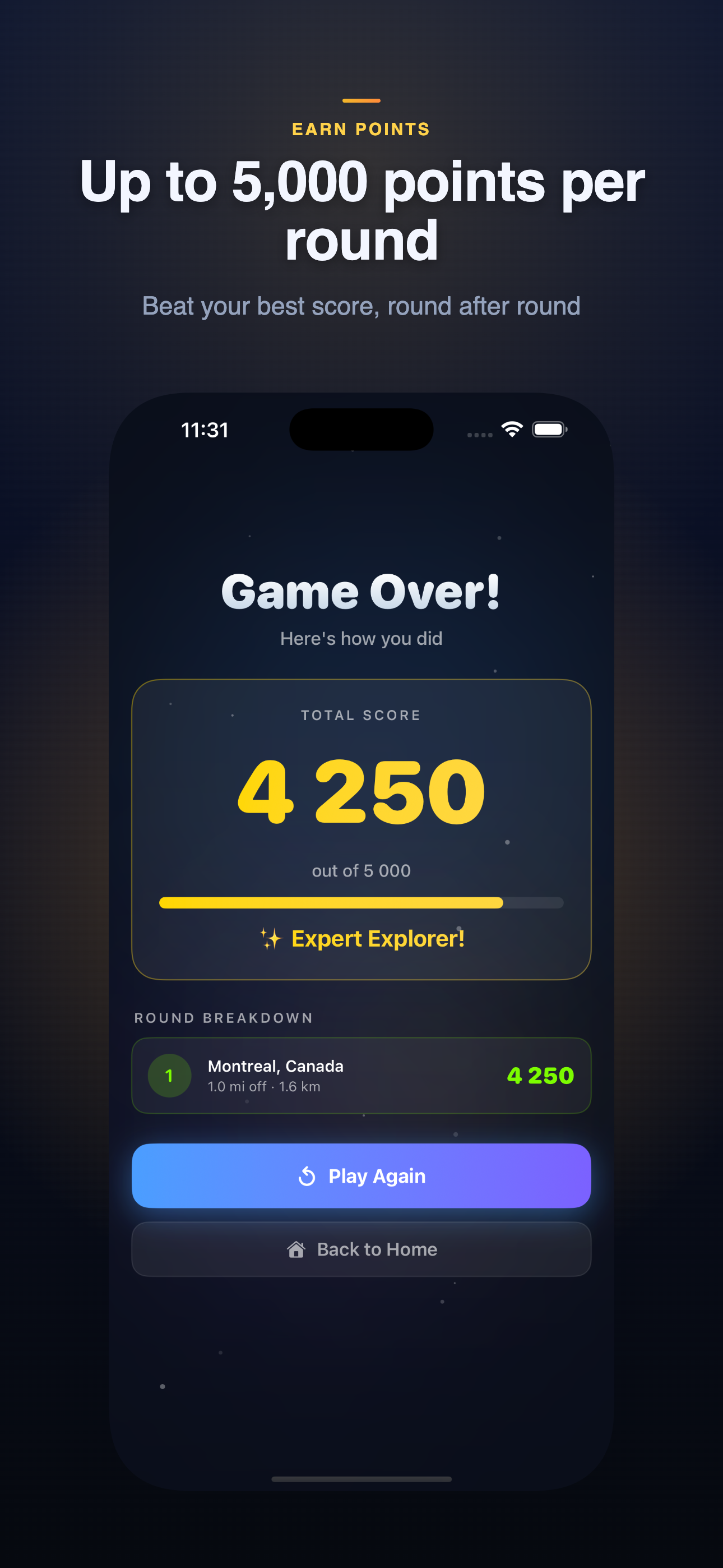
That is the format that works: look at a scene, commit to a guess, find out, look at what you missed. GeoExplorer is built around that loop.
Two habits that speed it up:
Commit before looking further. Make a guess from the first impression, then examine the details. Comparing your instinct with the evidence is what builds recognition, where studying the scene first only builds knowledge.
Learn one region properly. Being genuinely good at Europe beats being vaguely aware of everywhere. Depth transfers - once you can tell Poland from Czechia, you have learned to look at poles and kerbs, and that habit applies everywhere.
The order to work through a scene
- Driving side. Two thirds of the world gone.
- Script and diacritics on any visible text.
- Road markings, kerbs and bollards.
- Utility poles.
- Vegetation and soil colour.
- Sun position, for hemisphere and latitude.
- Architecture and roof materials, last - they vary more within countries than people expect.
Landmarks are not on the list because they are rarely there, and when they are the question was never difficult. The skill is entirely in the ordinary background - which is also what makes it satisfying.