Underneath any face analysis is landmark detection: the model locates a few dozen specific points - pupil centres, nose corners, mouth corners, jaw outline - and everything after that is distances and ratios between them.
That much is genuinely objective. The same photograph produces the same landmarks, and the measurements derived from them are reproducible. The interesting question is what happens next.
Symmetry
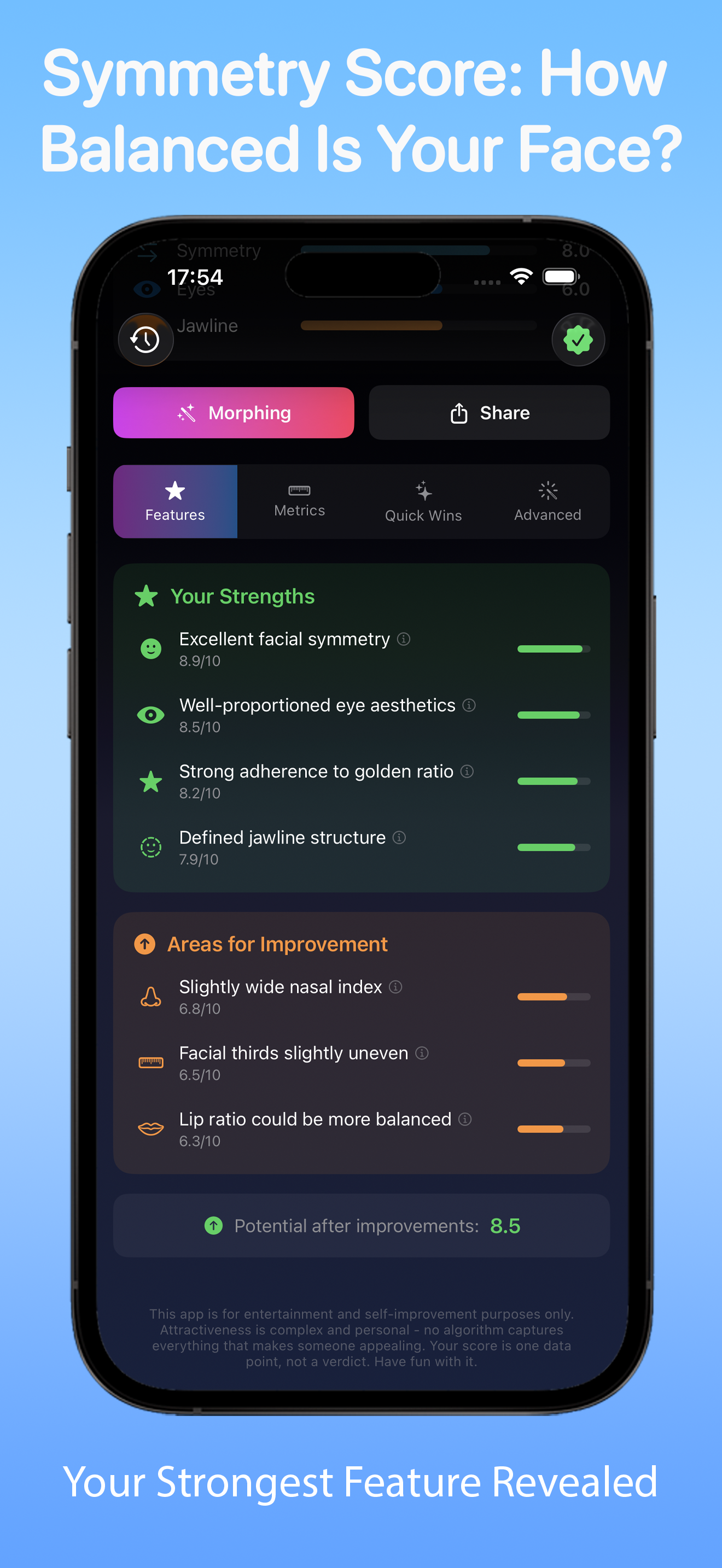
Compare the left half against the mirrored right half and measure the difference. Straightforward and the most commonly reported number.
What is worth knowing: perfect symmetry is not a real thing. Every human face is asymmetric, and noticeably so - the halves differ in eye height, nostril shape, jaw width. Mirroring one half to produce a perfectly symmetric face reliably produces something people find slightly unsettling, which is a well-documented result.
So a high symmetry score is a measurement, not an ideal. The most attractive faces in any study are not the most symmetric ones; they are within a normal range with the asymmetry that reads as human.
Facial thirds
A classical proportion from figure drawing: hairline to brow, brow to base of nose, nose to chin. In a canonical face these are equal.
This one has genuine practical use outside aesthetics - it is used in reconstructive and orthodontic assessment, where restoring proportion is a clinical objective. As a description of a face it is meaningful. As a judgement it is a convention from European academic art rather than a universal.
The golden ratio
The one to be most sceptical about.
The claim is that attractive faces show ratios close to 1.618 between various features. The problem is that a face has dozens of measurable distances, and picking pairs until some of them land near 1.618 is not difficult on any face at all.
The historical claims about the golden ratio in classical art and architecture have largely not survived examination either - many were retrofitted centuries later. It is an appealing idea with far weaker evidence than its ubiquity suggests, and any app presenting it as the basis of a score is overstating what is known.
What the research does support
Two findings are robust and neither is a single number.
Averageness. Composite faces made by averaging many individuals are consistently rated more attractive than most of the individuals in them. The leading explanation is processing fluency - the brain handles typical configurations more easily, and ease of processing feels positive.
Cross-cultural agreement is real but partial. There is meaningful agreement across cultures on some attributes, and substantial variation on others, and individual preference varies more than either. Any single score compresses a genuinely multidimensional thing into one dimension, which is where the information is lost.
How to read a score sensibly
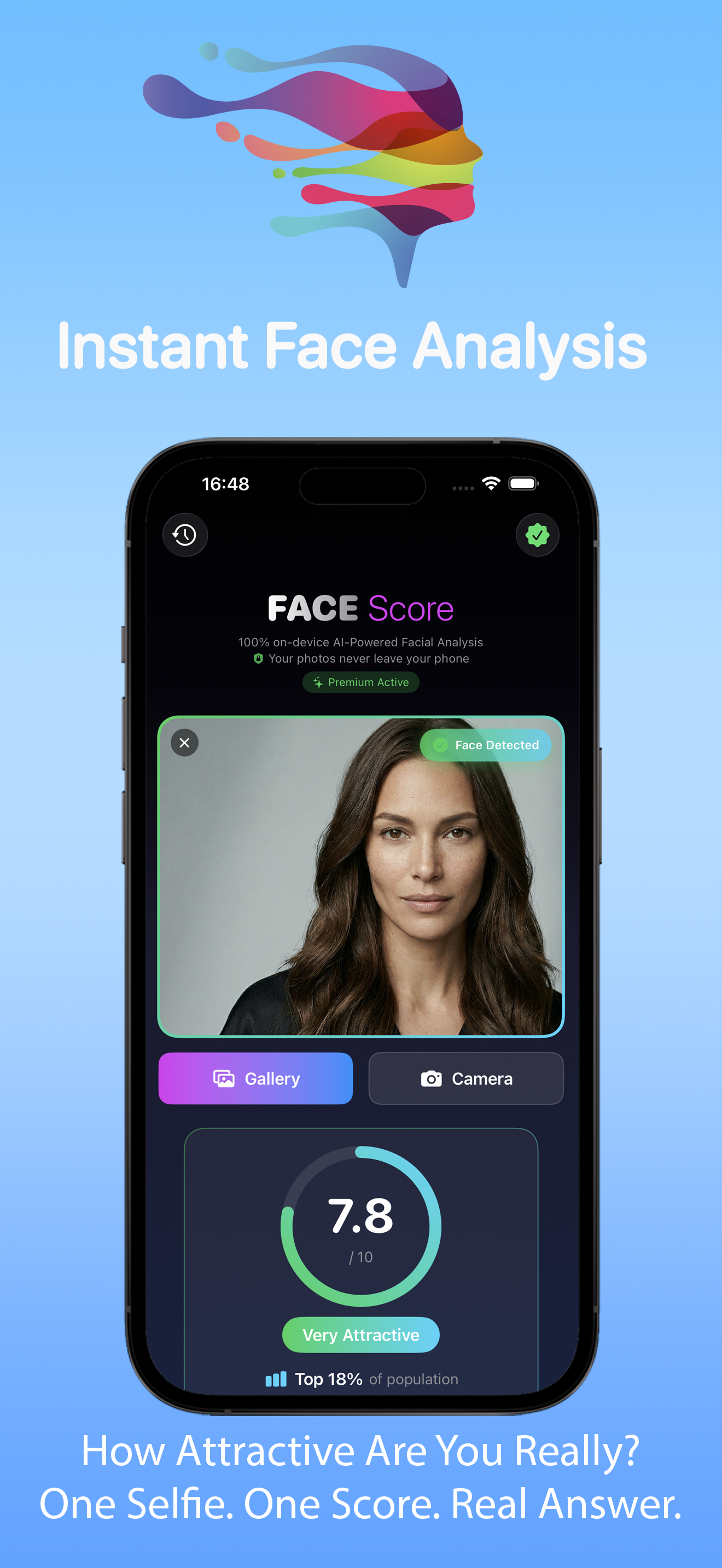
The individual measurements are more informative than the total. Symmetry at a particular percentage and thirds within a few percent of each other are facts about your face. The composite number is a weighted sum of those facts, and the weighting is an opinion held by whoever built the app.
Two practical caveats that affect the numbers more than anything about your face:
Photo conditions dominate. Camera angle, lens focal length and lighting change measured proportions substantially. A phone held close exaggerates the nose; a slight head tilt destroys the symmetry measurement. Comparing two scores from different photographs mostly compares the photographs.
Expression matters. A slight smile changes mouth landmarks and jaw measurements. Neutral expression, straight on, even lighting is the only way to get a number that means anything twice.
AI Face Score runs the analysis on device and shows the individual measurements rather than only the total, which is the more useful way round.
The part worth saying plainly
These apps are entertaining, and the geometry is real. What they cannot do is tell you something meaningful about your worth, and a number derived from a photograph is not evidence about a person.
Used as a curiosity - what are my proportions, how symmetric am I, what changes if I turn my head - it is a genuinely interesting thing to look at. Used as a verdict, it is measuring the lighting in your bathroom.