A peg is a fixed picture tied to a number. You learn the pegs once, and after that they work like numbered hooks: whatever you hang on peg three is item three, and you can go straight to it.
The rhyming pegs
The easiest pegs to learn are words that rhyme with their number, because the number itself reminds you of the picture. A common version of the first ten goes like this:
| Number | Peg | Number | Peg |
|---|---|---|---|
| 1 | Sun | 6 | Sticks |
| 2 | Shoe | 7 | Heaven |
| 3 | Tree | 8 | Gate |
| 4 | Door | 9 | Wine |
| 5 | Hive | 10 | Hen |
Lists vary - some use Bun for one, or Line for nine - and it does not matter which you pick, as long as you never change it. The pegs need to be as automatic as the numbers. Say them forwards and backwards until you do not have to think.
Hanging an item on a peg
Suppose item three is "mango". Peg three is Tree. You do not picture a mango and then a tree; you make one image out of both. A tree so loaded with giant mangoes that the branches crack. A mango that splits open and a tree grows out of it. Add the smell of ripe fruit and the thud as one hits the ground.
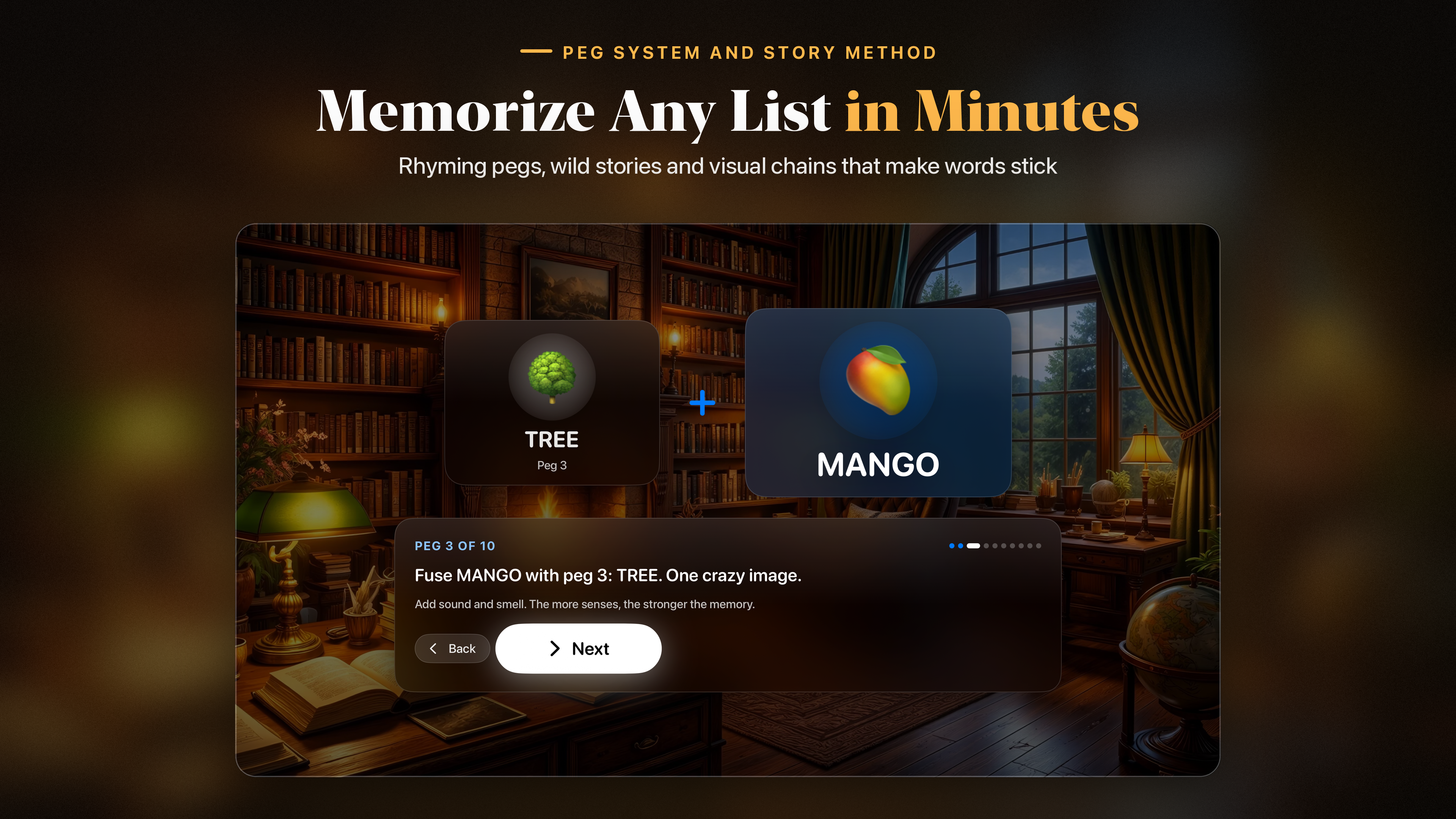
The same rules as in a memory palace apply: make it big, make it move, make the two things touch, and add a sense other than sight. The only difference is that the hook is a numbered picture instead of a place.
Recalling by number
Asked for item seven, you go to seven - Heaven - and look at what is up there with the clouds and the harps. No counting, no walking a route from the start. You can also recall the list in reverse, or every even item, just as easily.
That is the peg system's real advantage over a palace, and why it is worth learning both.
Going past ten
Rhymes get strained after ten, so people extend the list in other ways: rhymes for the teens, or pictures chosen by shape (eleven looks like a pair of chopsticks) or by meaning (twelve is a dozen eggs). Memory Palace uses twenty rhyming pegs in total. Learn the first ten until they are effortless before adding more; a shaky peg is worse than no peg.
For longer lists and for numbers themselves, the peg idea grows into the Major System, which gives every number from 00 to 99 its own picture by sound.
Reusing pegs
Pegs are hooks you use again and again, which means yesterday's images can linger. Two habits help:
- Let a day pass before reusing the pegs for an unrelated list; old images fade quickly if you do not review them.
- Keep long-term lists in a palace instead. Use pegs for short, throwaway lists and quick recall by number, and palaces for anything you want to keep.
When to choose pegs
- A numbered list: ten rules, twelve steps, the top five of anything.
- When you will be asked for items out of order.
- When you have no palace handy - pegs travel with you.
For a one-off list you only need in order, the story method is quicker still. For anything long, the memory palace scales best.