A memory palace is a place you can picture, walked along a route that never changes. To remember a list, you leave one vivid image at each stop. To recall it, you walk the route again and look at what you left.
That is the whole method. The rest is about doing each part well.
Where it comes from
The usual origin story is about the Greek poet Simonides of Ceos. He left a banquet hall moments before the roof collapsed, and the bodies were too damaged to recognise - but he could identify the guests by remembering where each one had been sitting. Cicero tells the story in De Oratore, and Roman handbooks on rhetoric taught the technique to anyone who had to deliver a long speech without notes.
Its Latin name, the Method of Loci, simply means "the method of places". Twenty centuries later it is still the main tool of people who compete at memory championships.
Why places work
You can walk through your childhood home in your head and describe every room. Nobody sat you down to learn it; spatial memory is something the brain does all day without being asked. A shopping list has none of that structure. It is a set of unrelated words with no order and no place.
The memory palace borrows the structure you already have. The route supplies the order. Each stop supplies a hook. All you add is an image connecting the item to the hook.
Step 1: pick a route
Start with a place you know well or can see clearly - your flat, your walk to work, or a room on a screen. Choose stops that are distinct from one another: a fireplace, a window, a globe, a desk. Two identical chairs make a bad pair of stops, because the images on them blur into each other.
Fix the order and never change it. Left to right, clockwise, the same way every time. Ten to fifteen stops are plenty to begin with.
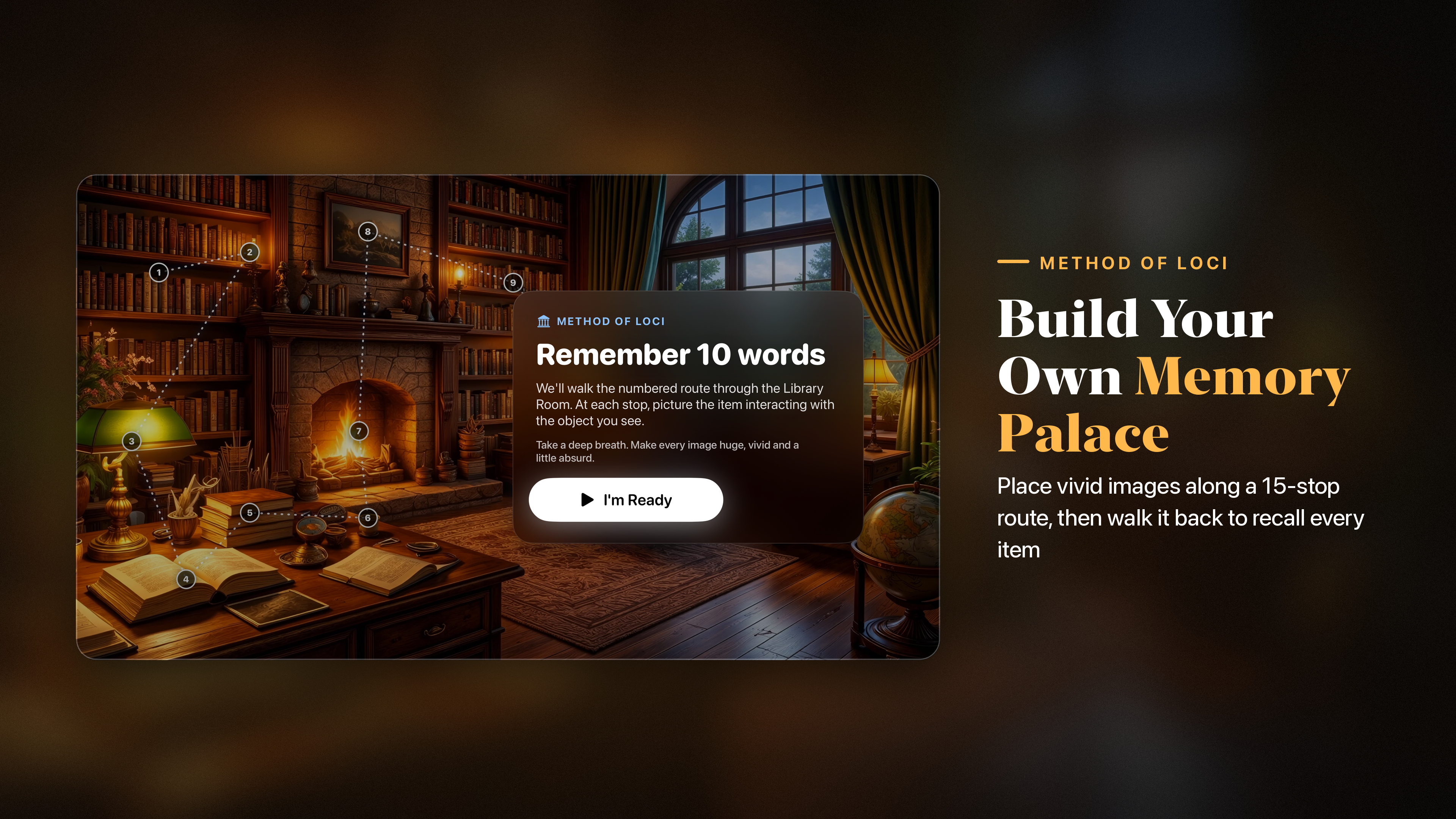
Step 2: make the item do something to the stop
This is where most beginners go wrong. "An apple on the desk" is not an image; it is a sentence, and it will be gone tomorrow. The images that survive share a few traits:
- They are big. An apple the size of an armchair crushing the desk.
- They move. It is rolling, splitting, rotting in fast motion.
- They touch the stop. The item must interact with the object, not float near it.
- They use more than sight. The crunch, the sweet smell, the juice running onto your papers.
- They are a little absurd. The normal is forgettable. The ridiculous is not.
Spend a few seconds on each stop, until you can see the scene. Rushing is the most common reason for a miss.
Step 3: walk it back
When the list is placed, go back to the first stop and look. The image should be there, and it should hand you the item. Then move to the next stop. Because the route is fixed, you always know where to look next, and you know immediately when something is missing - there is an empty fireplace where a picture should be.
Walk the route once more in your head before you need the list. That single rehearsal does a lot.
Step 4: keep it or clear it
If you only need the list today, do nothing: the images fade on their own within a day or two, and the palace is free for the next one. If you want to keep it, review it - tomorrow, in a few days, next week. That is spaced repetition, and the palace makes each review quick because you know exactly where everything is.
What goes wrong
- Ghosts. Reusing a palace too soon leaves last week's images in the way. Rotate between several palaces.
- Abstract words. "Justice" has no picture. Turn it into something you can hold - a set of scales, a judge's gavel.
- Two items on one stop. Possible, but it doubles the confusion. Beginners should keep one per stop.
- Testing yourself too kindly. Recalling in order is easier than recalling at random. A good test asks what was at stop seven.
Practising it on the TV
The hardest part for a beginner is building a clear palace in your head before you have learned to use one. That is why Memory Palace for Apple TV provides the rooms: five 4K palaces, each with a fifteen-stop route drawn on objects you can actually see. The camera moves you from stop to stop, tells you what to picture, and at the end asks you, in random order, what was where.
Once the method feels natural, build your own palaces from places you know. The technique is the same; you simply bring the room.