Roger Ulrich's 1984 study is the one everyone cites: surgical patients in rooms facing trees needed less pain medication and left hospital sooner than those facing a brick wall. It has been replicated in various forms, and the broader finding - exposure to natural environments lowers measured stress markers - holds up reasonably well.
The interesting question is what happens when the nature is a video.
What transfers to a screen
Studies using nature video and images rather than real views generally find a smaller effect in the same direction. Lower self-reported stress, faster recovery of heart rate after a stressor, improvement on attention tasks.
Smaller, and not nothing. The mechanism proposed is the same one behind ambient displays generally: natural scenes hold attention without demanding it, which lets effortful attention recover.
What does not transfer is everything that is not visual. A real view comes with daylight, air movement, temperature, birdsong you have not chosen and the knowledge that the space continues beyond the window. A large share of the original effect is probably those, and no screen provides them.
So the honest framing: a nature video is a modest version of a real thing, and better than a blank wall. Anyone claiming it is equivalent to going outside is overselling.
Which footage works
The properties that matter are the same as for any ambient content, with one addition.
No narration. This is the big one and it disqualifies most wildlife programming. A voice is content, content recruits attention, and attention is what you were trying to leave alone. Documentary footage without the documentary is a different object entirely.
No dramatic events. Predation sequences are compelling television and the opposite of calming. Footage that settles a room is animals moving around, not hunting.
Long takes, few cuts. The editing rhythm of broadcast wildlife - a cut every three seconds - is designed to hold attention. Ambient footage wants the opposite: long, slow, uninterrupted.
Stable brightness. Jungle footage that swings between bright canopy and dark understory makes a room feel like it has a flicker in it.
Why 4K genuinely matters here
More than for most content, and for a specific reason: natural subjects are detail-dense in a way that compresses badly.
Foliage, fur, water and feathers are essentially fine random texture, which is the hardest thing for a codec. Upscaled 1080p shows as mushy leaves and soft animal edges, and on a large panel at close range this is very visible.
It is worth checking what you are getting. A listing that says 4K without saying whether the source was shot at 4K is often describing the output resolution rather than the capture.
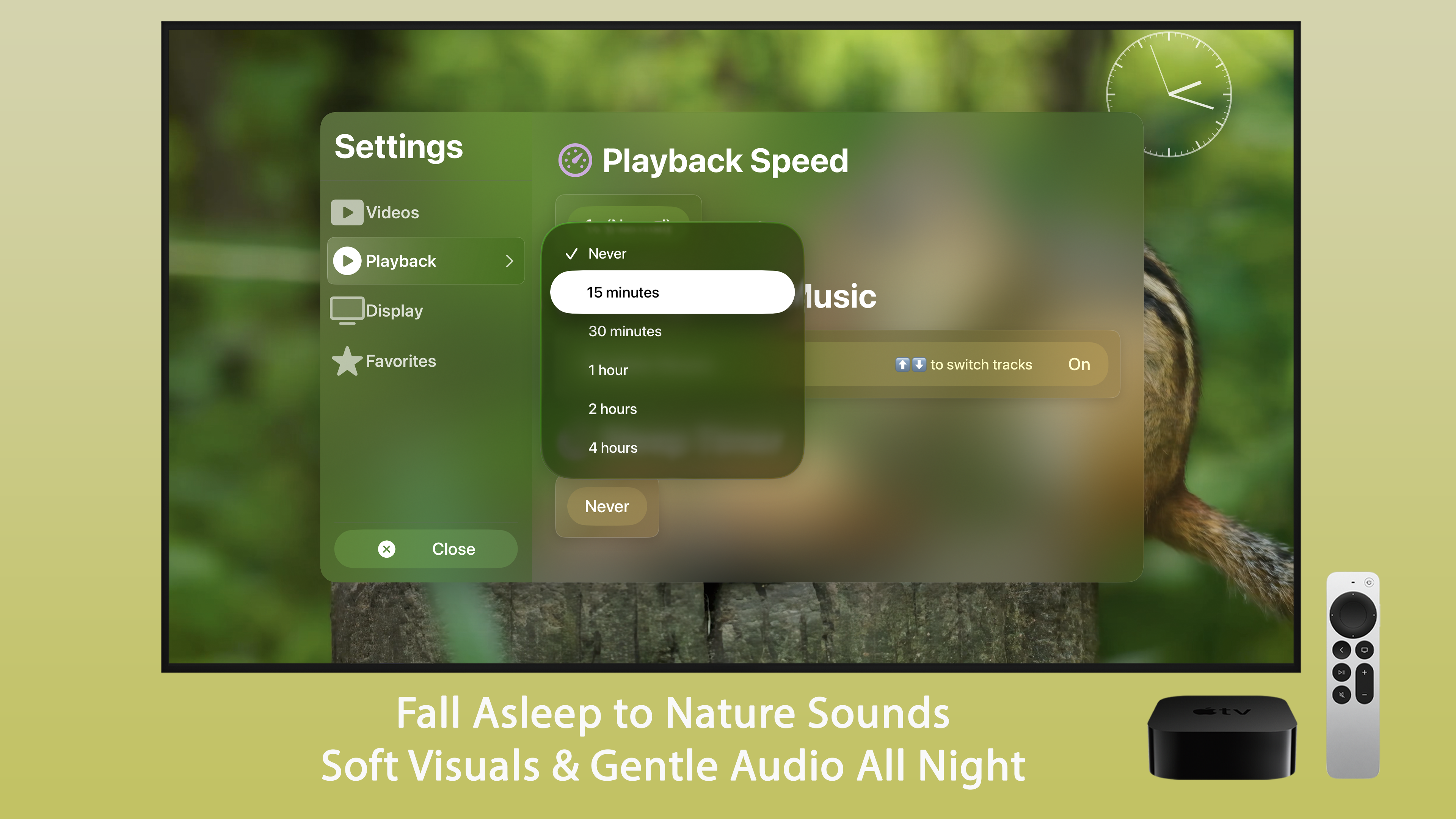
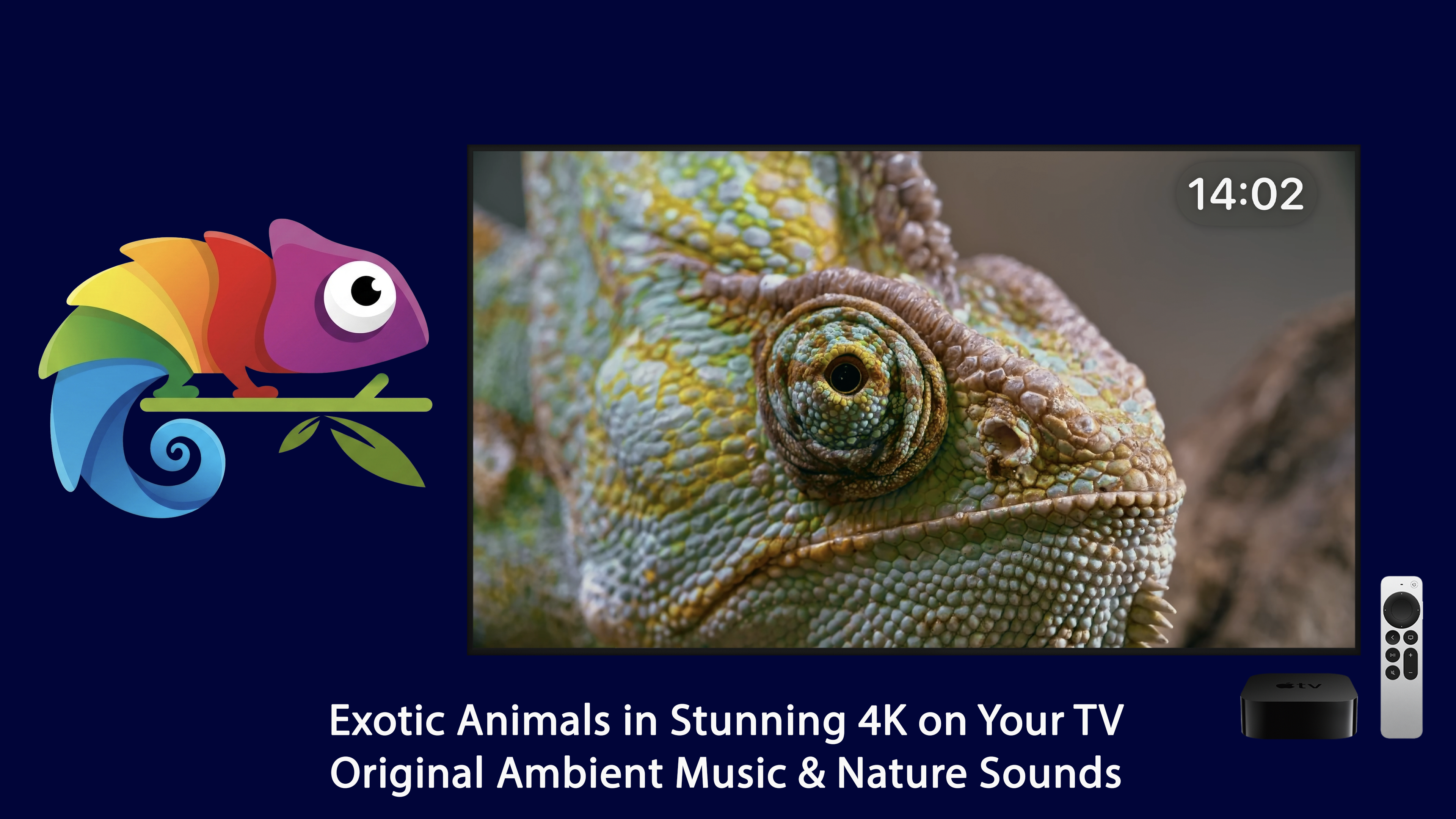
Exotic Animals 4K is our version of this for Apple TV - wildlife without narration, in long takes.
Which subjects suit which room
- Water - reef, river, coastline. The most reliably calming category and the most forgiving of a bright room.
- Animals moving - the most engaging, and the best choice when people are present and might glance at it.
- Landscape and weather - good in the evening; watch for brightness swings in cloud footage.
- Forest - visually rich, and the category most damaged by poor compression.
What to avoid regardless of subject: anything with a timelapse. Sped-up motion is the opposite of soft fascination - it is inherently attention-grabbing, and it is in an unfortunate number of "relaxing nature" compilations.
Using it deliberately
Two things make the difference between an effect and wallpaper.
Switch it on for a reason. Something running permanently becomes invisible within a week. Putting it on when you sit down in the evening keeps it doing something.
Turn the brightness down. The same rule as every ambient display: matched to room lighting rather than to a shop floor, or it reads as a television rather than as a window.
And the caveat worth keeping: if the choice is between a nature video and going for a walk, the walk wins by a wide margin in every study that has compared them. The screen is for the evenings when that is not on offer.