Vocabulary has two halves: what a word means, and how it behaves - its gender, its plural, its irregular forms. Flashcards tend to train the first half and leave the second to luck. Memory techniques handle both, as long as you put the grammar into the image.
Always learn the article with the noun
The first rule costs nothing: never learn agua on its own. Learn el agua. Never voiture, always la voiture. If the article is part of what you rehearse, it is part of what you recall.
(And yes, agua is feminine - it takes el in the singular only because it begins with a stressed "a" sound. Las aguas gives it away. Words like this are exactly why the article has to be learned, not deduced.)
The keyword method for meaning
In 1975 the psychologists Richard Atkinson and Michael Raugh tested a technique for learning Russian vocabulary. Learners found an English word that sounded like the foreign word - the keyword - and made an image linking it to the meaning. Those who used it remembered substantially more words than those who simply rehearsed.
For Spanish pez (fish), the keyword might be pest: a fish that is an absolute pest, splashing everyone. For French pomme (apple), a cheerleader's pom-pom made of apples. The sound gets you from the foreign word to the image; the image gets you to the meaning.
A trick for gender
Here is where most learners stop short. Give each gender its own consistent quality, and put that quality into every image:
- Masculine things are on fire.
- Feminine things are frozen solid.
Now the pest of a fish is on fire - el pez. The bicycle is frozen in a block of ice - la bicicleta. When you recall the image, the fire or the ice tells you the article. Any pair of strong contrasts works: loud and silent, giant and tiny, gold and silver. Choose one and never mix them.
Putting words in a palace
A memory palace is ideal for a vocabulary set: ten or fifteen new words on one route, each image carrying its meaning and its gender. Recalling them in order is a quick first check. The better test is random order - "what was at the fountain?" - because a vocabulary test in real life never asks in the order you learned.
Palaces also help with themes. Food words in the kitchen of your palace, travel words by the front door. The place becomes one more cue.
Then keep them
A mnemonic gets a word in fast; it does not keep it for ever. Review the set the next day, again after a few days, then after a week or two - spaced repetition. As you use a word in real sentences, the image becomes unnecessary and quietly drops away. That is the goal: the image is scaffolding, not the building.
Practising on the TV
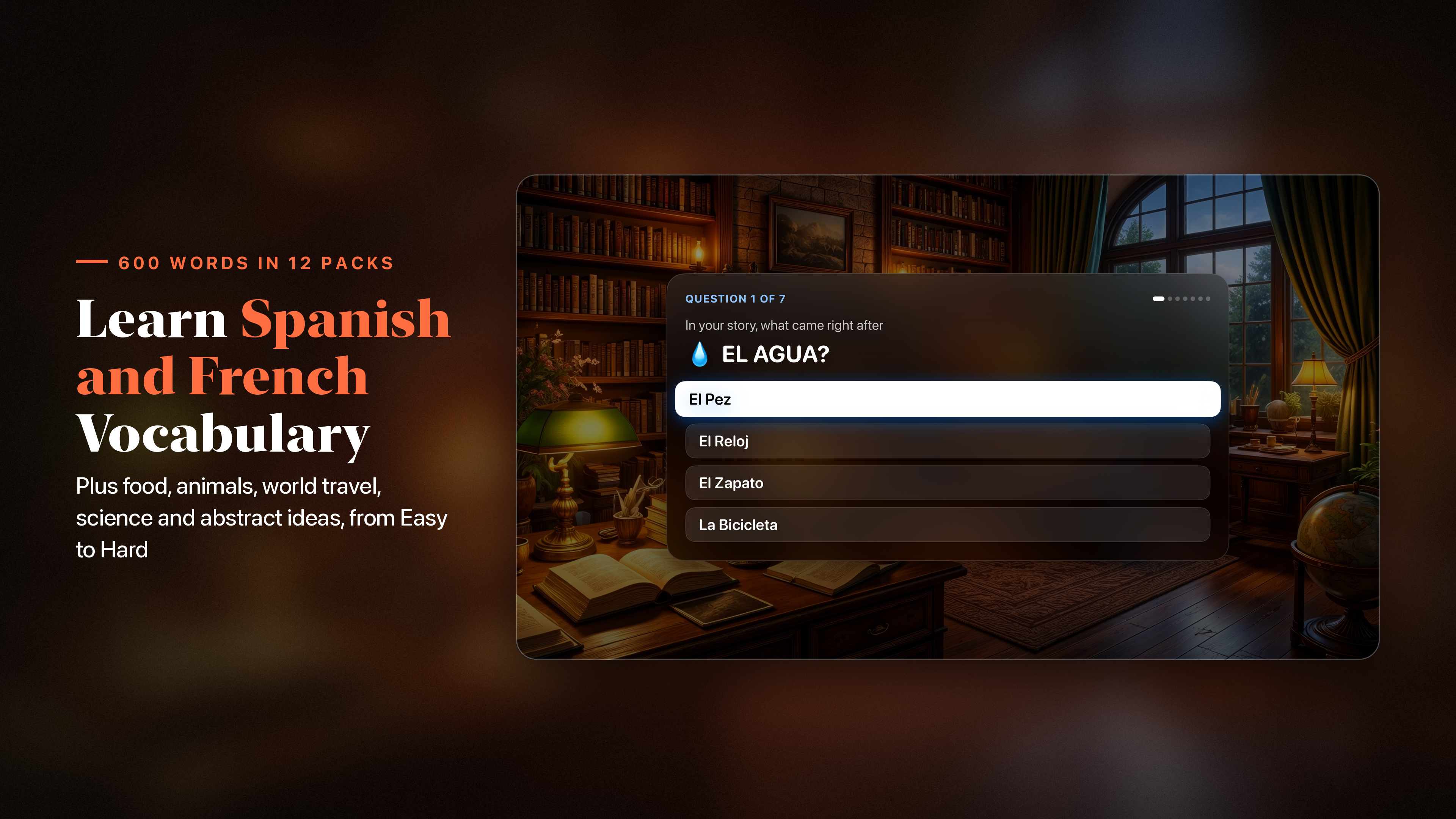
Memory Palace for Apple TV includes Spanish and French packs among its twelve word packs, and every word comes with its article, so you practise the gender each time you practise the word. Packs come in Easy, Medium and Hard, and the recall test asks in random order - or, in a story session, what came right after a given word.