The short answer is yes - for remembering the kind of material you train on. The longer answer is more interesting, because it explains both why the technique is so effective and why it will not make you better at everything.
Memory champions have ordinary brains
In 2003 a team led by Eleanor Maguire at University College London scanned people who performed at the top of the World Memory Championships and compared them with ordinary volunteers. They were looking for something special - a larger hippocampus, a different structure, unusual intelligence.
They did not find it. The champions' brains were not structurally different, and they did not stand out on general cognitive tests. What was different was how they worked: almost all of them used the Method of Loci, and while memorising they relied on brain regions involved in spatial memory and navigation far more than the control group did.
In other words, the extraordinary performance came from a method, not from the hardware.
Beginners improve fast
A 2017 study in the journal Neuron, led by Martin Dresler, tested whether ordinary people could learn it. Volunteers with no memory training practised the Method of Loci for about half an hour a day for six weeks.
Before training they recalled, on average, around 26 words from a list of 72. Afterwards the average was around 62. Four months later, with no further training, they still remembered far more than before. Their patterns of brain connectivity had also shifted toward those of memory athletes. Control groups who practised a simple memory game, or nothing at all, improved much less.
That matches what most people find on their first attempt: a list of ten words that would normally slip away is suddenly easy to recall in order.
Why it works so well
Three effects stack together:
- Spatial memory is strong by default. We remember places and routes with little effort, and the palace borrows that capacity.
- Images beat words. A concrete, vivid picture is far easier to recall than an abstract word, especially if it is bizarre or emotional.
- Cues are built in. Most forgetting is a failure to find a memory, not its loss. A fixed route hands you a cue for every item in order, so you always know where to look next.
What it does not do
The gains are real but specific. A classic study published in 1980 by K. Anders Ericsson, William Chase and Steve Faloon trained a student over many months to extend his digit span - the number of digits he could repeat back - from the usual seven or so to around eighty. When they tested him on letters instead of digits, his span was back to normal.
That is the general pattern. Mnemonic training makes you much better at memorising the material you practise with the method you practise. It does not raise IQ, and it will not by itself fix everyday absent-mindedness like losing your keys. If someone promises a general "brain upgrade", be sceptical.
What does transfer is the method. Once you can build a palace, you can use it for anything you choose to: a speech, a vocabulary list, a set of historical dates, a phone number.
What about older adults?
Research on older adults has found that they can learn and use the method, and many enjoy it, although gains tend to be smaller and depend on regular practice. It is a skill like any other. Treat it as a calm, useful mental exercise - not as a treatment or a way to prevent any medical condition, which no memory app can honestly claim.
How to test it on yourself
You do not need a lab. Ask someone to write down fifteen random words, read them once, and see how many you recall in order. Then learn the method, try a fresh list, and compare. Repeat the recall the next day. The difference is usually obvious - and more convincing than any study.
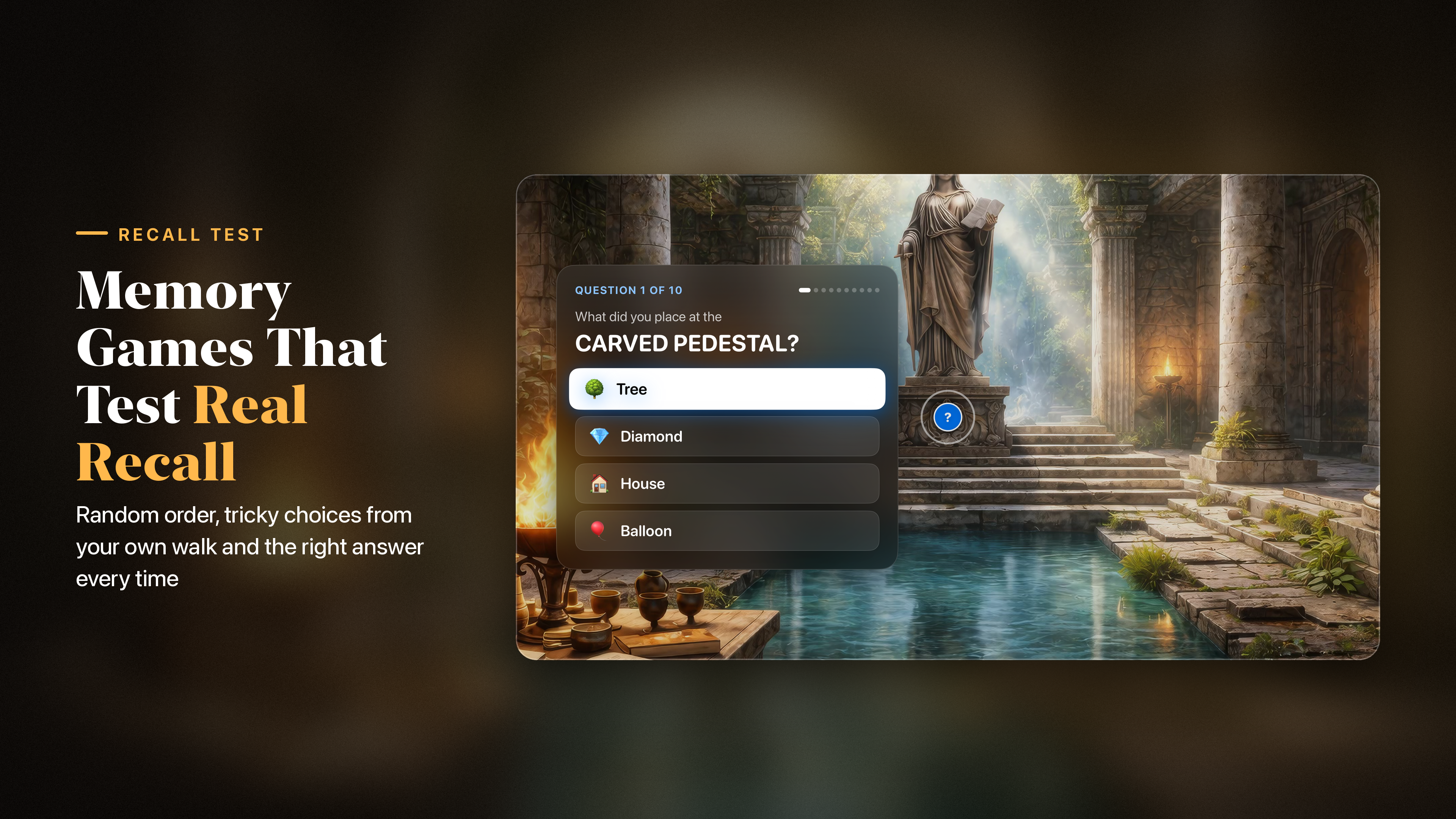
The one thing to insist on is an honest test: random order, not the order you learned in, and wrong answers you also saw, so that familiarity cannot carry you. That is the test Memory Palace for Apple TV gives you at the end of every walk.