An AI image detector is a classifier. Show it an image and it returns a likelihood that the image was generated. Like any classifier, it makes two kinds of mistake, and accuracy claims tend to mention only one.
Two numbers, not one
- Detection rate - out of the AI images tested, how many it flagged. Missed ones are false negatives.
- False alarm rate - out of the real photos tested, how many it wrongly flagged. These are false positives.
A detector that flags every image as AI has a perfect detection rate. It is also worthless. A claim of "99% accurate" means little until you know how it treats real photos.
Why false alarms matter more than they look
Most images people check are real. That changes everything.
Imagine checking 1,000 images, of which 50 are generated. A detector that catches 90% of fakes and falsely flags 5% of real photos will correctly find 45 fakes - and wrongly flag about 47 real photos. More than half of its "AI" verdicts would be wrong.
That is why the false alarm rate, not the headline detection rate, decides whether a score is useful in practice.
Reading a real benchmark
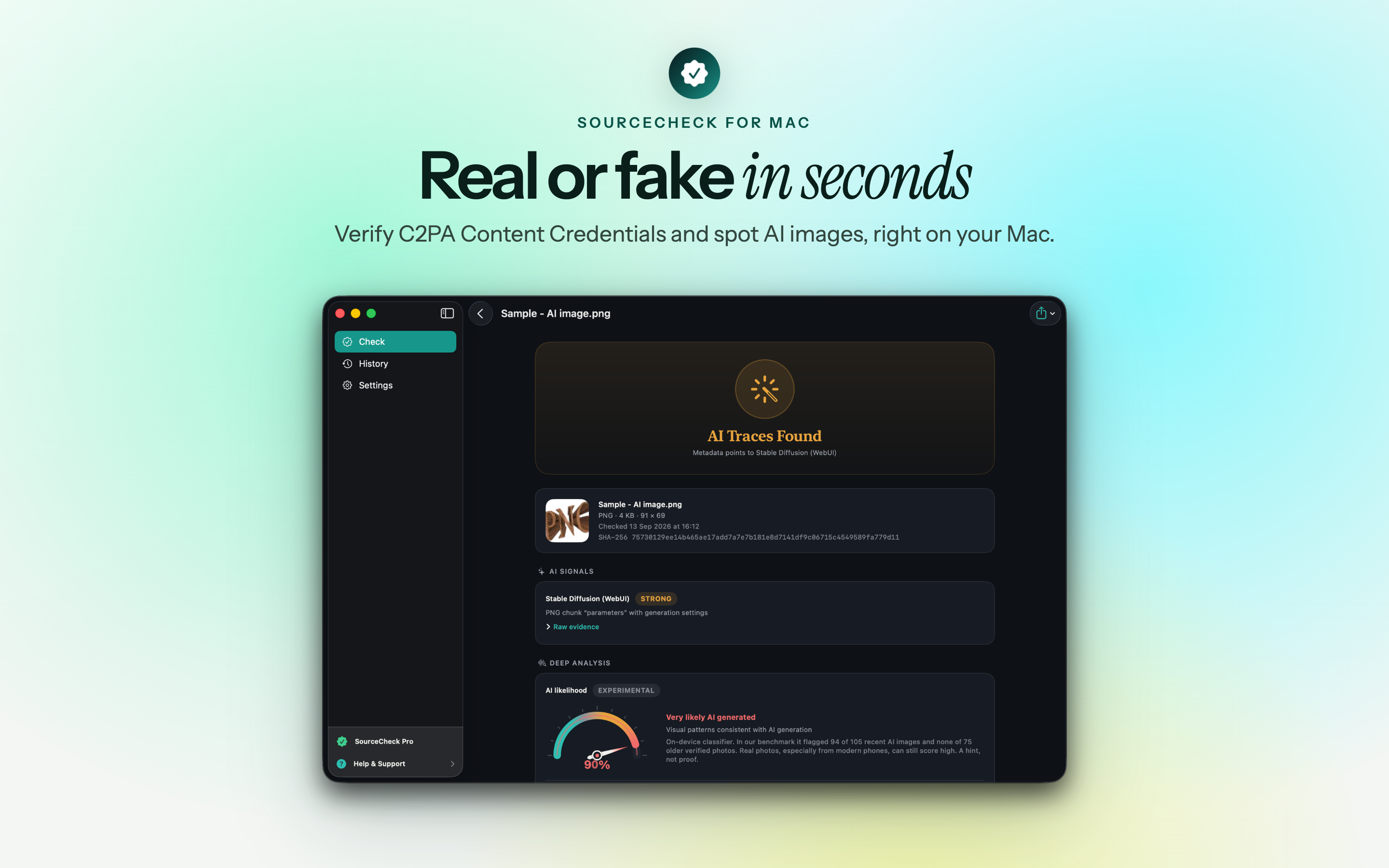
SourceCheck publishes its benchmark in the app, which makes it a useful worked example. Its classifier flagged 94 of 105 recent images from Midjourney, Flux and GPT, and raised no false alarms on 75 verified camera photos.
What that supports:
- A detection rate of about 90% on those generators - roughly one generated image in ten was missed.
- No false alarms in that sample, which is a genuinely good sign.
What it does not support: a claim that the false alarm rate is zero. With 75 real photos and no errors, a common statistical rule of thumb still puts the plausible false alarm rate anywhere up to about 4%. A bigger and more varied set of real photos is needed to narrow that down. The app itself notes that real photos, especially from modern phones, can still score high.
What makes detectors fail
New generators. A classifier learns the fingerprints of the models it was trained on. A new model, or a new version of an old one, can produce images it has never seen.
Recompression and resizing. Detectors often rely on subtle pixel statistics. A screenshot, a crop or a round trip through a social network can erase them.
Heavily processed real photos. Modern phones apply aggressive computational photography - noise reduction, sharpening, merged exposures, portrait blur. The result can look statistically closer to a generated image than an unprocessed photo does.
Partial edits. A real photo with one AI-inpainted object may be scored as mostly real.
How to use a score properly
- Check provenance first. Content Credentials or generator traces in metadata are stronger evidence than any score.
- Treat a high score as a reason to investigate, not a conclusion.
- Treat a low score as weak evidence, especially for a recompressed image.
- Consider how the image reached you, and look for earlier copies.
- Be wary of any tool that presents its score as a definitive verdict.
The fair summary
Good detectors are genuinely useful: they catch most images from the generators they know, and they are fast. They are not lie detectors. The best ones say so plainly, show their benchmark, and sit alongside checks that do not depend on guessing from pixels.