Advent - from the Latin adventus, "coming" - is the season of waiting before Christmas. For most of its history it was marked in church. The calendar that counts it down at home is less than two hundred years old.
Chalk lines and candles
In the nineteenth century, Protestant families in Germany found simple ways to make the waiting visible to children. Some drew twenty-four chalk lines on a door and let the children rub one out each day. Others lit a candle every evening, or hung up a small religious picture each morning.
None of these were sold. They were household habits, and they all solved the same problem: a young child cannot hold "three weeks" in their head, but can see a line disappear.
The wheel with twenty-four candles
The Advent wreath comes from the same idea. In 1839 the Lutheran pastor Johann Hinrich Wichern, who ran a home for poor children in Hamburg, made a wooden wheel with a candle for every day of the season - small red ones for weekdays and four large white ones for the Sundays. The children lit one more each day.
Over time the weekday candles were dropped, the wheel became a ring of evergreen, and the four Sunday candles are what most families light today.
The first printed calendars
The man most often credited with the printed advent calendar is Gerhard Lang, a printer from Munich. As a child his mother had made him a card with twenty-four small sweets attached, one for each day. Around 1908 his firm began printing calendars with little pictures to cut out and stick on, one a day, and later added the small doors that became the standard design.
Other printers made similar calendars at about the same time, so "invented by" is too strong - but Lang's firm did more than anyone to turn the idea into a product.
War, paper and a comeback
During the Second World War, production in Germany stopped because cardboard was rationed. After the war, the Stuttgart publisher Richard Sellmer started printing calendars again, and they spread well beyond Germany. In the United States, newspaper photographs of President Eisenhower's grandchildren with an advent calendar in the 1950s did a great deal for their popularity.
Chocolate
The first calendars with chocolate behind the doors appeared in 1958. They changed what an advent calendar was for: the picture behind the door became a reward, and the reward is what most children now remember.
Since then the format has stretched to toys, tea, beauty products and almost anything that comes in twenty-four small pieces.
Why twenty-four doors?
Advent itself does not start on December 1. It begins on the fourth Sunday before Christmas, which can fall anywhere from November 27 to December 3, so its length changes every year. A calendar that starts on the first of the month and ends on Christmas Eve is simply easier to print and easier for a child to follow - which is why almost every calendar has twenty-four doors, whatever the church calendar says. See what Advent is for the full story.
The same idea, on the TV
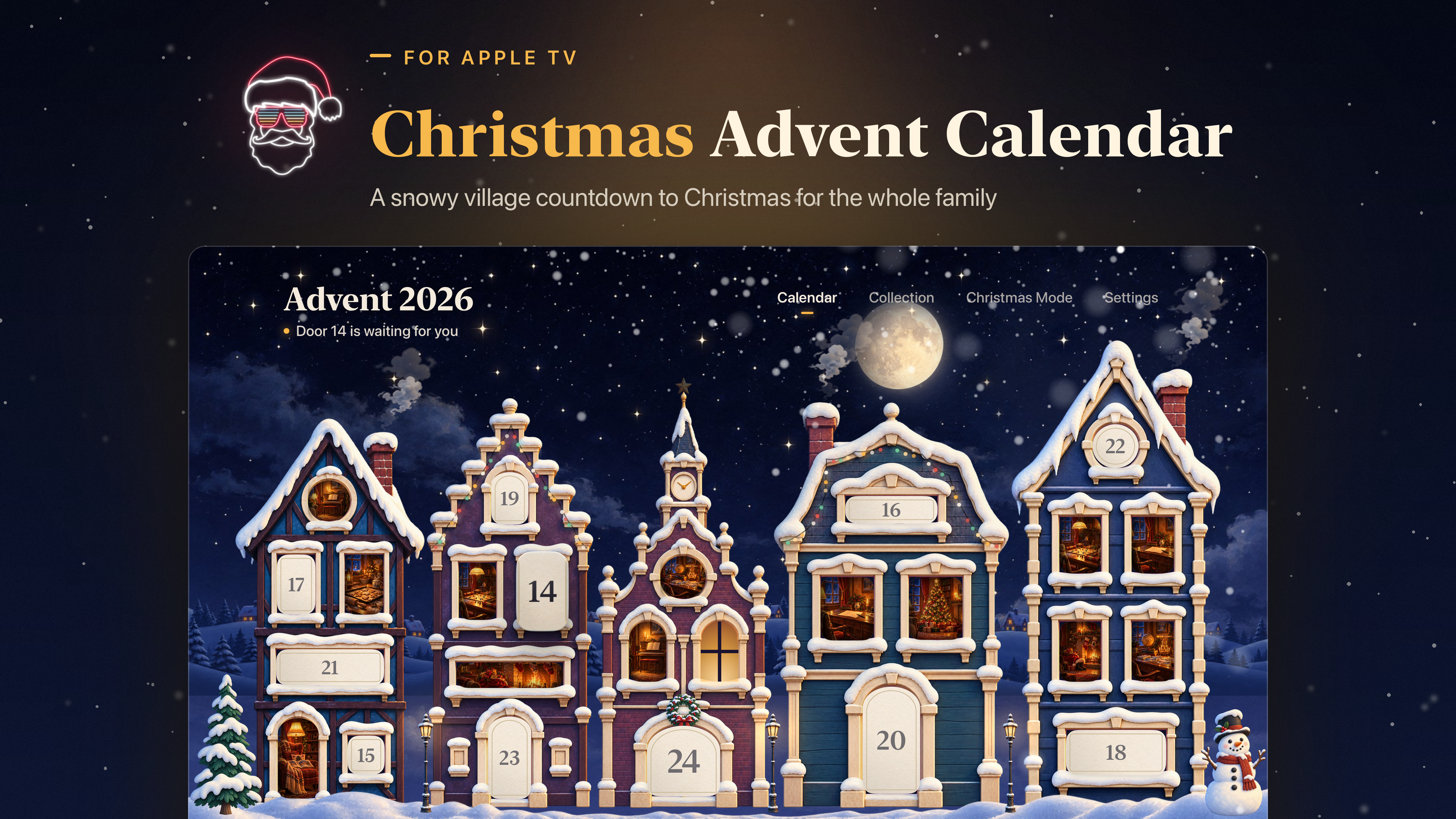
What every version shares is a small daily moment the whole family can watch. Christmas Advent Calendar keeps that shape on the big screen: an illustrated village street with a paper door for every day, a carol, recipe or story behind it, and a village that lights up a little more each morning.