Children develop a sense of duration gradually, and dates arrive late. "Tomorrow" is usually solid by three. "Next week" is vague until five or six, and a calendar date means nothing at all until a child can already count reliably and has a reason to care.
What does work is a quantity that goes down. Not a date - a number of things left. Every good countdown for a small child is a way of turning time into an amount they can see shrinking.
What makes a countdown land
It must be visible without asking. If a parent has to be summoned to reveal the number, the child asks constantly, which is the problem you were solving. It should be somewhere they can look.
It should change once a day, at a predictable moment. Morning is best - it gives the day a shape. A countdown that ticks by the second is a stopwatch and is worse than nothing for this purpose, because nothing visible ever happens.
Something should be removed, not added. Twenty-four boxes that gradually empty communicates progress in a way a number climbing toward a target does not.
It has to be readable by the youngest person using it. A number they cannot yet read is decoration.
The formats that work
Paper chain
One loop per day, torn off each morning. Still the best physical countdown ever invented for a small child, and the reason is that the chain visibly shortens. A child can see the difference between a chain that reaches the floor and one with four links left without counting anything.
Advent calendar
Twenty-four doors, one per day. Works because it combines the countdown with a small daily event. The chocolate is not incidental - the reward is what makes the day's opening a moment rather than a chore.
A screen the whole room can see
The version that suits a household where the television is already the focal point of the living room. A large number, changing once a day, that everyone walks past.
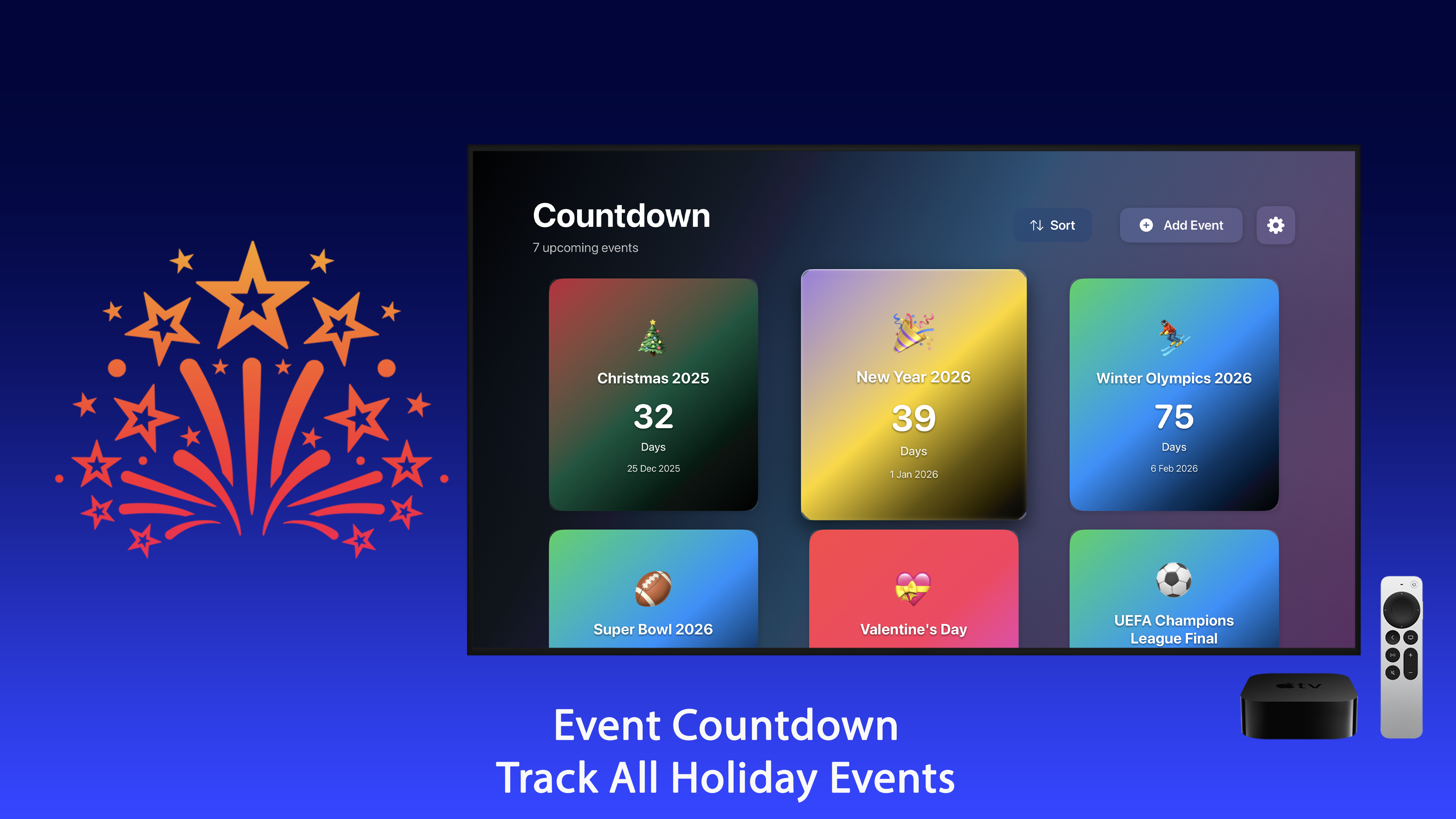
Its real advantage over paper is that it handles more than one thing. Children rarely have a single event in mind - there is Christmas, and a birthday, and the last day of school, and the day grandparents arrive. A display that shows several at once answers all of those questions before they are asked.
Event Countdown runs on Apple TV for exactly this, with several events at once.
Making the number mean something
The trick that works better than any format: attach the number to a known unit of the child's own life.
"Three more sleeps" is the classic and it is genuinely good pedagogy - a sleep is a unit a small child has direct experience of, unlike a day. "Two more nursery days" works the same way for a child who knows their week by which mornings they get dressed for nursery.
Once a child is around six and reading numbers, the abstract count starts working on its own, and the sleeps framing becomes something they will tell you they have outgrown.
Pacing the anticipation
A four-week countdown to a single event is a long time for a child, and the last week is where it becomes difficult for everyone.
Two things help. Break the run with smaller markers - the day the tree goes up, the day the lights go on, the school play - so there is something closer than the big one. And in the final days, shift the focus to preparation: making something, wrapping something, choosing what to leave out on Christmas Eve. Anticipation with a job attached is much easier to hold than anticipation alone.
After the day
The flat feeling on the 26th is real, and a countdown that ends at zero and disappears makes it worse.
The simple fix is to have the next thing already on the display. A birthday, a trip, the day school goes back if that is a good thing in your house. It costs nothing and it turns an ending into a handover, which for a small child is a meaningfully different experience.