A larger vocabulary is often imagined as knowing more impressive words. In practice the useful kind of growth is precision: having the word that fits the situation exactly, and knowing what the words you already use actually mean.
Words that do not mean what people use them for
Some of the most common imprecisions come from words that look like they mean something they do not.
- Fortuitous means happening by chance. It is often used to mean fortunate. A chance meeting can be fortuitous and unlucky at the same time.
- Disinterested traditionally means impartial, with nothing to gain. Uninterested means not interested. A good judge should be disinterested, not uninterested.
- Reticent means reluctant to speak or share. It is often used for reluctant in general.
- Imply is what the speaker does; infer is what the listener does.
Usage does change over time, and dictionaries record newer senses once they become widespread. But a reader who knows the older meaning may understand something you did not intend.
Words that carry a tone you did not choose
Near-synonyms often differ in attitude rather than meaning.
- Famous and notorious both mean well known. Notorious means well known for something bad.
- Thrifty, frugal and stingy all describe careful spending, with increasing disapproval.
- Confident and arrogant can describe the same behaviour from opposite points of view.
Choosing between them is choosing what you think, so it is worth getting right.
Precision is not length
The exact word is frequently the short one. "Use" is often better than "utilise". "Help" is usually better than "facilitate". Long words chosen to sound serious tend to blur meaning rather than sharpen it.
The goal is fit. Sometimes the fitting word is "ubiquitous". Much more often, it is a plain word used carefully.
How to build a more exact vocabulary
Notice your approximations. When you catch yourself describing a thing with a phrase - "that feeling when you are nostalgic for a place you have never been" - that is a sign a precise word might exist.
Learn words in contrast. Learning "fortuitous" next to "fortunate" fixes the difference far better than learning either alone.
Keep the meaning to one line. A definition you can recall in a single breath is one you will actually remember. Long dictionary entries are for reference, not memory.
Write it in your own sentence. Use the word about something from your life before you try to use it in public.
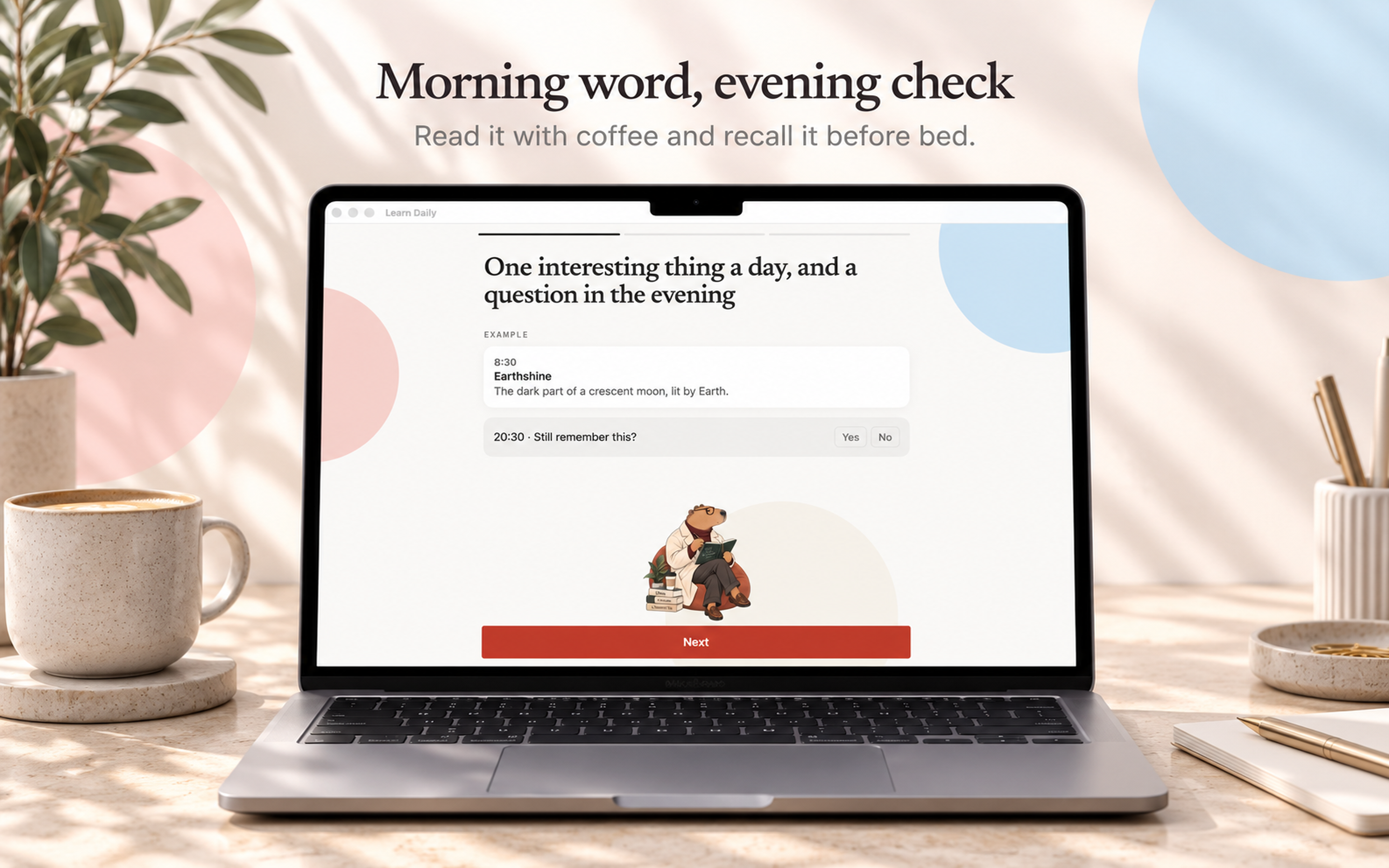
Review it later, not more often. Seeing a word once and recalling it again a few days later does more than looking it up five times in one afternoon.
One a day is enough
This does not need a study session. A single precise word or distinction a day, recalled that evening and brought back over the following weeks, changes how exactly you write and speak within a few months - without ever feeling like a vocabulary course.