The Geminids, around 13-14 December
The Geminids are often the strongest meteor shower of the year. Under a truly dark sky, at the peak, an observer can see well over a hundred meteors an hour; from a town, a few dozen is more realistic, and still worth the cold. They are often slow and bright, sometimes with a touch of colour.
They are also unusual. Most meteor showers come from the dust left behind by comets, but the Geminids come from an asteroid, 3200 Phaethon, whose orbit takes it closer to the Sun than Mercury. And because the point they appear to come from - near the bright star Castor, in Gemini - rises early in the evening, you do not have to stay up until dawn: they are already going by mid-evening, and best after midnight, when Gemini is high.
The Ursids, around 22 December
A small shower that peaks right around the solstice, coming from near the Little Dipper and so best seen from the Northern Hemisphere. Usually about ten meteors an hour, from the dust of comet 8P/Tuttle. A modest show - but a nice one for a clear night just before Christmas.
The Quadrantids, around 3-4 January
The season ends with a shower that can rival the Geminids, but only for a few hours: its peak is short and sharp, so timing and luck matter. It is named after a constellation that no longer exists, Quadrans Muralis, the Mural Quadrant, which once sat near today's Boötes.
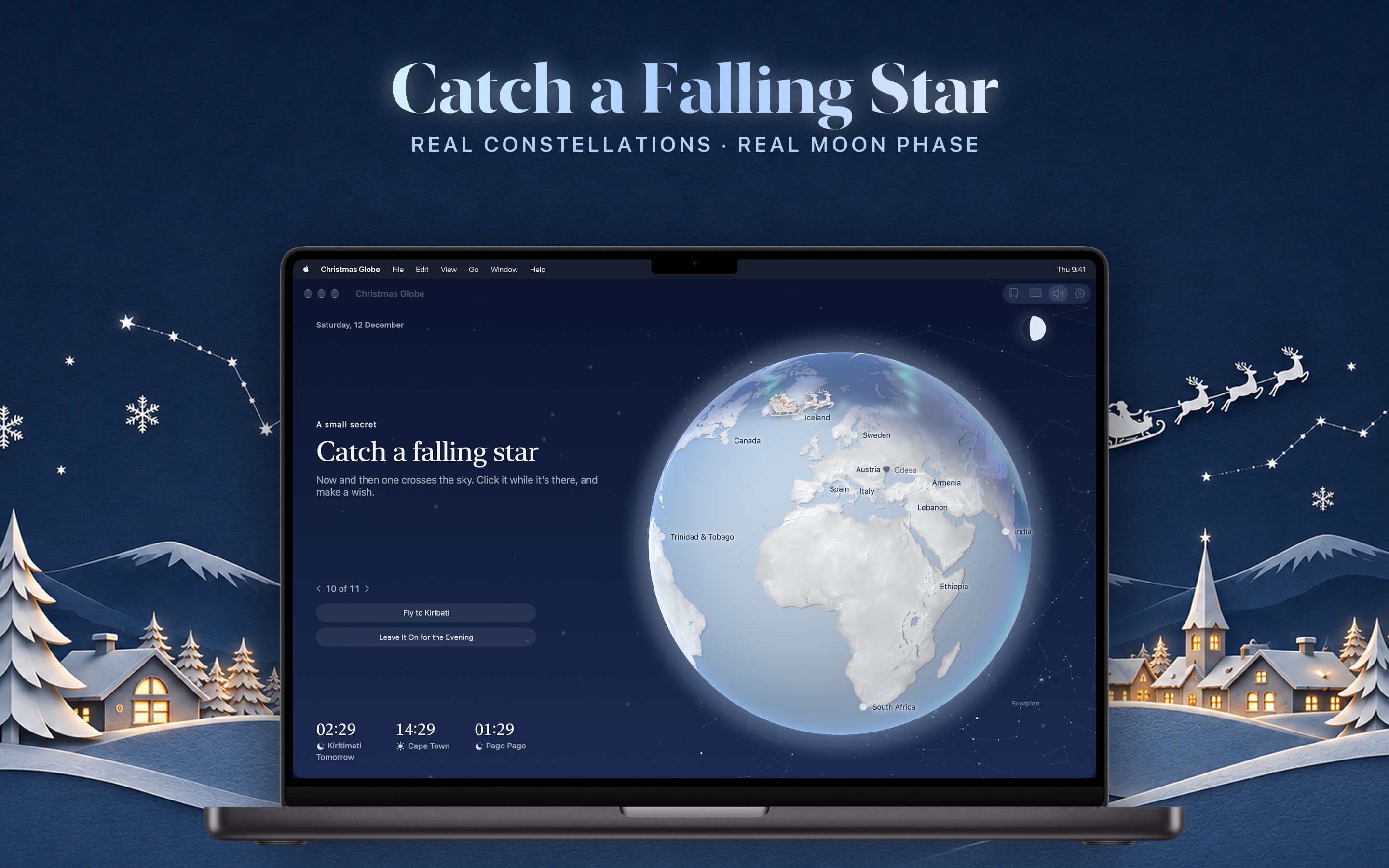
Why the Moon decides
The single biggest factor for any meteor shower is not the shower but the Moon. Moonlight washes out all but the brightest meteors. In December 2026 the Moon is a thin crescent that sets early in the evening at the time of the Geminids, which makes for unusually dark skies - while the Ursids fall close to full Moon, on the run-up to Christmas. A Moon's phase is easy to check before you go out; in Christmas Globe, clicking the Moon tells you tonight's phase and how long until it is full.
The winter solstice
In the Northern Hemisphere, the solstice is the longest night of the year; in 2026 it falls on 21 December. In the Southern Hemisphere it is the longest day, and Christmas is a summer festival. From the solstice on, the days slowly get longer again - one reason so many midwinter festivals, from Yule to Saint Lucia's crowns of candles in Sweden, are about bringing back the light.
A "Christmas star"?
The star of Bethlehem has been explained as a comet, a nova, or a close meeting of planets - the astronomer Johannes Kepler suggested a series of conjunctions of Jupiter and Saturn in 7 BC. Jupiter and Saturn met again, closer than they had appeared for centuries, on 21 December 2020, and newspapers around the world called it the "Christmas Star".
How to watch
- Get away from lights if you can, or at least out of the glare of street lamps. See stargazing with light pollution for what still works in town.
- Give your eyes twenty minutes to adapt to the dark, and avoid your phone screen - or turn it right down.
- Lie back and look up, not straight at the radiant: meteors are spread all over the sky, and the longer ones appear away from it.
- No telescope. Meteors move too fast; your eyes are the right instrument.
- Dress for it. A reclining chair, a sleeping bag and something hot to drink make an hour outside easy.
Christmas Globe turns under the real sky - the stars where they are tonight and the planets you can step outside and see - and brings more falling stars to catch on the peak nights of the winter showers. The solstice gets its own moment too.