Fake listing photos come in three kinds, and each needs a slightly different check.
- Stolen photos - real pictures of a real item, taken from someone else's listing, a manufacturer's site or a review.
- Staged or edited photos - a real item made to look newer, bigger or undamaged.
- Generated photos - an item, a flat or a car that was never photographed because it does not exist in that form.
1. Save the images properly
Download the full-size images rather than taking screenshots. Screenshots discard everything useful in the file and shrink the image, which makes every later check weaker.
2. Reverse-search every photo
This catches the most common fraud by far. Run each image through Google Lens, TinEye or Bing Visual Search. If the same photo appears on another listing in another city, on a stock photo site, or on the manufacturer's page, you have your answer.
Search all of them, not just the first. Scammers often mix one stolen hero shot with a few genuine but uninformative photos.
3. Check the files
Open the saved images in a checker. Two things are worth looking for.
AI signals. Generator traces in metadata, AI-labelled Content Credentials, or a high AI likelihood score. Generated product and property photos are increasingly common in rental and holiday-let scams in particular.
Editing traces. A software field naming an editor, or forensic signs of a local edit, such as a scratch or a stain painted out.
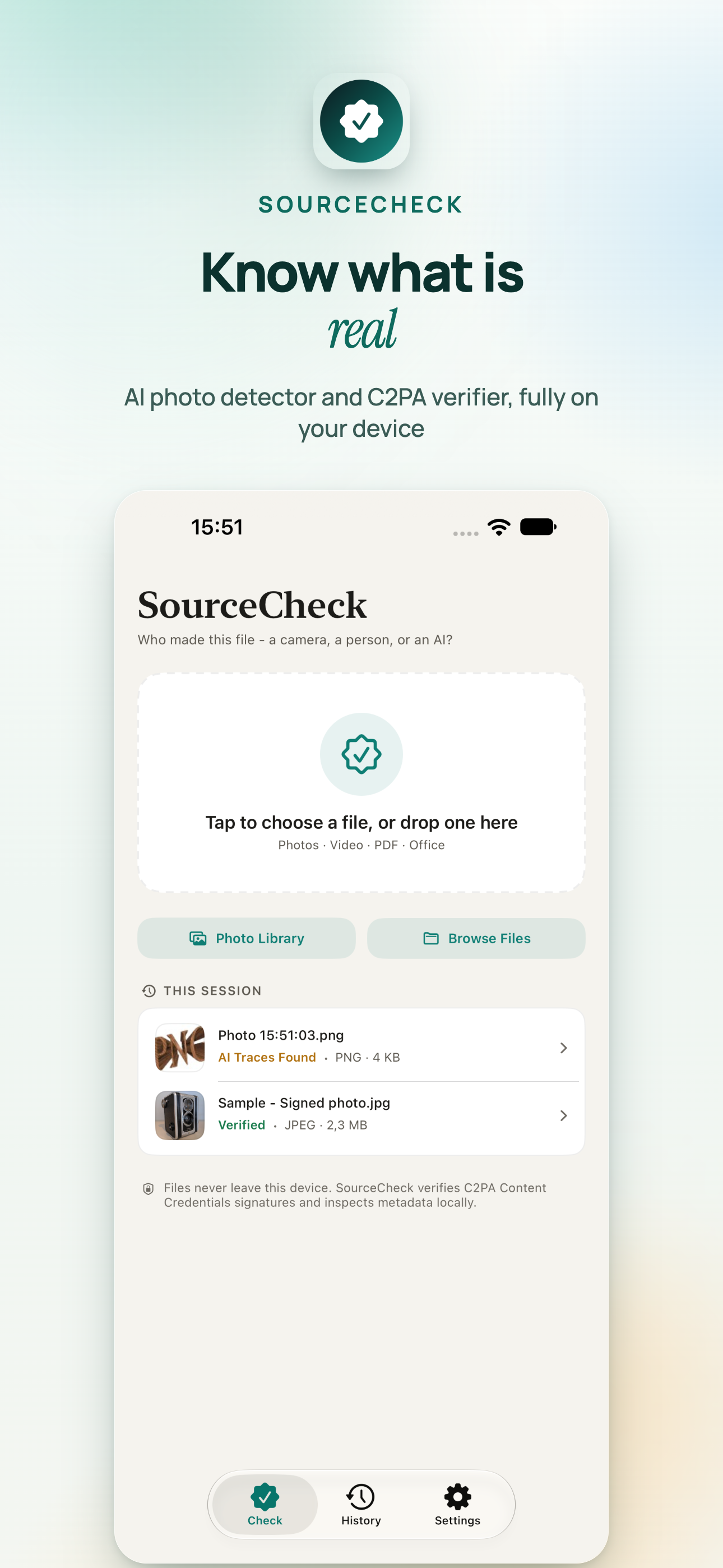
Be realistic about empty results. Most marketplaces strip metadata when images are uploaded, so "No Credentials" and missing EXIF are normal here. They are not red flags on their own.
4. Compare the photos with each other
Real listings are usually shot in one place, in one session, on one phone. Look across the set:
- Does the background, flooring and light match from photo to photo?
- Does the wear on the item stay consistent between angles?
- Is the image quality similar, or is one photo suspiciously polished?
A set where one photo looks like an advert and the rest look like a kitchen table is worth a question.
5. Ask for a photo that cannot already exist
This is the most reliable check, and it costs the seller thirty seconds if they are genuine. Ask for a new photo of the item with something specific in the frame: a piece of paper with today's date and your name, or the item photographed from an angle you choose.
A genuine seller can do this immediately. A seller with stolen photos has to invent an excuse.
6. Weigh it against the deal
Photo checks sit alongside the usual warning signs: a price far below the market, pressure to pay quickly, payment methods with no buyer protection, and a reluctance to meet or show the item on a video call. One odd result is not proof of fraud. Several together are a good reason to walk away.
The short version
- Save full-size images.
- Reverse-search all of them.
- Check each file for AI and editing traces.
- Compare the photos for consistency.
- Ask for one new, specific photo.