A modern television is a metre-wide light source with perfect colour control, and at Halloween most of them are switched off or showing a film nobody is watching. Used as a decoration rather than a screen, it does something no other prop can: it changes the light in the room.
Two entirely different jobs
Worth deciding which one you are doing, because the right content for each is different.
Atmosphere for people inside. The screen is ambient - it lights the room, it is glanced at, nobody watches it. Wants continuous motion, no jump scares, no loud audio, and stable brightness so conversation is not interrupted.
A display for people outside. The screen faces a window and is aimed at the street. Wants high contrast, bold shapes, and content that reads from ten metres through glass. Subtlety is wasted here.
Trying to do both from one screen produces something that is not quite either.
For the room
The strongest effect is flickering firelight and candlelight. Warm, irregular, low-contrast movement changes how a room feels more than any amount of orange gel over a lamp - and it is the one thing a screen does better than a physical decoration, because real candles are a fire risk with children and costumes in the house.
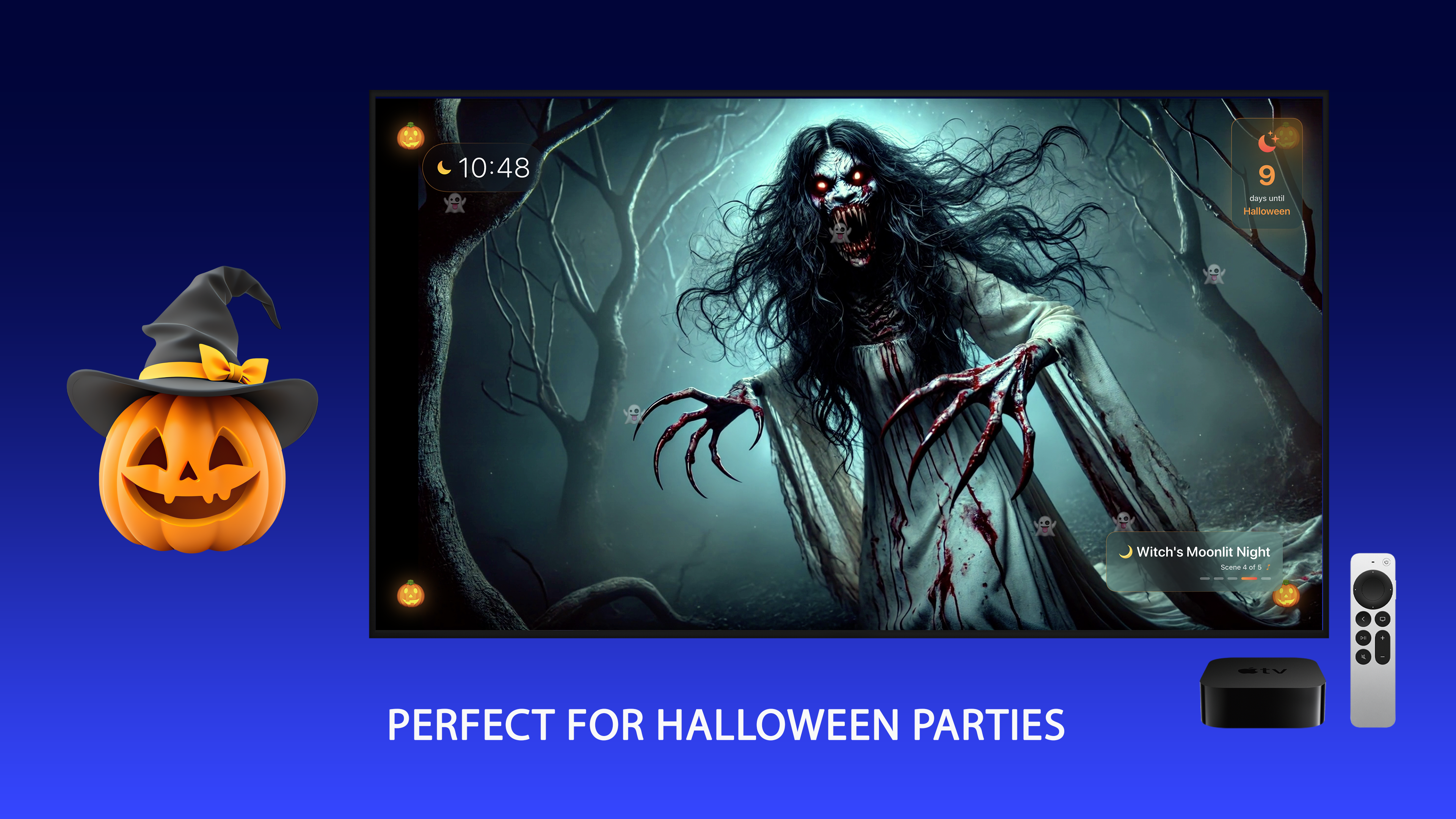
Add to that: fog and mist scenes, slow-drifting graveyards, anything with continuous atmospheric motion. Spooky Halloween Party 4K is the set we made for exactly this, in 4K so it holds up on a large panel.
What does not work indoors, learned the hard way:
- Jump scares on a loop. Funny once. By the fourth time, everyone in the room is braced for it and nobody is talking.
- Loud audio. Ambient screens should be silent, with your own playlist over the top.
- Anything with a narrative. A film pulls attention. You want the room lit, not an audience.
For the window
This is the one that gets photographed by neighbours.
Put the television close to the window facing out, and hang a thin white sheet or tracing paper across the glass as a diffuser. The picture becomes a glowing silhouette panel rather than a screen with a bezel, and from the street the effect is far more convincing than the setup deserves.
Practical notes:
- Turn the brightness up. This is the one situation where maximum is right - you are competing with a street light.
- Kill the room lights behind it. A lit room behind the screen destroys the illusion entirely.
- Angle it slightly downward if the window is above street level, so people are seeing the picture rather than the panel edge-on.
- Check it from outside before you are satisfied. It always looks different from where the audience stands.
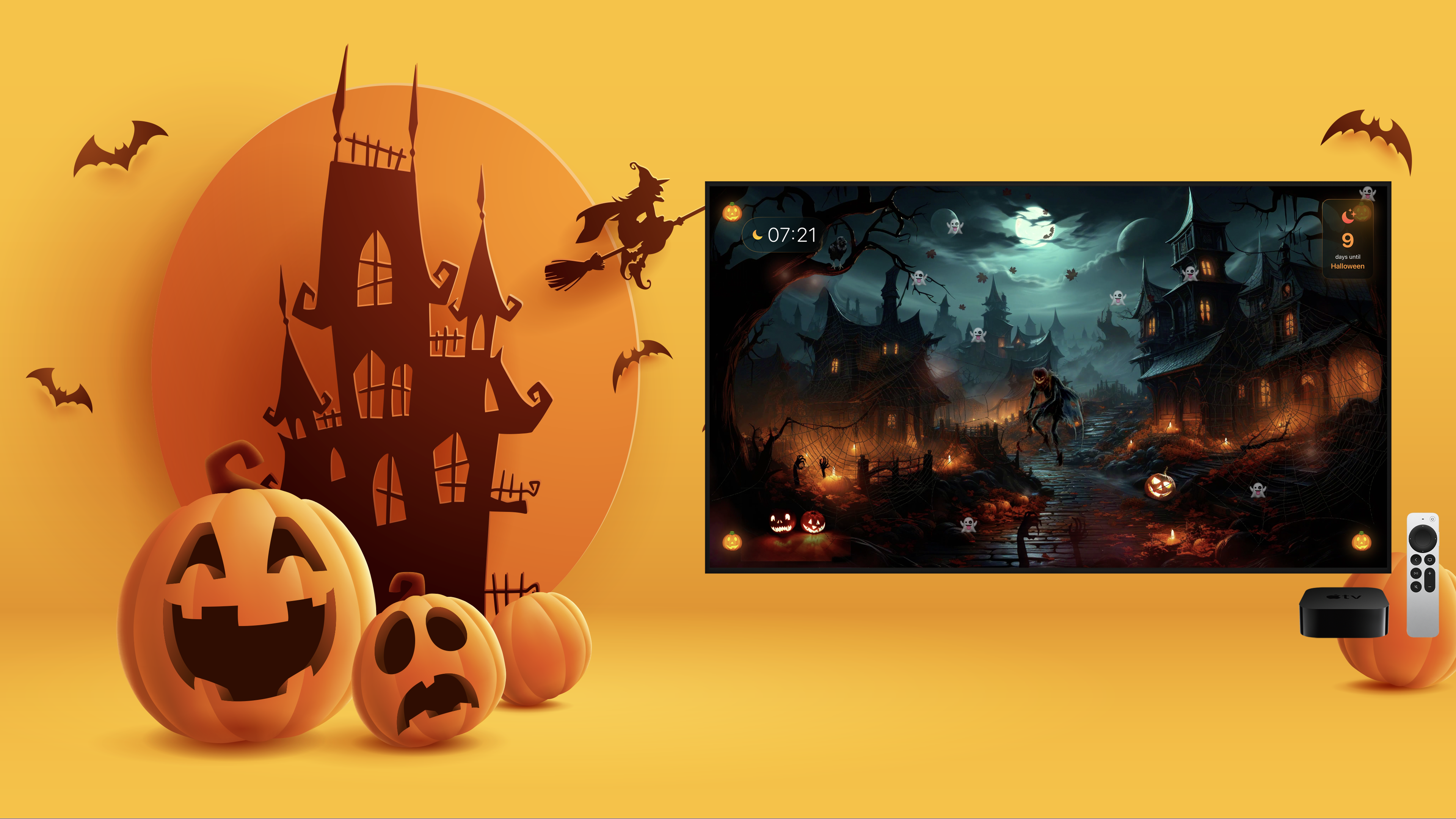
Settings that stop it looking cheap
Three things separate a good screen decoration from an obvious television.
Turn off motion smoothing. The soap-opera effect makes atmospheric footage look like video rather than film, and it is on by default on most sets.
Hide the interface. Any overlay, clock or progress bar breaks it immediately. Content that runs full screen with no chrome is the whole requirement.
Match the colour temperature to the room. A cool-toned screen next to warm lamps looks like a television. Warm mode makes it look like part of the lighting.
Timing it
The evening runs in stages and the screen should follow. Early, with children at the door, keep it warm and unthreatening - candlelight and pumpkins. Later, once the trick-or-treating is done, the darker scenes land better.
Set it up the weekend before rather than on the night. The window arrangement in particular takes a couple of attempts to get right, and doing it in the dark twenty minutes before people arrive is how the sheet ends up crooked.
The same logic works through the rest of the year, incidentally - we wrote about the general case in what to put on a screen you are not watching. Halloween is just the one occasion where everyone is already thinking about the lighting.