American passport photos are a 2 by 2 inch square - 51 by 51 mm - which is a format almost no other country uses. A photo prepared for a US application is not valid anywhere that expects 35 by 45 mm, and the reverse is equally true.
The specification
| Rule | Requirement |
|---|---|
| Print size | 2 × 2 inches (51 × 51 mm), square |
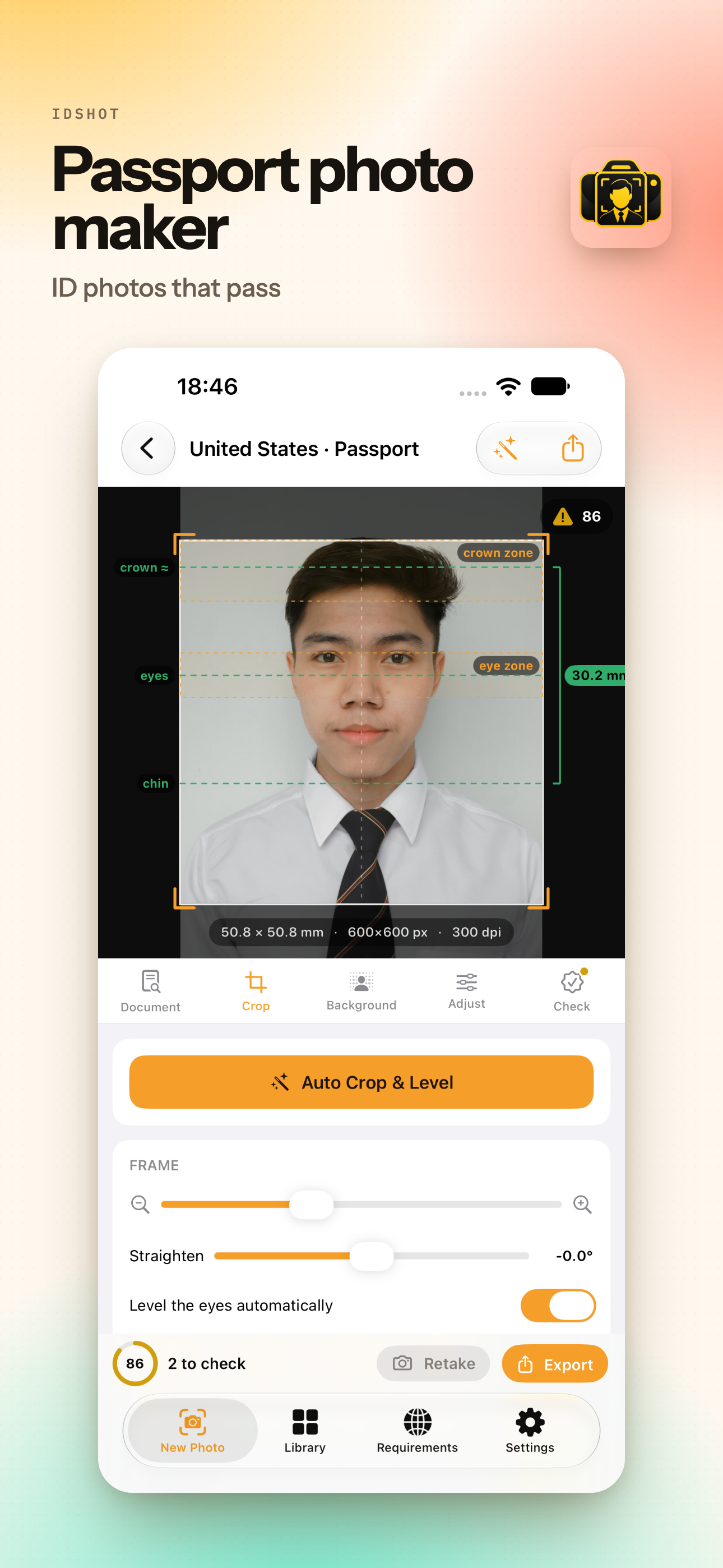
| Head height | 1 to 1 3/8 inches (25-35 mm), chin to crown |
| Eye line | Roughly 1 1/8 to 1 3/8 inches from the bottom |
| Digital size | Square, 600 × 600 to 1200 × 1200 pixels |
| Background | Plain white or off-white |
| Expression | Neutral or a natural smile, both eyes open |
| Glasses | Not permitted |
| Age of photo | Taken within the last six months |
| Colour | Colour, not black and white |
Head height is often restated as the head occupying 50 to 69 percent of the image height, which is the same rule expressed as a proportion. Both are measured chin to crown, where crown means the top of the head including hair that lies flat.
The rules people get wrong
Glasses. Removed from acceptable photos in November 2016 after reflections and frames became a leading cause of rejection. This is still the single most common surprise for anyone who has not applied in a decade.
Uniforms and camouflage. Not permitted. Everyday clothing only. Religious attire worn daily is acceptable.
Headphones and wireless earpieces. Explicitly called out and refused. Hearing aids and similar medical devices are fine.
Digital alteration. Filters and retouching are refused. This includes the beauty processing some phones apply automatically, which is worth turning off before you shoot rather than trying to detect afterwards.
Other people in frame. Including hands supporting an infant. For children this is the hardest rule to satisfy - see passport photos for babies and children.
Digital versus printed
A paper application takes a printed 2 by 2 inch photo, stapled or attached as instructed on the form. An online renewal takes a digital file, square, between 600 by 600 and 1200 by 1200 pixels.
Note that 600 by 600 pixels is precisely a 2 inch square at 300 DPI, which is why the two specifications agree. If you prepare the digital version first, the print follows for free - see millimetres, pixels and DPI.
The DV Lottery is a different specification
The Diversity Visa entry uses the same square format and the same appearance rules, but adds a hard file-size cap of 240 KB and rejects entries outright for photo problems, with no correction step. It has its own guide: DV Lottery photo requirements.
What actually gets photos rejected
In rough order of frequency: head too large in the frame, shadow on the background, glasses, a photo that is visibly older than six months, and digital alteration. Three of those five are measurable before submission, and the other two are decisions you make before pressing the shutter.
Taking it at home
Stand about a metre and a half from a plain, light wall, with a window or other soft light source in front of you rather than above. Have someone else hold the camera at your eye level - an arm's-length selfie distorts the face and usually puts the head at the wrong size. Neutral expression, eyes open, glasses off.
IDShot carries the US passport and DV Lottery presets with their own head-height bands and file-size targets, crops to them automatically, and checks the appearance rules before you export.
Requirements are changed by the authorities that publish them, and the official page is the only source that settles an argument. Each preset in IDShot links to that page, so you can confirm the current wording before you submit.