A Schengen visa is issued by one member state but valid across the area, and the photograph follows a common standard derived from ICAO guidance. It is the most widely used ID photo specification in the world.
The standard
| Rule | Requirement |
|---|---|
| Print size | 35 × 45 mm |
| Head height | 32-36 mm, chin to crown (about 70-80%) |
| Background | Plain light grey, uniform |
| Expression | Neutral, mouth closed, eyes open and visible |
| Position | Face square to the camera, no tilt or turn |
| Glasses | Refused if there is glare, tint or frame obstruction |
| Age of photo | Taken within the last six months |
| Quantity | Usually two identical prints |
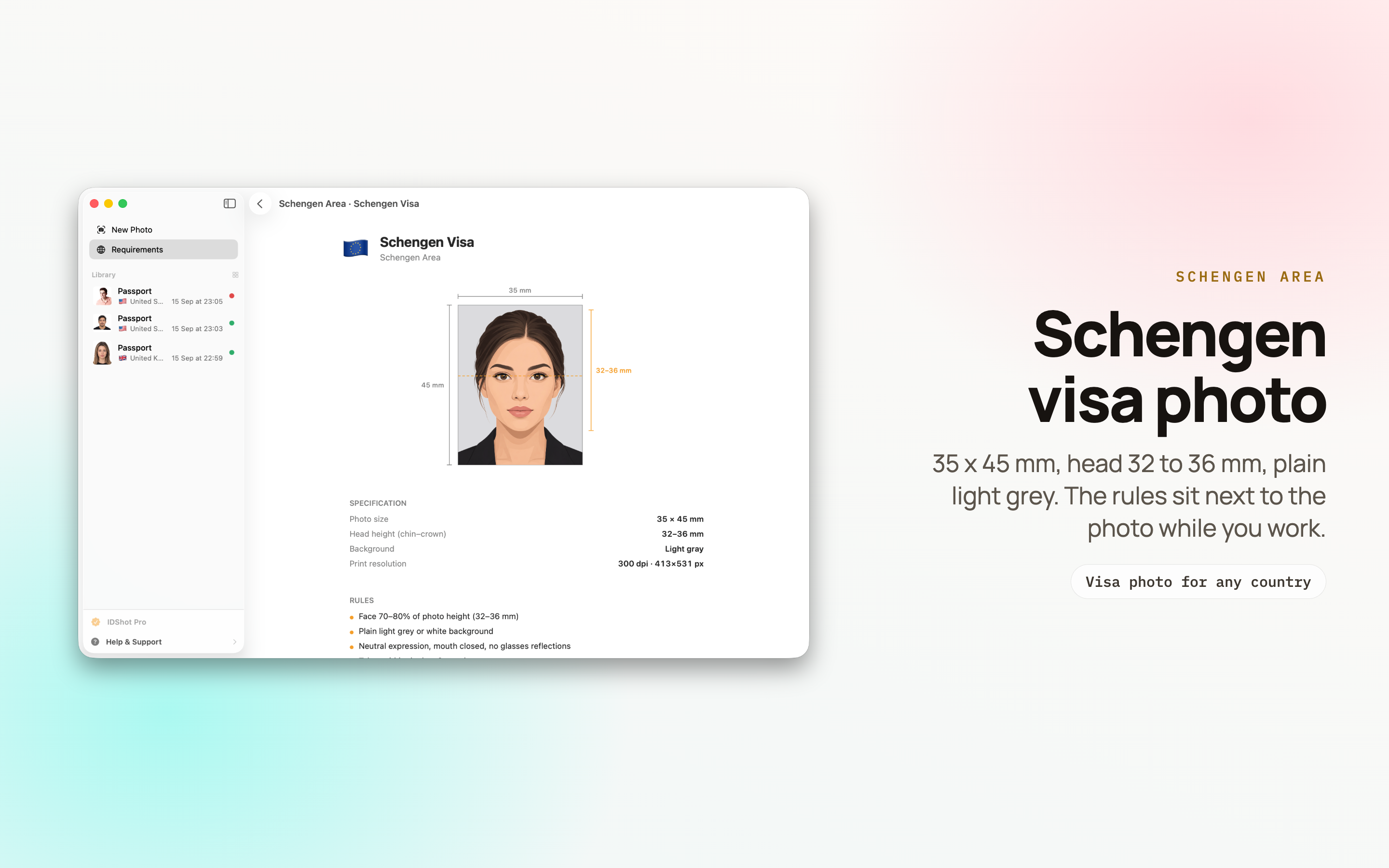
Where members differ
The dimensions are consistent. What varies is the surrounding wording:
- Background. Light grey is the standard, but some consulates accept white and a few explicitly ask for it. Where the instruction says "light, uniform", grey is the safe reading.
- Glasses. Some consulates refuse them outright, others only when there is glare.
- Number of prints. Usually two, sometimes one, occasionally more for specific visa types.
- Digital upload. Consulates that take applications online publish their own pixel and file-size requirements, and these vary considerably.
Because the visa is issued by the country you are applying to, that country's consulate page is the authority - not a general Schengen summary, including this one.
The German template
Germany publishes an unusually explicit photo template - a printed diagram with measurement bands for head height and eye position, used by photographers and accepted as the reference. If you are applying through a German consulate, or to any authority that follows the German model, it is worth reading: it makes visible exactly what "32 to 36 mm" means in relation to the frame.
We cover it separately in the German biometric photo template.
What gets photos refused
In practice, four things:
- Head height outside the band. Almost always too large, from cropping in too far.
- Background that is not uniform - a shadow, a gradient, or visible texture.
- Head turn. The standard asks for the face square to the camera. A few degrees of turn is common and is checked.
- Prints that are not identical. Two photos from different sessions, or printed at slightly different scales.
The last one is avoidable by printing both from the same file on the same sheet, which also guarantees the scale matches.
Preparing one
Plain wall, stand a metre away from it, soft light from the front, someone else holding the camera at your eye level about a metre and a half back. Neutral expression, mouth closed, head straight, no glasses. Then crop to 35 by 45 mm with the head inside 32 to 36 mm and replace the background with the required grey.
IDShot carries Schengen presets per member state, so the background colour and head band come from the country you are applying to rather than from a generic European template, and each links to that consulate's own page.
Requirements are changed by the authorities that publish them, and the official page is the only source that settles an argument. Each preset in IDShot links to that page, so you can confirm the current wording before you submit.