There are two entirely different things called an earthquake alert, and conflating them is why people are disappointed by both.
Early warning detects the fast-moving first waves and warns you before the slow, damaging ones arrive. It buys seconds - occasionally tens of seconds. That is enough to get under a table, stop a train or close a gas valve, and it is genuinely life-saving.
Notification tells you an earthquake happened, after the fact. Useless for taking cover, valuable for knowing whether family in another region felt something, and for understanding what you just experienced.
Your iPhone can do both, from different sources, with different coverage.
What arrives without installing anything
iOS carries government emergency alerts, and in earthquake-prone regions those include early warning where the local system exists.
- United States west coast. ShakeAlert covers California, Oregon and Washington, delivered through the wireless emergency alert system and through Android's built-in detection.
- Japan. The most mature system in the world, run by the JMA, with alerts that reach effectively everyone.
- Mexico, Taiwan, parts of Europe and elsewhere have systems of varying coverage.
- Most of the world has no early warning at all, because it requires a dense sensor network and there is no substitute for that.
Two settings decide whether you receive them: Settings → Notifications → scroll to the very bottom → Government Alerts. They are usually on, and people do turn them off after a false alarm and forget.
Where the gaps are
Even with everything switched on, the official channel has deliberate limits.
Magnitude thresholds are high. Emergency alerts fire for events likely to cause damage where you are. A magnitude 4.5 twenty kilometres away will not alert you, though you will certainly feel it and want to know what it was.
They are local to you. The system warns about shaking at your location. It says nothing about the earthquake that just happened where your parents live, which for a lot of people is the thing they actually want to know.
Coverage is national. Travelling somewhere without a warning system means you get nothing, and nothing changes on your phone to tell you that.
Seconds are all you get. Early warning is limited by physics: the closer you are to the epicentre, the less warning is possible, and directly above it there is none at all.
Filling in the rest
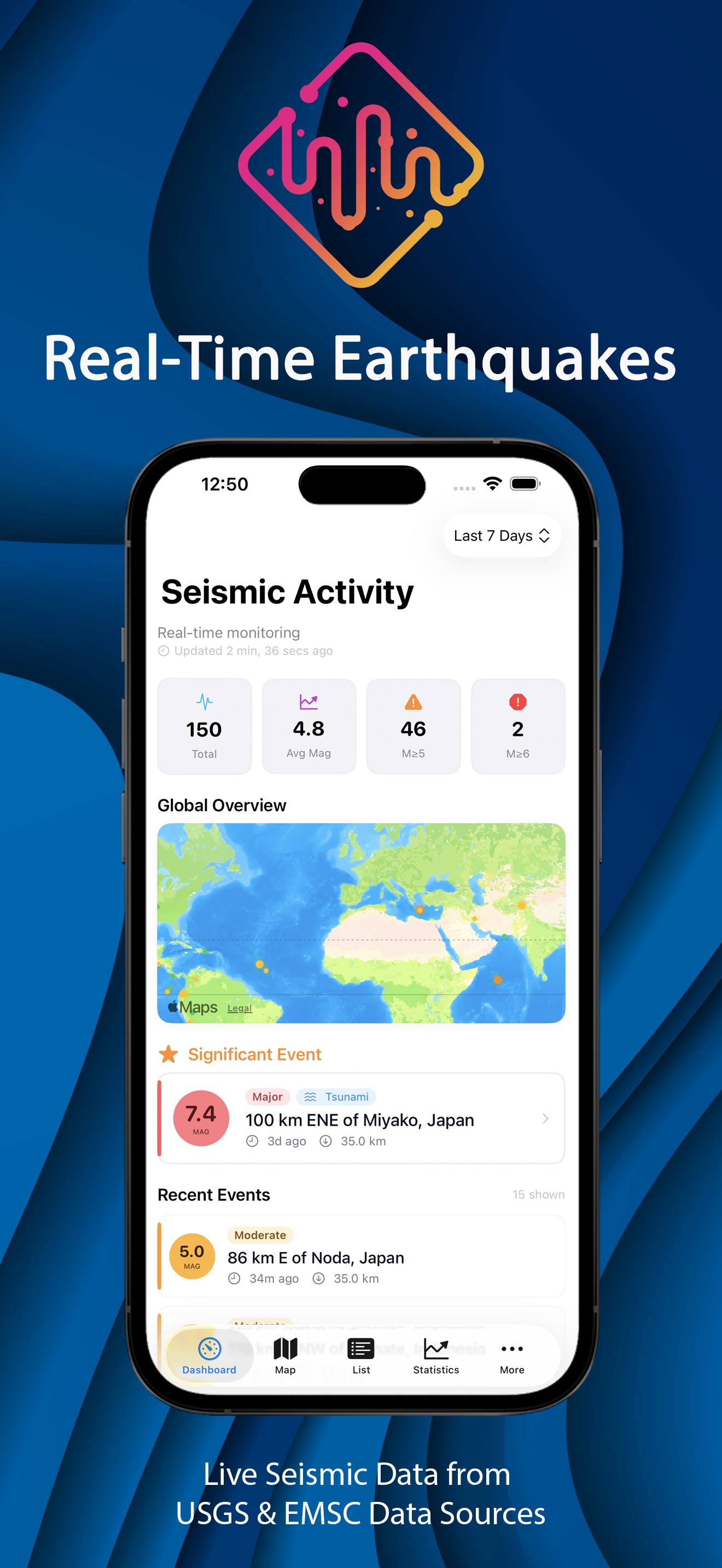
The gaps above are the reason a monitoring app exists alongside official alerts rather than instead of them. Public seismic networks - USGS, EMSC and their regional equivalents - publish events within a couple of minutes, worldwide, with no magnitude floor.
That gets you three things the government channel does not offer:
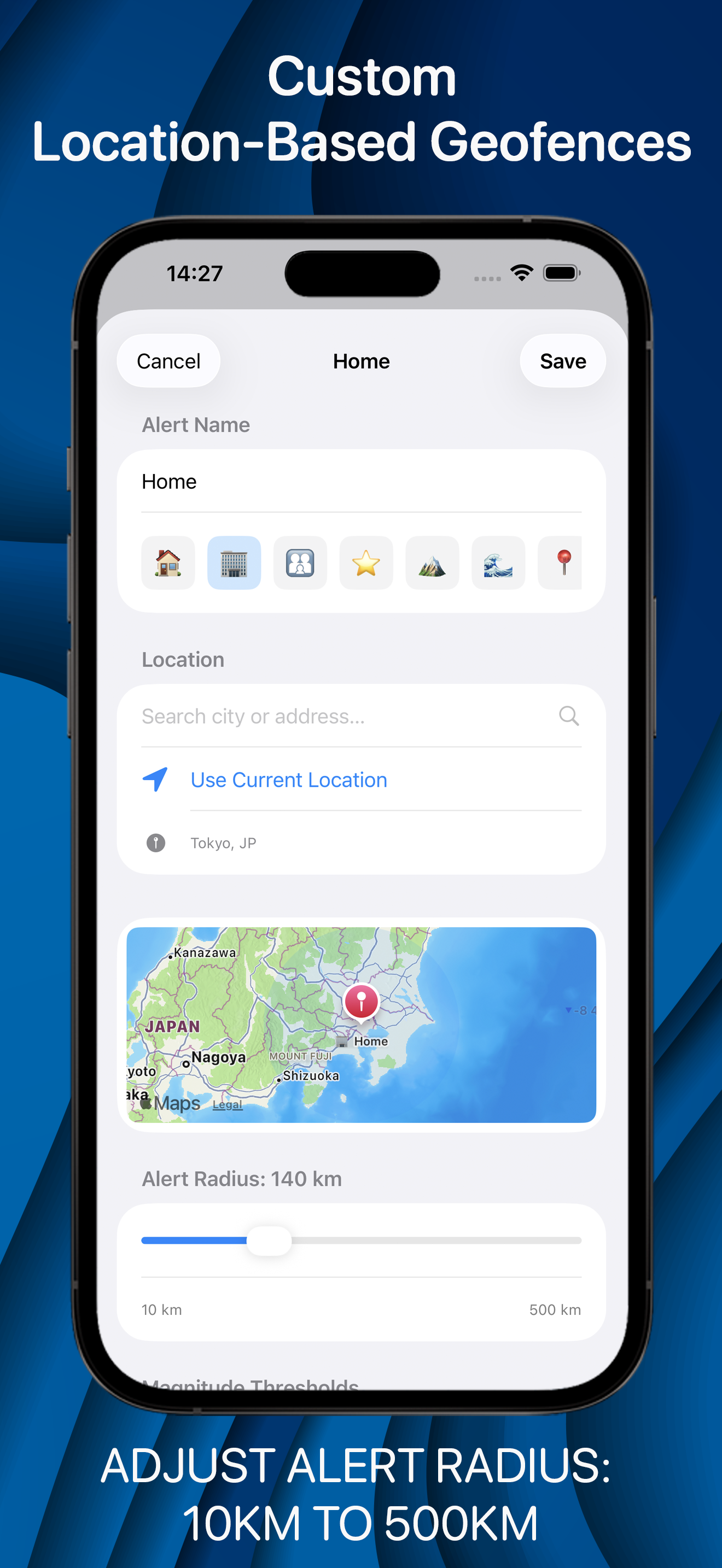
- Regions you choose. Alert on anything above magnitude 4 within 200 km of a specific city, whether or not you are there.
- Thresholds you set. Including small events, which matter if you are near a fault and want to know about swarms.
- Context. Depth, distance and what else has happened nearby recently - the information that turns "was that an earthquake?" into an answer.
Earthquake Monitor reads those public feeds and lets you set the thresholds and regions yourself.
Reading what you get
Two numbers do most of the work, and one of them is routinely misread.
Magnitude is logarithmic. Each whole step is roughly 32 times more energy. A magnitude 6 is not marginally worse than a 5 - it is a different category of event.
Depth matters as much as magnitude. A shallow magnitude 5 at 10 km does more at the surface than a magnitude 6 at 200 km. When two events sound similar and felt entirely different, depth is usually why.
We went further into the scale itself in what the Richter scale actually measures, including why modern reporting no longer uses it.
A setup worth having
- Confirm Government Alerts are on, at the bottom of Notification settings.
- Add a monitoring app for events below the official threshold and for regions you care about but do not live in.
- Set one alert for where you live at a low magnitude, and one for family locations at a higher one.
- Decide in advance what you do when an early warning fires. Seconds are not enough time to make a plan.
That last point is the one that matters most and costs nothing. Early warning gives you the time to act on a decision already made, and no time at all to reach one.