The Earth turns once in roughly twenty-four hours, so the whole zodiac passes the eastern horizon in that time. Three hundred and sixty degrees in about 1,440 minutes works out at a degree every four minutes, and a new sign rising roughly every two hours.
That single ratio explains most of the confusion people have about their own charts.
What each size of error costs
- A minute or two. Nothing you would notice. The Ascendant shifts by a fraction of a degree.
- Ten minutes. About two and a half degrees. Usually harmless, unless the Ascendant already sits near the edge of a sign or a planet sits right on a cusp.
- Half an hour. Seven or eight degrees. House cusps move enough that a planet near one can change house, and the Moon has moved perceptibly.
- An hour. Fifteen degrees or so, and a coin flip on whether your rising sign is still the same sign. Most house placements are now in question.
- Unknown. Signs survive. Houses, angles and the Moon's exact degree do not.
Notice what is not on that list: the Sun. It moves about one degree a day, so even being a few hours out rarely changes anything about it. This is why sun-sign astrology works fine with no time at all, and also why it is the thinnest slice of a chart.
Remembered times are worse than people think
Ask a room full of people for their birth time and the answers cluster on the hour and the half hour. Births do not. What you are seeing is memory rounding, one layer of it at least - somebody glanced at a clock, told somebody else later, and the number got tidied on the way.
"Just after midnight" is a particularly expensive phrase, because it may also mean the date is wrong.
The birth certificate is better, though not universally. Some countries record the time as a matter of course; others do not record it at all. Hospital records sometimes carry it when the certificate does not. If two sources disagree, prefer the one written closest to the event.
Do not adjust the time yourself
This is the mistake that produces the most confidently wrong charts. Someone knows their country was on summer time that month, subtracts an hour before typing it in, and hands the app a time that was never on any clock.
Enter what was written down. A chart calculator worth using resolves the offset that was legally in force at that place on that date - including daylight saving, including the years several countries sat on a permanent wartime offset, including the periods when neighbouring towns were on different times.
A birth in Britain in the summer of 1943 is the standard example: the country was on Double Summer Time, two hours ahead of GMT. An app that assumes today's rules puts that chart two hours out. An app that resolves the historical rule gets it right and needs no help from you.
When you genuinely do not know
You have three honest options.
Use noon and say so. A noon chart gives correct sign placements for everything except, sometimes, the Moon. It is fine for reading planets by sign. It is not a basis for anything involving houses, and the Ascendant it shows is meaningless. The failure mode is forgetting the caveat six months later.
Rectify. Work backwards from events you can date - a move, a marriage, a bereavement, the month a career turned - and test candidate times to see which put the angles where your own history would expect them. It takes patience and it produces a range rather than a minute, but it is a real method rather than a guess.
Read the chart without houses. Planets by sign, aspects between them, the overall balance of elements and modalities. It is less than a full chart but every part of it is true, which is more than can be said for a house placement built on a time somebody rounded to the hour in 1978.
The one check worth doing
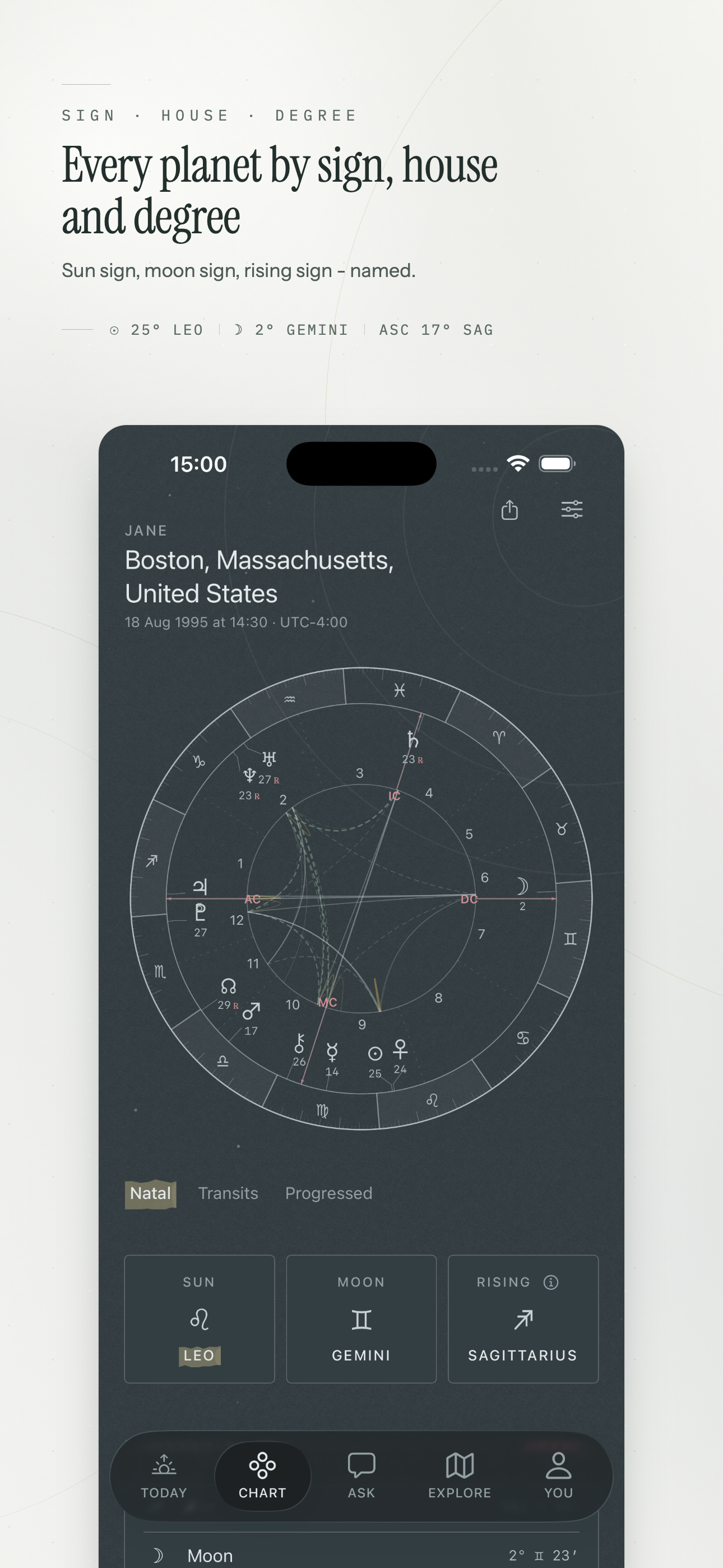
Cast the chart and look at the Ascendant degree. If it sits at 28 degrees of something, or at 2 degrees, you are close to a boundary and the exact minute is carrying more weight than usual. That is the moment to go and find the certificate rather than trust the family story.
If it sits comfortably mid-sign, a few minutes either way changes nothing, and you can stop worrying about it.