Ask most people what a birth chart is and you get an answer about meaning. Ask what a birth chart is, mechanically, and it turns out to be a snapshot of where a handful of solar system bodies were, seen from one point on the Earth's surface, at one instant. That snapshot has a correct answer. The reading laid on top of it does not, and it helps enormously to keep the two apart.
Step one: turn the birth moment into a single number
Everything downstream needs one unambiguous instant. Local clock time is not that. It depends on the time zone in force at that place on that date, which is a legal fact and a surprisingly messy one - offsets have changed, daylight saving has been introduced and abandoned, and several countries have spent years on a wartime clock.
So the first job is converting the recorded local time to Universal Time, then to a Julian Date: a continuous count of days that has no months, no leap years and no time zones in it. From that point on, the calendar has stopped being a problem.
This is also where most wrong charts are born. If the conversion applies the wrong offset, everything after it is consistent, confident and an hour out.
Step two: find the planets
Given the instant, where was each body? There are two ways to answer.
The cheap way is a lookup table - positions computed in advance at intervals, with interpolation between them. It is fast, it is small, and it is fine to a degree or so, which is why plenty of apps do it.
The other way is to evaluate an analytical theory of motion. VSOP87 describes the planets as long sums of periodic terms, derived from the gravitational interactions of the solar system; ELP2000 does the same job for the Moon, which needs far more terms because its orbit is perturbed by both the Earth and the Sun. Modern implementations correct these against JPL's numerical ephemerides - DE440 being the current reference - which brings the error below an arcsecond across several centuries either side of now.
An arcsecond is one 3,600th of a degree. A chart wheel cannot draw it and no interpretation depends on it. The reason accuracy at that level matters is different: it means the error contributed by the ephemeris is nowhere near the error contributed by anything else, so if a chart is wrong, you know where to look.
Step three: work out which part of the sky was rising
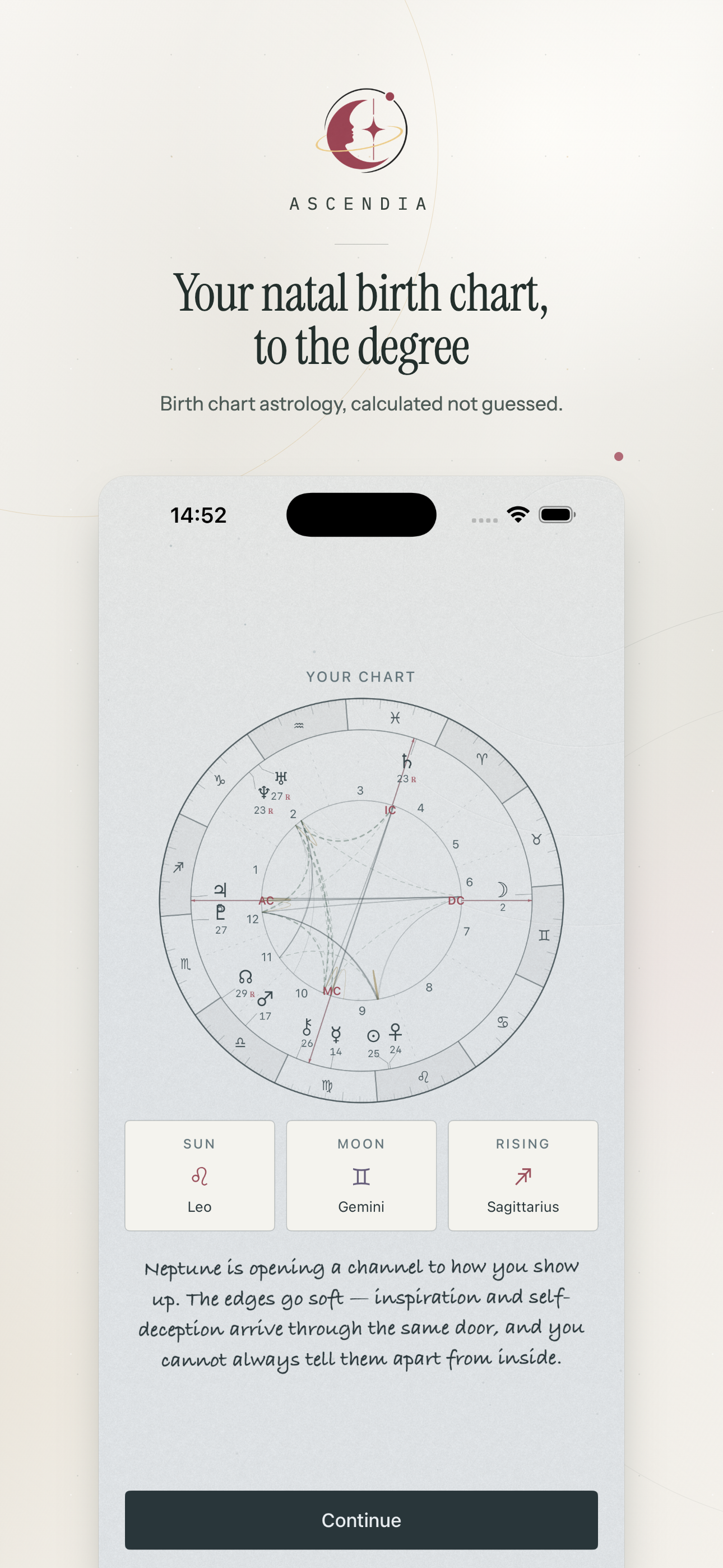
The planets are now placed against the zodiac. That is a sky-wide fact and identical for everyone alive at that moment. What makes the chart yours is the second half: the orientation of that sky relative to the horizon where you were born.
That comes from local sidereal time - the Earth's rotation measured against the stars rather than against the Sun, which is why a sidereal day runs about four minutes short of a solar one. Combine sidereal time with the geographic longitude and you know which degree of the ecliptic was on the meridian: the Midheaven.
The Ascendant needs one more ingredient, latitude, because the angle at which the ecliptic meets the horizon depends on how far north or south you are. This is the reason the Ascendant races through the signs at some latitudes and crawls at others, and the reason two people born the same minute in different cities have different charts.
Step four: divide the sky into houses
Here the arithmetic stops being uncontroversial. Everything up to this point has one right answer. House division has several, because the question - how do you cut a sphere into twelve pieces anchored to the horizon - can be answered in more than one defensible way.
- Whole Sign gives each house one entire sign, starting with the sign of the Ascendant. No trigonometry at all.
- Equal takes the exact Ascendant degree and steps thirty degrees at a time from there.
- Porphyry takes the four angles and trisects each quadrant along the ecliptic.
- Placidus divides the time a degree takes to travel from horizon to meridian, which is why its houses come out unequal.
- Koch, Campanus and Regiomontanus each pick a different great circle to divide, producing different cusps again.
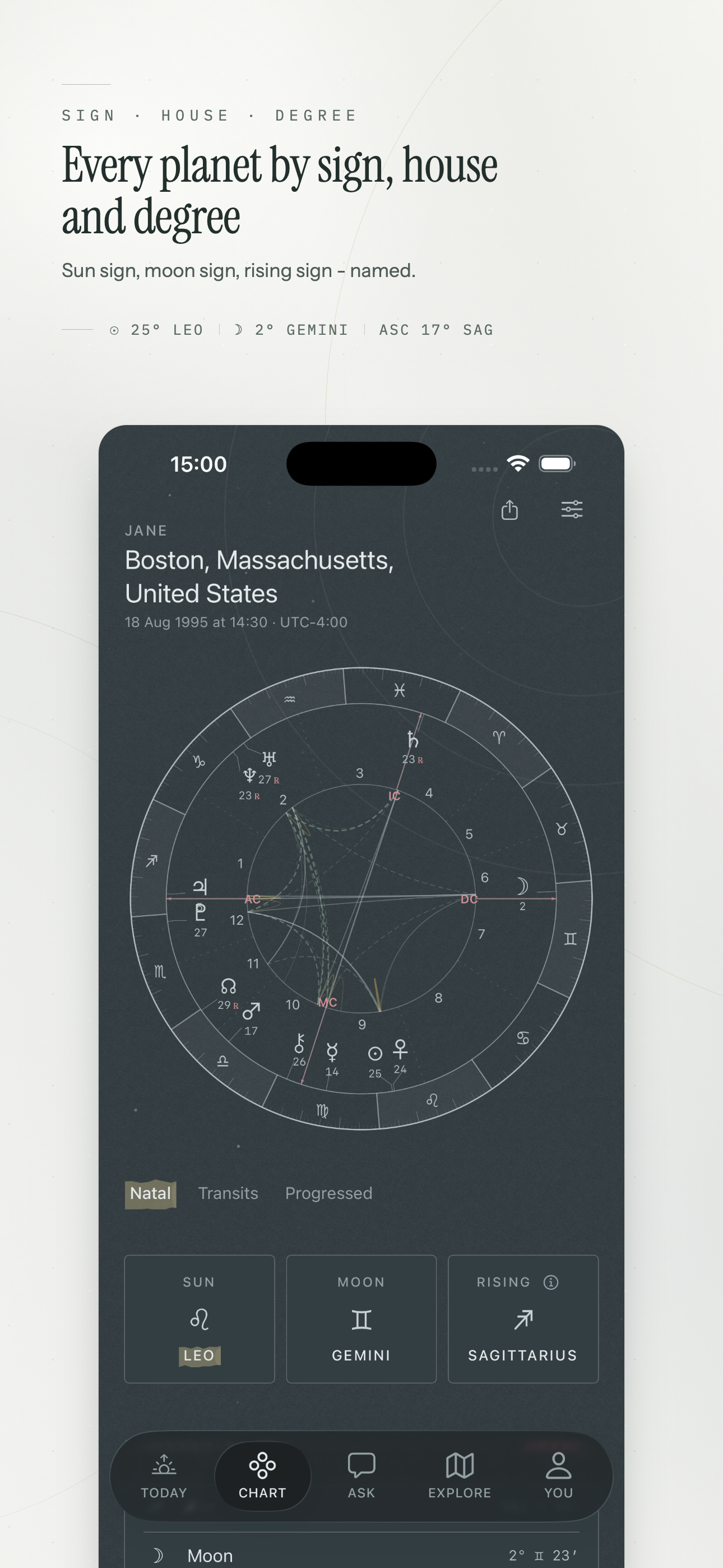
The practical consequence is that a planet near a cusp can sit in the eleventh house under one system and the twelfth under another. That is not a bug in any of them. It is what happens when a real disagreement gets rendered as a picture, and it is the strongest argument for using an app that lets you switch and watch.
Step five: measure the angles between things
Aspects are the easiest part: subtract one longitude from another and see how close the result lands to 0, 60, 90, 120 or 180 degrees. The distance from exact is the orb.
What is not arithmetic is how much orb to allow. Three degrees, eight degrees, more for the Sun and Moon than for Pluto - these are conventions, and they vary between traditions. An app that shows you the actual orb rather than a tidy label is handing you the number so you can apply your own judgement to it.
What this tells you about the app you are using
Four questions separate a calculator from a decoration:
- Does it resolve historical time zones, or assume today's rules applied in 1943?
- Does it ask for a town, or only a country?
- Does it give the angles to the arc minute, or round to the degree?
- Does it let you change house system and see what moves?
An app that gets all four right can still be wrong about what a placement means - that part was always going to be interpretation. But at least the thing being interpreted is real.
One more test that costs nothing: turn off the network and cast a chart. If it still works, the ephemeris is on the device, and your birth date, exact time and place were never sent anywhere. Those three facts together are most of what an identity check asks for, which makes it a reasonable thing to check before typing them in.