Here is the problem, stated plainly. You have a sphere, an observer somewhere on it, and a requirement to cut the sky into twelve regions anchored to that observer's horizon. There is more than one reasonable way to make the cut, and different traditions made different ones.
The result is that two competent astrologers, given the same accurate birth data, can put your Mercury in different houses and both be following their method correctly.
What each system divides
Whole Sign. The sign containing the Ascendant becomes the first house in its entirety, and each following sign is the next house. There is no trigonometry. It is the oldest approach in the Hellenistic material and it has come back into wide use over the last few decades.
Equal. Take the exact Ascendant degree and count thirty degrees at a time. Houses are equal in size but offset from the sign boundaries, so a house typically straddles two signs.
Porphyry. Take the four angles as fixed, then trisect each quadrant of the ecliptic between them. Simple, and the quadrants are respected.
Placidus. Divides time rather than space: each cusp marks how far a degree has travelled, in time, from the horizon towards the meridian. It produces unequal houses that vary with latitude, and it is what most twentieth-century Western material assumes.
Koch. Another time-based method with a different reference, giving cusps that differ from Placidus by a few degrees in the middle latitudes and diverge sharply further north.
Campanus and Regiomontanus. Both divide a great circle in space - the prime vertical for Campanus, the celestial equator for Regiomontanus - then project onto the ecliptic. Regiomontanus is the system most traditional horary work uses.
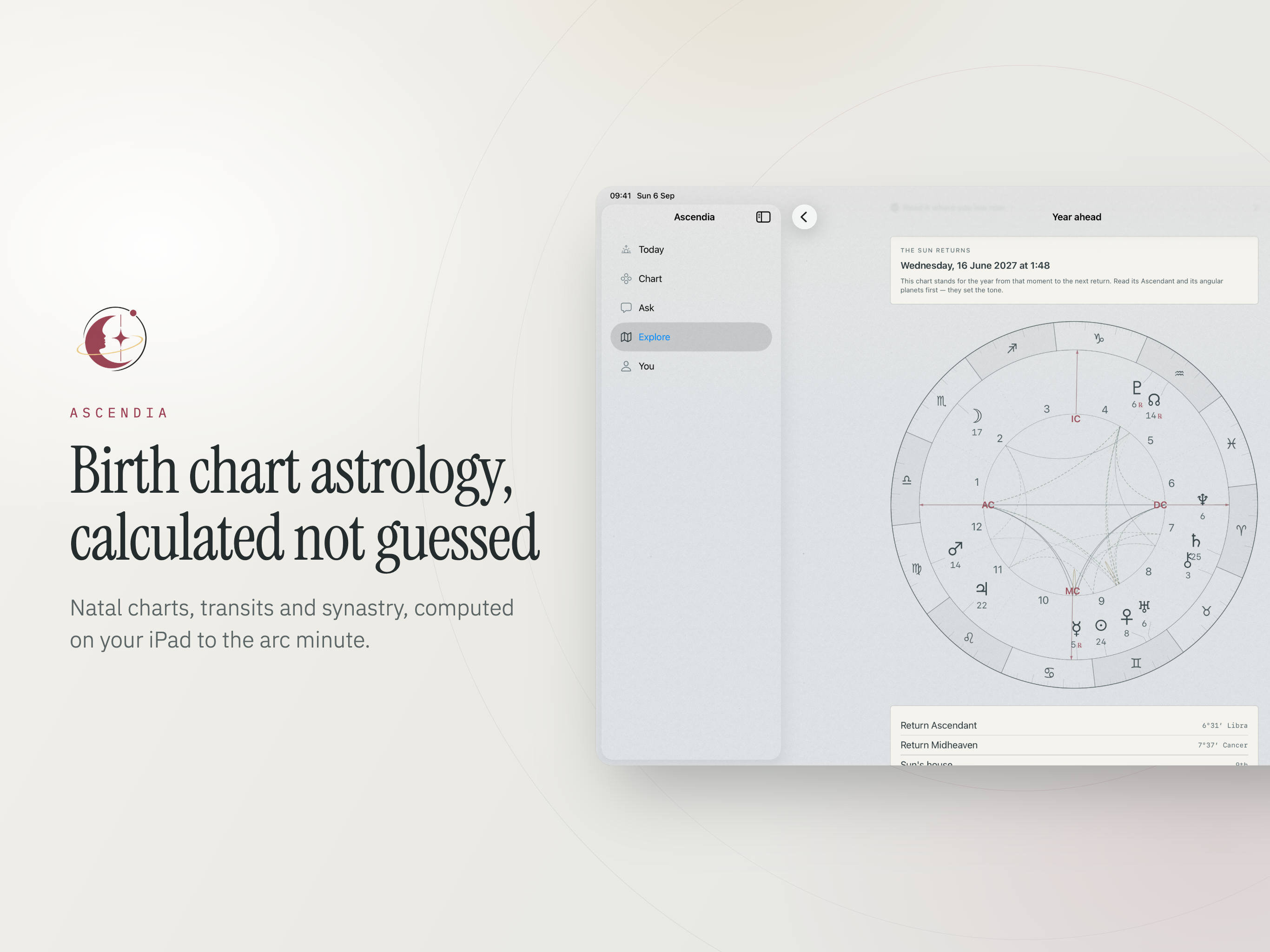
Where the systems break
Above roughly 66 degrees of latitude, the time-based systems run into a physical problem: within the Arctic and Antarctic circles, the Sun may not cross the horizon at all on the day in question. A method that divides the journey from horizon to meridian has nothing to divide.
In practice this means Placidus and Koch produce houses of absurd size, or fail to produce them, for births in northern Scandinavia, Alaska, northern Russia and Iceland. It is not an implementation flaw - the definition genuinely does not extend there.
Whole Sign, Equal and Porphyry keep working at any latitude, because none of them depends on the diurnal arc. If you are casting a chart for a birth far north, that is a practical reason to prefer them rather than a philosophical one.
How to find out whether it matters for your chart
Do this once and you will never have to read another argument about it.
- Cast your chart in Placidus and write down which house each personal planet is in.
- Switch to Whole Sign. Note what moved.
- Switch to Koch, then Equal. Note it again.
- Anything that stayed in the same house across all four is solid. Read it with confidence.
- Anything that jumped is cusp-adjacent. Read it tentatively, and say so out loud if you are reading for somebody else.
For a lot of charts the answer is that two or three placements move and the rest do not. That is a much more useful thing to know than a general opinion about which system is correct.
Why planets near cusps move
Because that is what a cusp is: a boundary whose position depends on the method. A planet at 3 degrees into a house under one system may sit at 27 degrees of the previous house under another, and the interpretation flips from one life area to a different one.
The tempting response is to declare the planet "on the cusp" and read it as both. That is usually a way of avoiding the question. The more honest response is to notice that your birth time carries an error bar too, and that between the two uncertainties the placement simply is not settled.
So which should you use?
If you learned from modern Western books, Placidus is what they assumed, and using anything else will make their examples stop matching. If you are reading Hellenistic or traditional material, Whole Sign is what it assumed. If your chart is from a high latitude, use one that works there.
Beyond that: pick one, use it consistently for long enough to build intuition, and check the others when a placement sits near a boundary. Switching systems every time a reading is unflattering is not method, it is shopping.