The logic is straightforward. Planets by sign barely move over a day, so they are known regardless. The Ascendant and Midheaven sweep through the whole zodiac in twenty-four hours, so they are entirely unknown. But those angles are also what the fastest-moving predictive techniques key off - which means that if you know when things happened, you can ask which birth times would have put the angles in the right place.
You are solving for one unknown using several equations. The catch is that the equations are astrological, so the whole exercise only works if you are ruthless about the inputs.
Gather events, not feelings
Usable events share three properties: you can date them to the day, they were externally visible, and you did not choose them because they suit a chart you already like.
Good candidates: a house move with a contract date, a marriage, a divorce filing, a bereavement, the day a job started or ended, a hospital admission, the birth of a child, an accident.
Poor candidates: the year you "started to change", a period of feeling stuck, a gradual realisation. Not because those are unimportant, but because they have no date, and a method that accepts undated events will confirm anything.
Six to ten well-dated events is a working set. Fewer than four and you are curve-fitting.
Hold some events back
This is the step that separates a rectification you can trust from one you cannot, and it costs nothing.
Split your events into two piles. Use the first to narrow the window. Then test the surviving candidate times against the second pile, which played no part in producing them. If the candidates still hold up, you have something. If they fall apart, you fitted noise.
Anyone who has done statistics will recognise this as holding back a test set, and the reason is the same: a model evaluated on the data that produced it always looks good.
Work coarse to fine
Start with the whole day if you have to. Most people can do better - "during the night", "some time in the afternoon", "before my father left for work". Even a rough constraint eliminates most of the range.
Narrow to a few hours, which usually settles the rising sign. Then to a window of minutes, which settles the house cusps. Do not begin at the minute level; you will find a beautiful answer inside a range that was wrong to start with.
Sanity checks that cost nothing
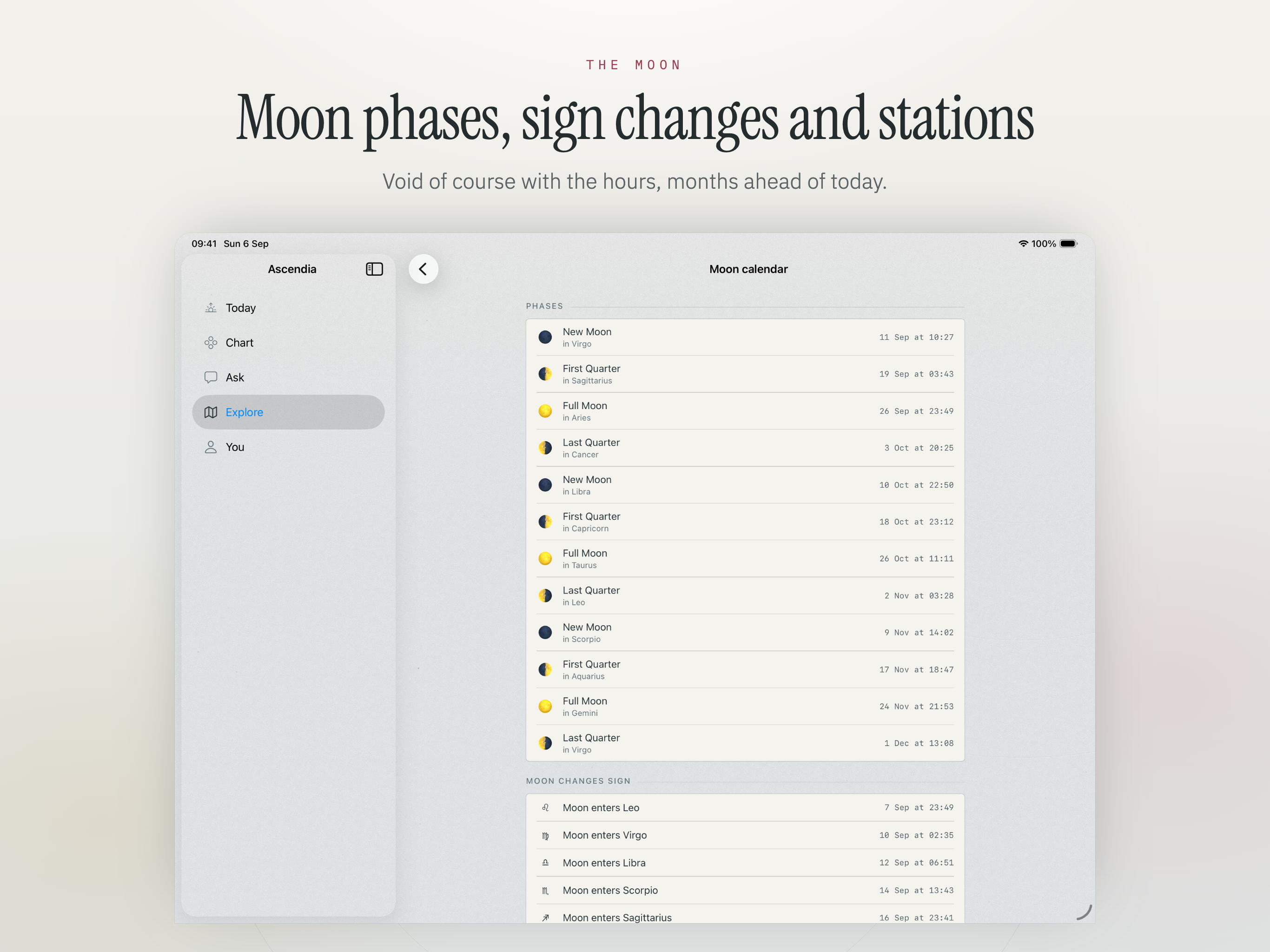
- Does the Moon's sign match? The Moon changes sign every two and a half days, so on some birth dates a wide time window straddles a boundary. If you have a strong sense of the Moon placement, that alone can halve the range.
- Does the rising sign survive the whole candidate window? If not, you are choosing between two quite different charts and should say so.
- Do the candidates cluster? Several near-identical times surviving independently is a good sign. Candidates scattered across the day mean the events are not constraining much.
The failure mode worth naming
Rectification is unusually good at telling people what they want to hear, because the search space is large and the interpretive vocabulary is flexible. Somewhere in twenty-four hours there is a chart that flatters almost anybody.
Three habits keep it honest. Write down the criteria before you look at results. Keep the held-back events genuinely held back. And notice when you are reaching - if a fit requires an unusual technique you would not normally use, it is probably the technique doing the work rather than the time.
Stop at a range
The output of an honest rectification is a window, not a minute. "Between 14:10 and 14:40, most likely near 14:20" is an answer. "14:23" implies a precision the method does not have.
Record it as a hypothesis and label it. If you read for other people, say which parts of the reading depend on the rectified angles and which would hold at any time that day. Someone who knows an Ascendant is inferred can weigh it appropriately. Someone who was told it as a fact cannot.