When does a vehicle flip backwards?
A vehicle on a slope stays on its wheels as long as its centre of gravity - the balance point of all its weight - sits somewhere between its wheels. On a steep climb the whole vehicle tilts back, and the centre of gravity moves towards the rear axle. Accelerate hard and the weight shifts back further still. Once the centre of gravity passes behind the point where the rear wheels touch the ground, nothing stops the vehicle rotating over.
Two things therefore decide how steep a vehicle can climb before it loops: how long it is between the wheels, and how high its weight sits.
The truck: long and planted
A pickup has a long wheelbase, so its centre of gravity has a long way to travel before it gets behind the rear axle. Its weight also presses the tyres into the ground, which gives grip. The cost is power to weight: there is a lot of truck to haul uphill, so it climbs slowly and steadily - like a tractor - and burns more fuel doing it.
The dirt bike: light and lively
A motorcycle has a very short wheelbase and, with a rider on board, a fairly high centre of gravity. That makes it easy to lift the front wheel - great for wheelies, dangerous on a steep climb. Its huge power-to-weight ratio means it accelerates and flies, but a little too much throttle loops it over.
Real hillclimb riders deal with this by leaning far forward over the bars, and in competition by fitting long extended swingarms that move the rear wheel back - effectively lengthening the wheelbase.
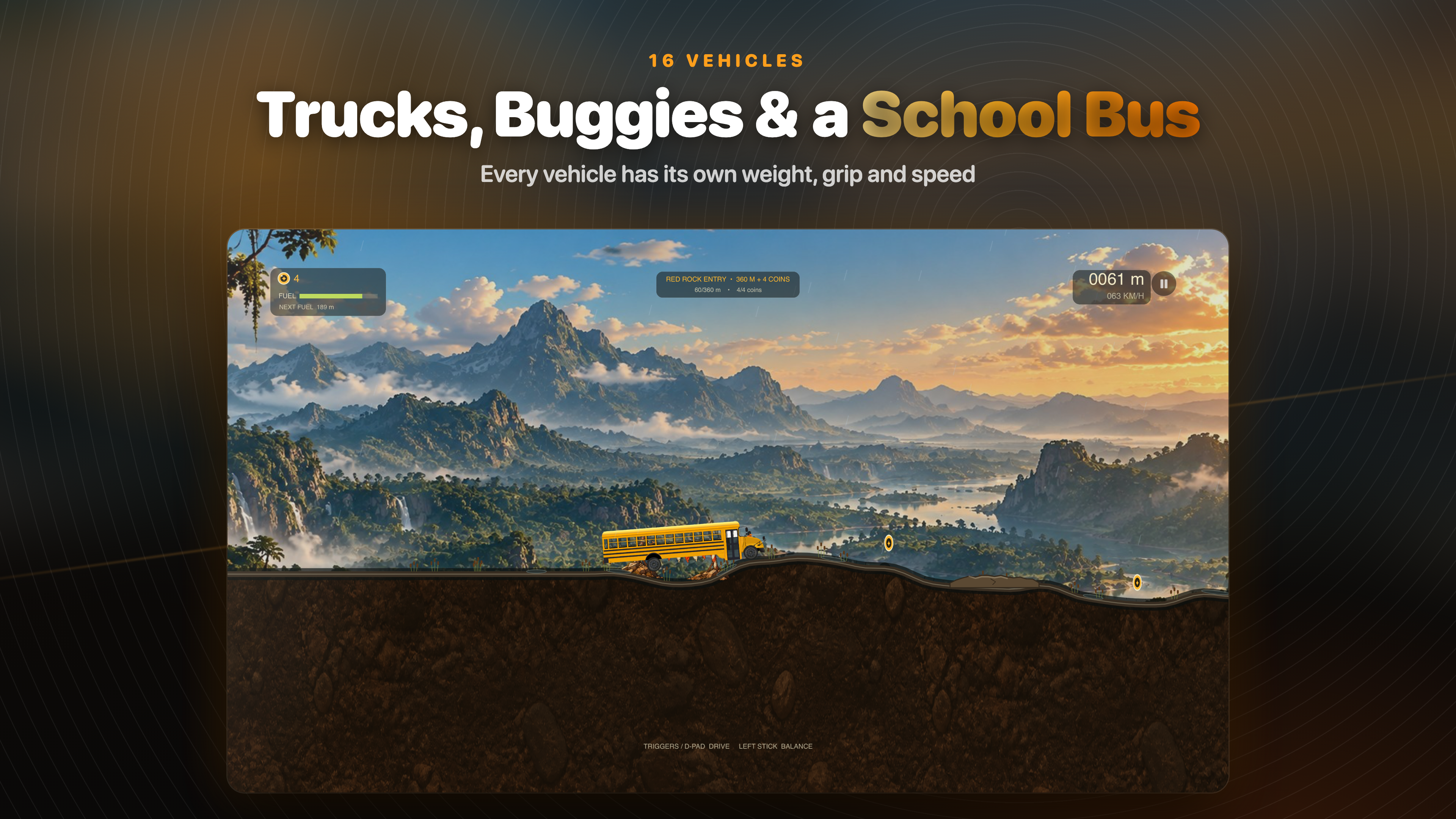
The bus: a challenge of its own
A bus has a long wheelbase, which helps, but a tall body and a high centre of gravity, which does not - and long overhangs at the front and back that scrape on crests and dips. It is slow to get moving and slow to stop. Getting one over a rocky crest is a test of patience.
Grip and suspension
- Grip decides whether the power reaches the ground. Without it, the wheels spin and the vehicle slides back down.
- Suspension keeps the tyres in contact over bumps. Stiff and you bounce off rocks; soft and the vehicle wallows and pitches.
- Weight helps grip but costs acceleration and fuel.
Choosing for the route
Steep rock shelves and long climbs suit long, heavy vehicles. Routes full of jumps and ravines suit light ones that can carry speed. In Dirt Climb, each of the 16 vehicles - from a lifted 4x4 pickup and a dune buggy to a school bus and eight motorcycles - has its own weight, grip, speed, suspension and fuel economy, so the same hill really does drive differently. Handling tips are in hill-climb driving tips.