Why full throttle flips you
When a vehicle accelerates, its weight shifts backwards onto the rear wheels. On flat ground that is just a feeling of being pushed into the seat. On a steep slope the vehicle is already tilted back, and adding hard acceleration shifts even more weight to the rear - until the front wheels lift and the whole thing rotates over its back axle.
That is why the most important skill in a hill-climb game is lifting off the gas. The gas pedal does two jobs: it moves you forward, and it rotates you backwards. On a steep climb, the second job wins.
Read the crest before you reach it
Crests are where most runs end. You arrive fast, the ground drops away, and the vehicle leaves the slope with its nose pointing at the sky. Three habits help:
- Ease off before the top, not at the top. By the time the nose is up, it is too late.
- Lean forward on the steepest part of the climb to keep the front wheels on the ground.
- Arrive at the crest slower than feels necessary. You almost always have more speed than you need.
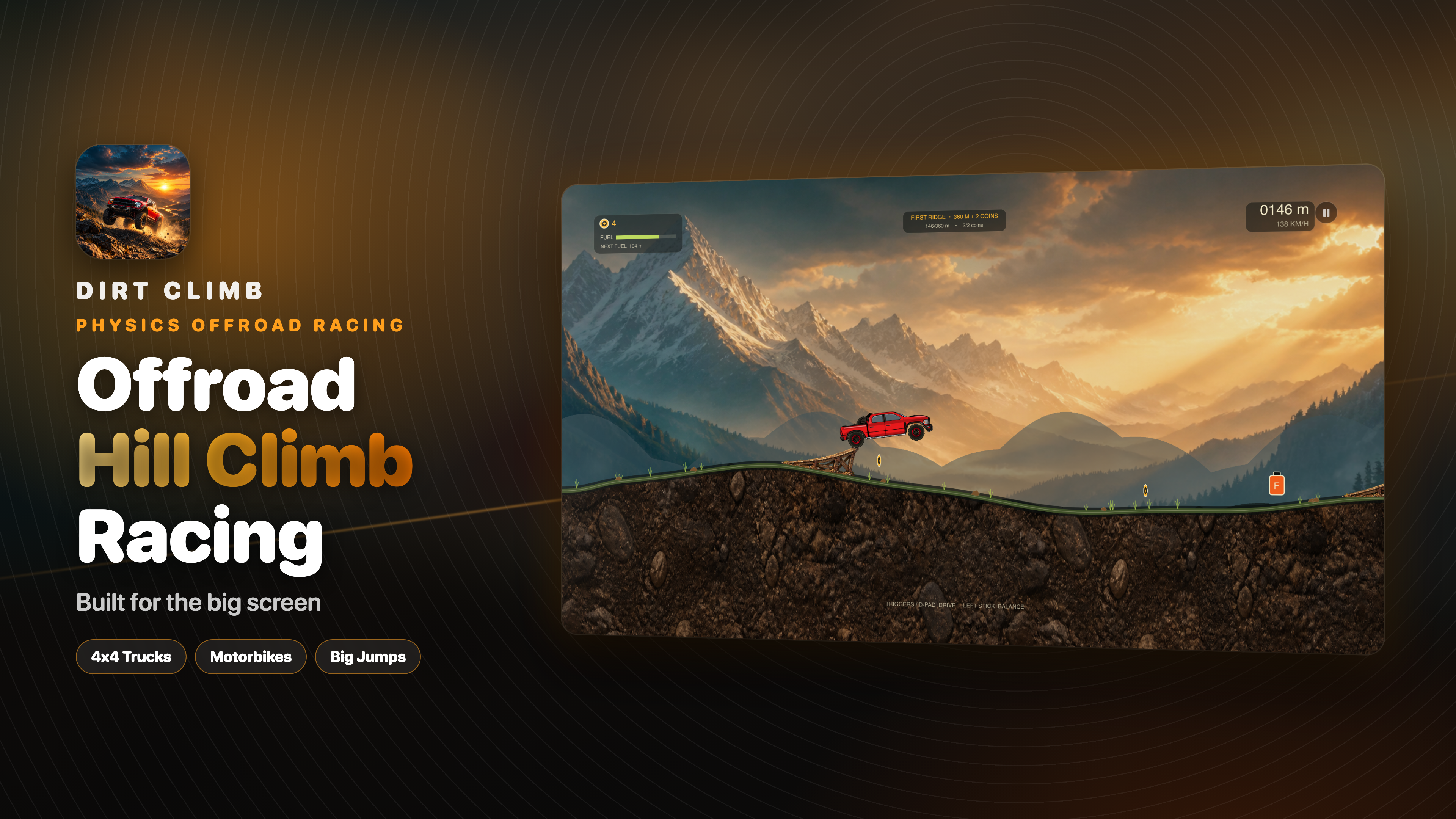
Use the lean
In the air, leaning is your only control, and it decides whether you land on your wheels or your roof. On the ground it matters too: leaning forward on a climb loads the front wheels, leaning back on a descent stops you going over the handlebars. Treat it as a second steering wheel, not an emergency button.
Landing is a skill of its own - see how to land a jump.
Momentum is free, fuel is not
Every bit of speed you carry into a climb is speed you do not have to make with the engine. Use the downhill before a hill to build momentum, keep the throttle steady through dips, and avoid stopping on a slope: getting moving again uphill costs far more than keeping going. The same idea is why a steady pace stretches a tank - more in throttle and fuel on a climb.
Pick the vehicle for the route
Heavy, long vehicles resist tipping over backwards and grip well on climbs. Light ones accelerate and fly further but are easy to overrotate. A route full of steep rock shelves suits a truck; a route full of jumps suits something light. Why they behave so differently is in truck vs dirt bike on a steep hill.
Practise short, not long
The fastest way to improve is to replay the same short section until the crest that keeps catching you stops catching you. A run that ends early is not wasted if you learned where to lift off.
All of this applies directly in Dirt Climb, a physics hill-climbing game for Apple TV: forward, back and lean are the only controls, and 16 vehicles each handle the same hill differently.