The format
A hill climb is simple. A road or track runs up a hill. Competitors start one at a time from the bottom, and the fastest time to the top wins. There is no wheel-to-wheel racing and no overtaking - just you, the hill and the clock.
That simplicity is why it appeared so early. In the first years of the motor car, a steep hill was the most obvious test of what an engine could do, and manufacturers were eager to prove theirs could climb it.
Shelsley Walsh, 1905
In 1905 the Midland Automobile Club held a hill climb on a private road at Shelsley Walsh in Worcestershire, England - a short, steep course of about 1,000 yards. It is still held there today, which makes it one of the oldest motorsport events in the world still run on its original course.
Pikes Peak, the Race to the Clouds, 1916
The most famous hill climb of all began in 1916 on Pikes Peak in Colorado. The course climbs about 12.4 miles and 156 turns to a finish at 14,115 feet, where the thin air takes a large share of an engine's power. For most of its history much of the road was gravel; it has been fully paved since 2011.
Its nickname, the Race to the Clouds, is literal: drivers often climb through cloud. The current outright record, just under eight minutes, was set in 2018 by Romain Dumas in an electric Volkswagen prototype - a fitting result on a mountain where petrol engines struggle for oxygen.
Europe's mountain roads
In continental Europe, hill climbs grew up on closed mountain roads, and the FIA has run a European Hill Climb Championship since 1957. Events in places like Italy, Germany, Switzerland and Slovakia draw large crowds lining the hairpins.
Motorcycle hillclimbs
Motorcycles have their own, wilder tradition: riders attacking slopes so steep that simply reaching the top is the goal, with the winner judged on distance if nobody makes it. The bikes are often fitted with long extended swingarms to stop them looping over backwards - a problem explained in truck vs dirt bike on a steep hill.
From mountains to the living room
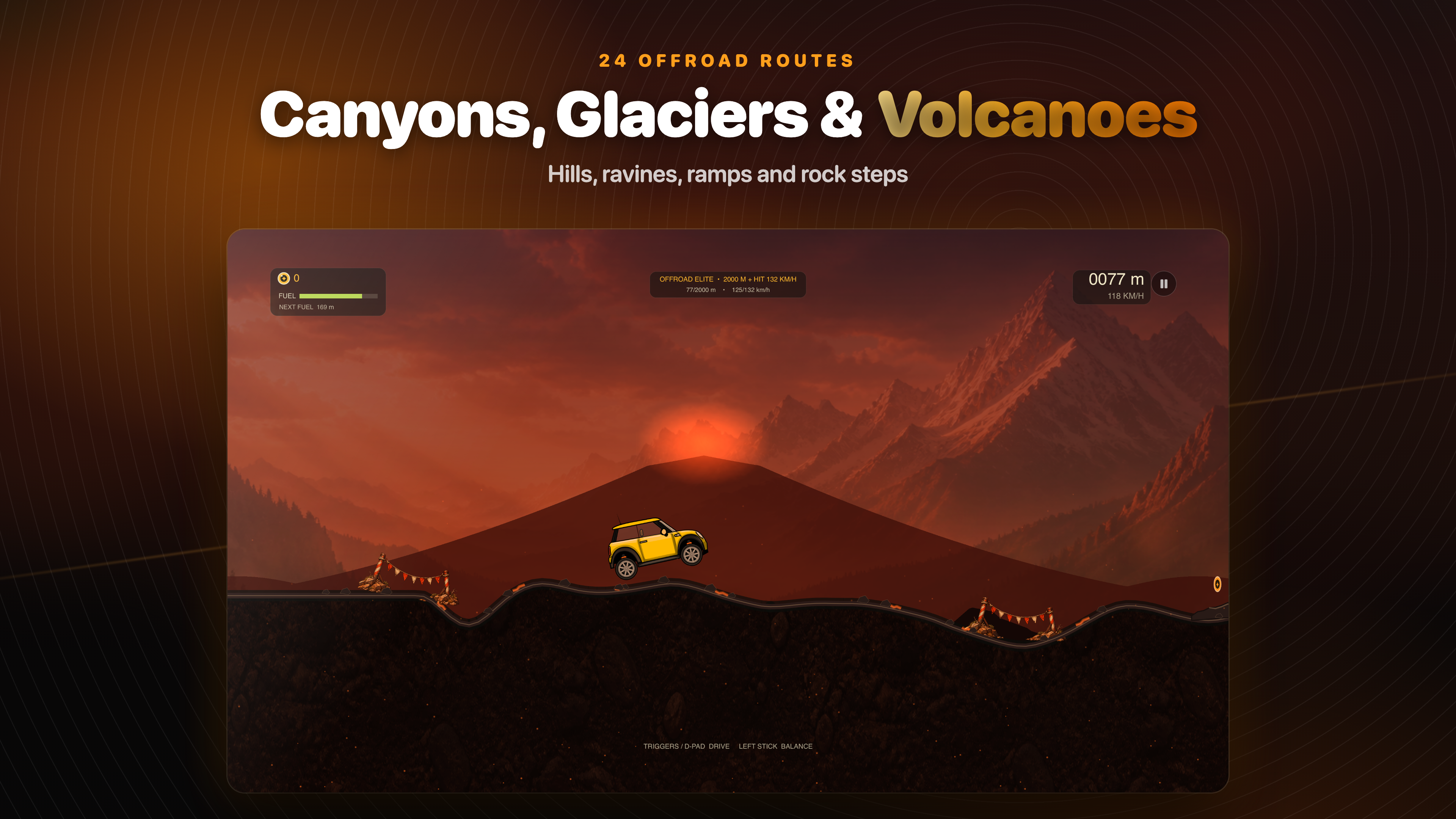
Physics-based hill-climb games borrowed the idea and kept its best part: one vehicle, one hill, and the question of how far you can get before gravity wins. Dirt Climb brings it to Apple TV with 16 vehicles, 24 routes from alpine trails and canyons to glaciers and volcanic steps, and a career of contracts that ask for distance, top speed, long jumps and fuel to spare.