Land parallel to the ground you are landing on
The single rule of landing a jump is to arrive with your wheels parallel to the slope you are landing on. Not level with the horizon - parallel to the ground under you.
When the wheels meet the slope at the same angle as the slope, the impact is spread across both wheels and turns into forward motion down the hill. Land nose-first and the front takes the whole hit and the rear kicks up; land tail-first onto a downslope and the front slams down after it. Either can end the run.
That is also why riders aim for the downslope of a landing ramp rather than the flat: landing on a slope that falls away in the direction of travel turns height into speed instead of a hard stop.
The take-off decides most of it
- Hit the ramp straight and steady. Accelerating or braking on the lip changes your rotation the moment you leave it.
- Do not arrive flat out. More speed means more height and more time to get the angle wrong.
- Watch the shape of the lip. A steep, short kicker throws the nose up; a long, gentle ramp is far more forgiving.
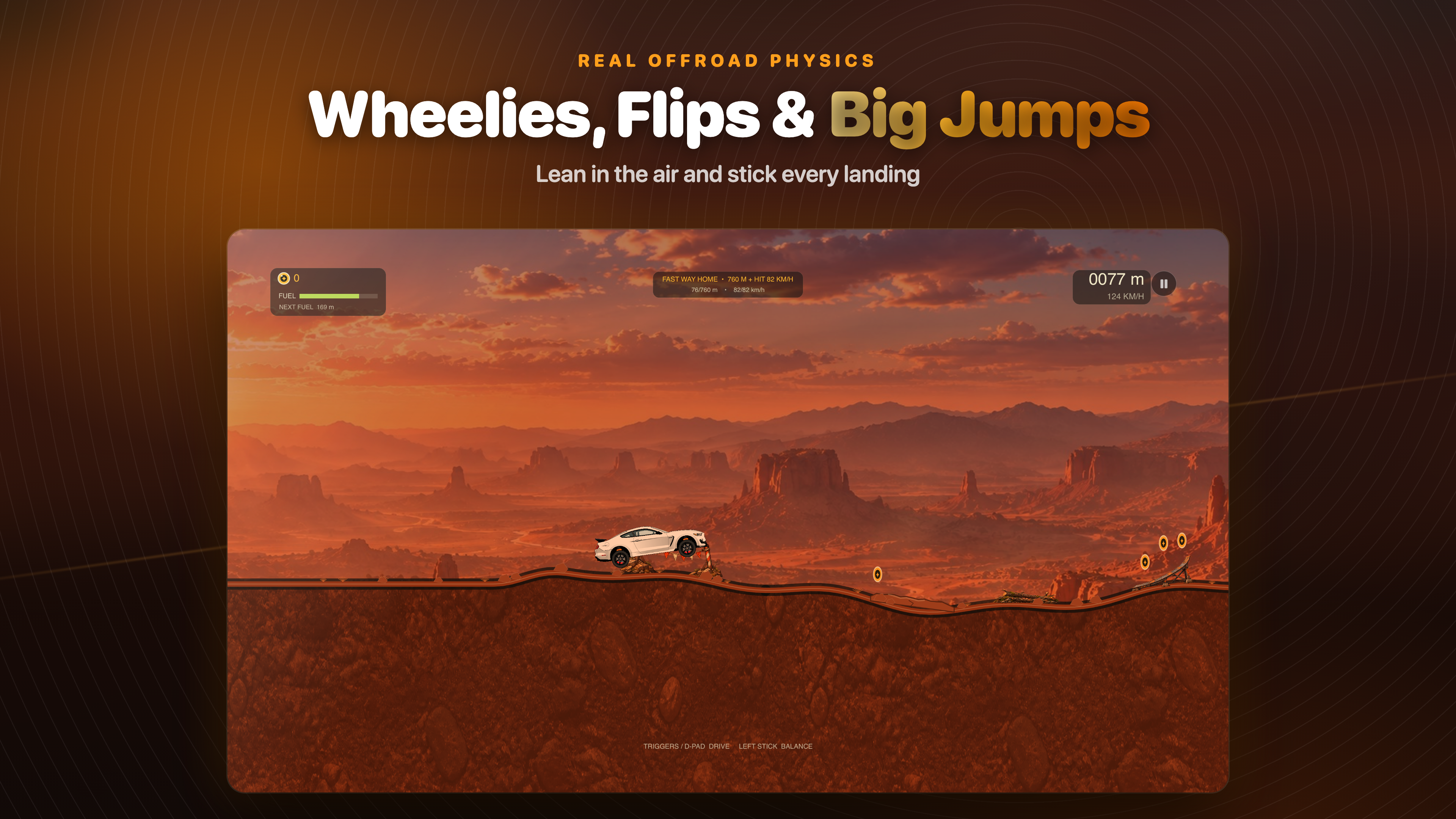
Changing your angle in the air
On a real motorcycle, riders can adjust their pitch in the air with the rear wheel. Opening the throttle speeds up the spinning rear wheel, and the bike rotates nose-up in response; tapping the rear brake slows it, and the nose drops. Riders also shift their body weight forward or back.
Hill-climb games turn that into a single control: lean. Lean back and the vehicle pitches nose-up; lean forward and it pitches nose-down. Small, early inputs work better than big late ones, because the rotation keeps going after you let go.
A routine for every jump
- Before the ramp: settle your speed.
- On the lip: hold the throttle steady.
- In the air: look at where you will land, not at the vehicle.
- Lean to match that slope, early and gently.
- Touch down with both wheels, then get back on the gas.
Practising it
In Dirt Climb, landing a long jump is one of the career contracts, and every route has its own ramps, ravines and rock shelves to fly off. Light vehicles and motorcycles fly furthest - and punish a bad landing the most. For what happens before the jump, see hill-climb driving tips.