Synastry compares two birth charts. There are three distinct things it can look at, and conflating them is the source of most of the confusion.
One: aspects between the charts
Take a planet in your chart and a planet in theirs and measure the angle between them, exactly as you would within a single chart. Their Venus trine your Mars is a contact. Their Saturn square your Sun is another.
Orbs matter here as much as anywhere. A contact within a degree is doing something; one at seven degrees is a footnote. If a compatibility tool is not showing you the orb, it is hiding the difference between a defining feature and a rounding error.
Two: house overlays
This is the part casual tools leave out, and it is often the most informative.
Drop their planets into your chart and see which of your houses they land in. Their Mars in your tenth house is a different experience from their Mars in your fourth, even though the planet has not moved. The overlay describes where in your life you encounter this person.
It is also asymmetric, which matters. Your planets in their houses is a separate picture from theirs in yours, and the two can differ sharply. One person may feel the relationship mostly at home while the other feels it mostly at work. A single compatibility number cannot represent that at all, because it has already averaged the two directions together.
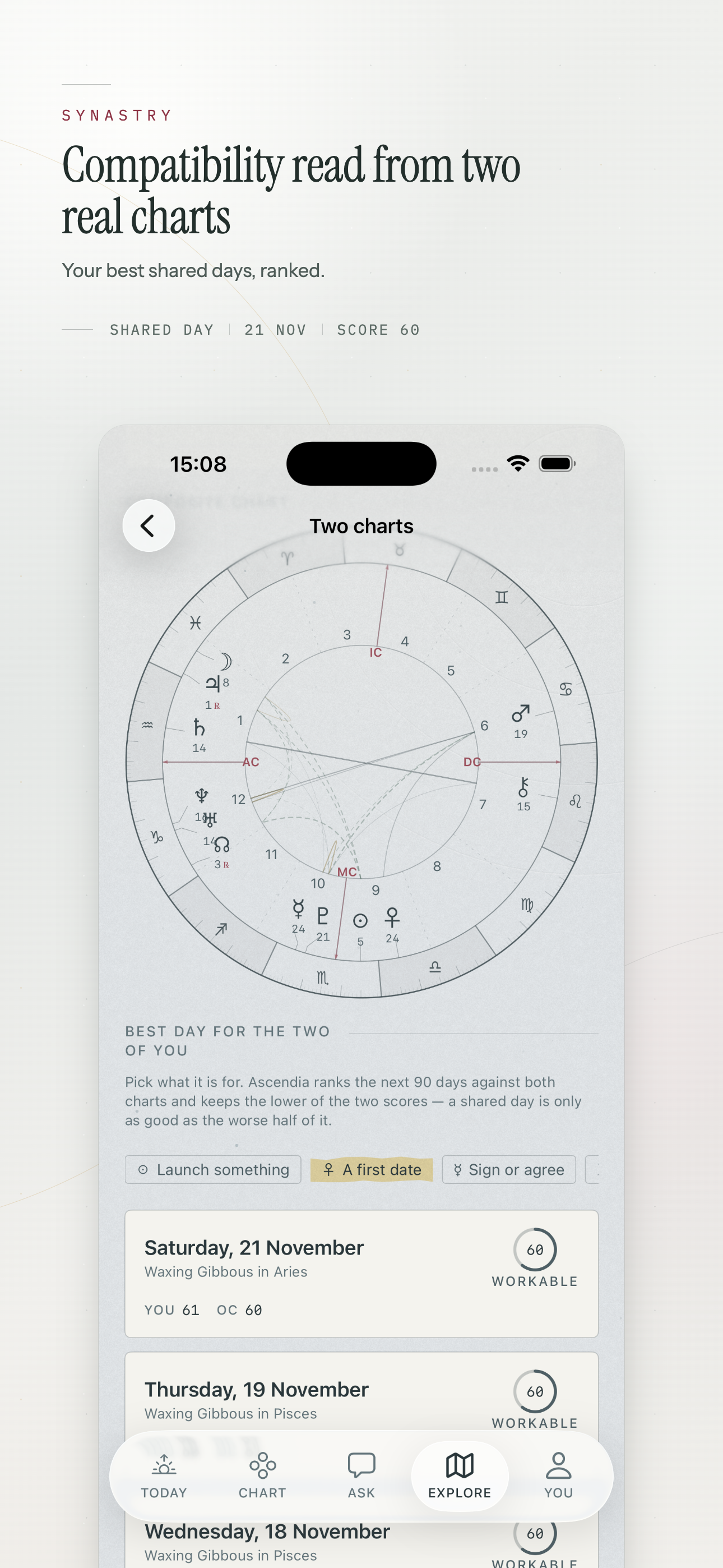
Three: the composite chart
A composite is built from midpoints - take the midpoint of the two Suns, the two Moons, and so on, and treat the result as a chart in its own right, with its own houses.
It is not an average of two people and it is not a prediction about the relationship. It is a third object derived from both, and it is read as a description of the relationship as an entity rather than of either participant.
Worth knowing: there is a competing method, the Davison chart, built from the midpoint in time and space between the two births rather than from chart midpoints. The two are different objects and reasonable practitioners disagree about which is more useful. Neither is a bug in the other.
Why naming the relationship changes the reading
The same contact does not mean the same thing in every relationship, and pretending otherwise is why so much synastry writing sounds like it was written about strangers.
Saturn contacts are the clearest example. Between romantic partners, Saturn on someone's personal planets is usually described in terms of weight, duty and endurance - the relationship as something that has to be worked at. Between a manager and a report, the same contact describes something fairly ordinary and often functional: one person providing structure the other operates within.
Mars contacts read as attraction or friction depending entirely on whether the relationship has a romantic register available to it. Between siblings the same aspect describes competition, and nothing about the geometry tells you which case you are in.
So an app that asks who the person is before interpreting is not being polite. It is asking for the one piece of context without which the contact cannot be read at all.
How to actually read a comparison
- Say what the relationship is. Partner, parent, friend, colleague.
- Look at the house overlays first, in both directions, and notice where they differ.
- Read the tight cross-chart aspects. Ignore the wide ones on a first pass.
- Look at the composite separately, as a third thing, not as a verdict on the first two.
- Stop before turning it into a score.
The output that is worth having is a short list of specific places where two people push on each other - and, just as usefully, the places where their charts barely interact at all, which tends to describe the parts of life they will simply never have opinions about together.
The limit worth stating
None of this predicts whether a relationship lasts. Charts with difficult contacts endure and charts full of easy ones end, routinely. What synastry offers is vocabulary for dynamics people usually already sense but have not articulated.
Used that way it is a reflection tool, and a good one. Used as a filter for deciding who to meet, it is a way of discarding people on the basis of an angle.