An aspect is an angular relationship between two points in a chart. The major ones are the conjunction at 0 degrees, the sextile at 60, the square at 90, the trine at 120 and the opposition at 180. Subtract one longitude from the other and you have the angle.
Nothing in the sky arranges itself at exactly 90.000 degrees. So every tradition allows some slack, and that allowance is the orb.
The number is not derived from anything
This is worth stating bluntly, because a lot of writing presents orbs as though they were measured. They were not. They are inherited conventions that vary between schools:
- Some allow more orb for the Sun and Moon than for the other bodies.
- Some allow more for conjunctions and oppositions than for sextiles.
- Traditional practice often assigns the orb to the planet rather than to the aspect.
- Modern practice frequently just uses a flat figure - eight degrees, or six, or five.
None of these is provably right. What they change is how crowded the chart looks. Set the orb wide enough and almost everything aspects almost everything else, at which point the chart has stopped discriminating and every reading becomes available.
Why an app should show you the number
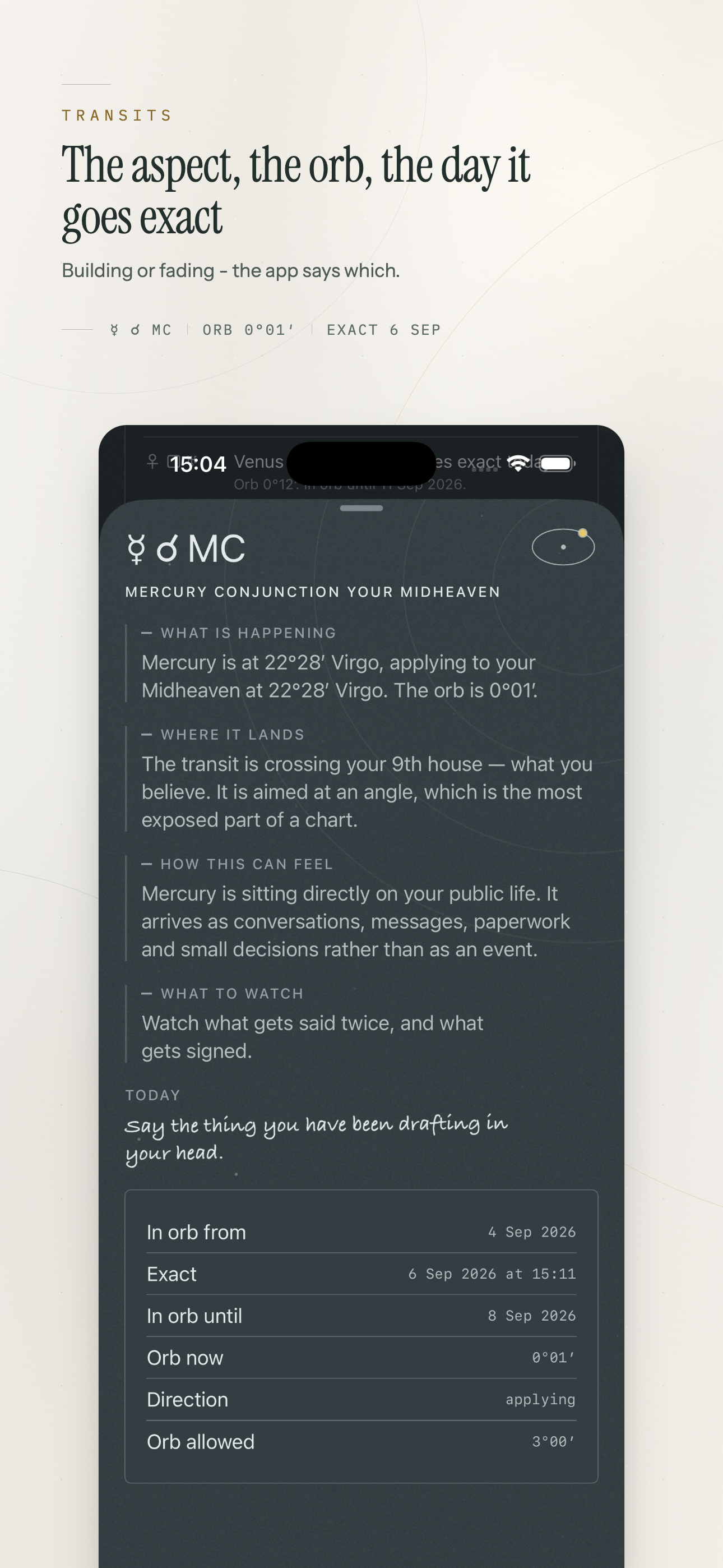
"Mars square Saturn" tells you an aspect exists. "Mars square Saturn, orb 0°14'" tells you it is nearly exact and probably the loudest thing in the chart. "Mars square Saturn, orb 7°52'" tells you it scraped in under a generous setting and might not deserve a paragraph.
Same three words, very different charts. An app that prints the orb is handing you the evidence; one that prints only the label is asking you to trust its threshold.
Tight, standard, wide
A practical way to use three settings rather than agonising over one:
Tight shows the aspects that are hard to argue with. Good for a first read of an unfamiliar chart, because what survives is the skeleton. Also good when you have talked yourself into a reading and want to know whether it rests on anything.
Standard is the working default and roughly what most books assume.
Wide is for a specific question: you are chasing a theme and want to see everything that might touch it, accepting that some of it is noise. Useful for research, misleading as a habit.
The mistake is reading a wide chart and treating every line on it as equally real.
Applying and separating
An orb is a distance, and distances change. When the faster body is moving towards exactness, the aspect is applying. When it has passed and the gap is opening, it is separating.
Traditionally applying aspects are read as the ones still to play out and separating ones as already spent. Whether or not you accept that, the distinction has a practical use: it tells you which direction the chart is moving and, for a transit, whether the exact date is ahead of you or behind.
That matters more than it sounds. "Saturn is squaring your Sun" describes a period that might last months. "Saturn squares your Sun exactly on the 14th, applying now, separating after" describes something you can actually put in a calendar and check against what happens.
Exactness is not intensity
One last caution. A tight orb means the geometry is precise. It does not automatically mean the effect is dramatic, and a chart is not a ranking of life events by orb size.
What the orb tells you reliably is how confident you can be that the aspect is doing anything at all. That is a smaller claim than most descriptions make, and a much more defensible one.