Tromso and Berlin will never see the same Kp night the same way, and everyone knows that. The part that trips people up is that Minneapolis and Moscow will not either, and those two sit at nearly the same latitude.
Minneapolis is at about 45 degrees north. Moscow is at about 56. Eleven degrees apart, more than a thousand kilometres, and yet the aurora reaches Minneapolis at a lower Kp than it reaches Moscow. If geography decided this, that would be impossible.
The pole the aurora cares about is not the one on the map
The aurora is not arranged around the geographic North Pole. It is arranged around the geomagnetic pole - the axis of Earth's magnetic field - and that pole sits in the Canadian Arctic, more than a thousand kilometres from the geographic one.
So the ring of aurora, the auroral oval, is centred over northern Canada rather than over the top of the globe. North America sits closer to the middle of that ring than its map latitude suggests. Siberia sits further out. Same parallel, different distance from the thing that matters.
The measure that captures this is geomagnetic latitude: how far you are from the magnetic pole, expressed in degrees, exactly the way ordinary latitude expresses distance from the geographic pole. Once you are working in geomagnetic latitude, the contradiction disappears. Minneapolis is at about 55 geomagnetic. Moscow is at about 51. Minneapolis is the more northern of the two in the only sense the aurora responds to.
What Kp actually does
Kp is a 0-9 scale of how disturbed Earth's magnetic field is over a three-hour window. It is a global average, and its practical meaning is simple: the higher it goes, the further from the magnetic pole the oval expands.
Roughly, each Kp step pushes the equatorward edge of the oval about two degrees of geomagnetic latitude further out. Which turns the whole question into arithmetic:
- Find your geomagnetic latitude.
- Find where the edge of the oval currently sits, in geomagnetic latitude.
- If the edge has come further out than you are, the aurora is above your horizon.
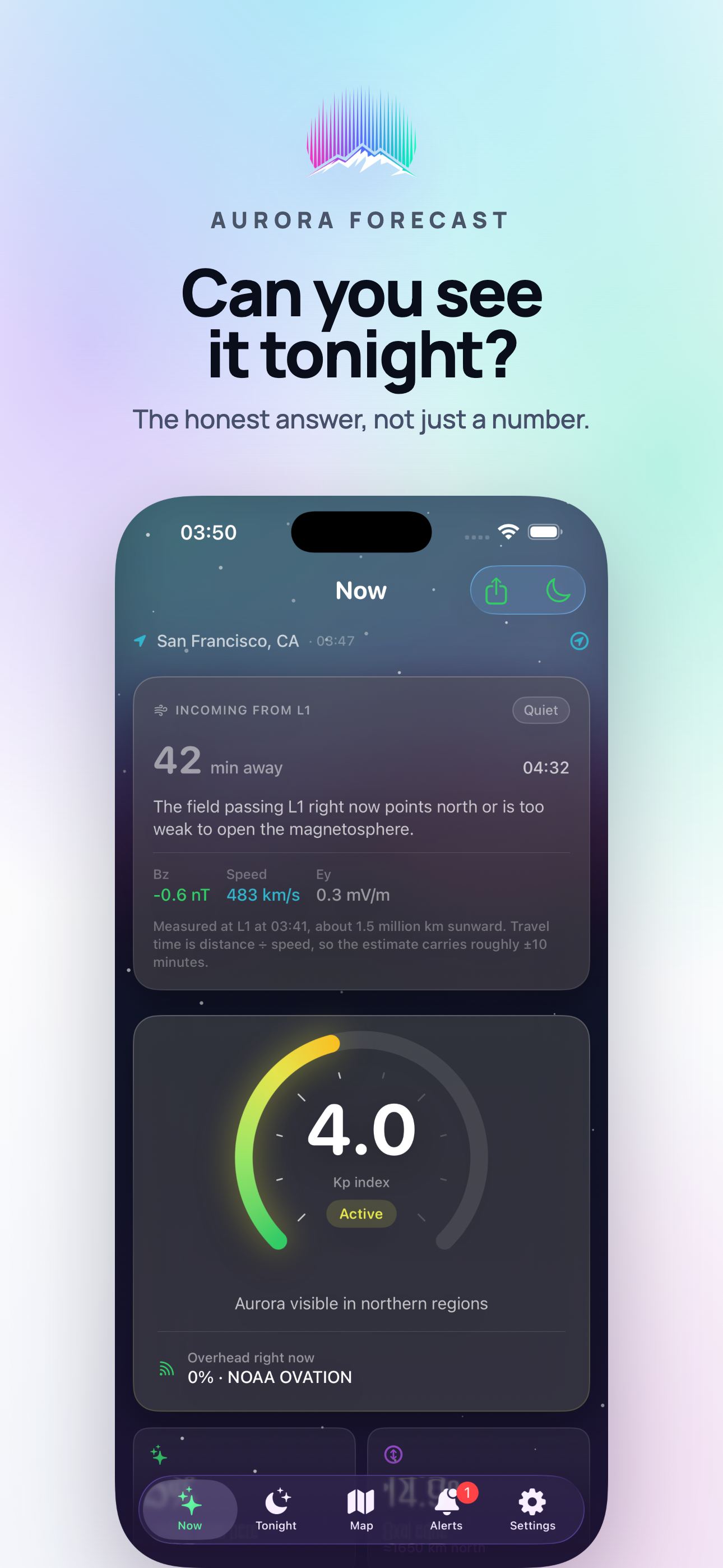
That is the calculation an aurora app should be doing for you, and it is why "your chance tonight" is a more useful headline than "Kp 4". The Kp is an input. The chance is the answer, and the answer is different for every user looking at the same number.
Overhead, on the horizon, or nothing
There is a second thing the raw index hides. Being inside the oval and being under its edge are very different experiences.
Inside the oval, the aurora is overhead. It moves fast, it fills the sky, and it does not look like the photographs, which are usually taken from further south. Under the edge, you get a green arc sitting low on the northern horizon - real, but small, and easy to miss if you are looking in the wrong part of the sky or standing behind a hill.
Ten degrees south of the edge, there is nothing to see at any time of night, no matter how clear the sky. This is why a distance - how many degrees, how many kilometres, you are from the edge right now - tells you more than a percentage. It says which of the three situations you are in.
The other half of the answer
Geomagnetic latitude decides whether the aurora is above your horizon. It does not decide whether you will see it. Four things have to line up:
- The oval has to reach you. That is the Kp and geomagnetic latitude question.
- It has to be dark. Which rules out the summer entirely above about 60 degrees north - there is no astronomical darkness in Tromso in June, and no forecast fixes that.
- The sky has to be clear. The most reliable way to waste a Kp 7 is a solid deck of cloud.
- You have to be looking. Substorms last twenty to thirty minutes and do not announce themselves.
Ordered by how often each one is the thing that ruins the night, cloud comes first by a wide margin. Most disappointing aurora nights are not quiet nights. They are active nights spent under cloud.
The Kp you need, by where you are
As a starting point for the naked eye in a dark, clear sky:
| You are in | Kp for a horizon arc | Kp for overhead |
|---|---|---|
| Tromso, Fairbanks, Yellowknife | 0-1 | 2-3 |
| Reykjavik, Anchorage | 2 | 4 |
| Inverness, Trondheim, Helsinki | 3-4 | 5-6 |
| Edinburgh, Oslo, Stockholm | 5 | 7 |
| Minneapolis, Seattle, Manchester | 5-6 | 8 |
| London, Berlin, Warsaw, Moscow | 7 | 9, effectively never |
Two caveats. A camera on a tripod picks up colour roughly a level earlier than your eyes, so the photography threshold is lower than the seeing threshold. And light pollution costs you about as much as a full Kp step - the same night is a different night from a car park on the edge of a city than from twenty minutes further out.
Why the map is worth opening
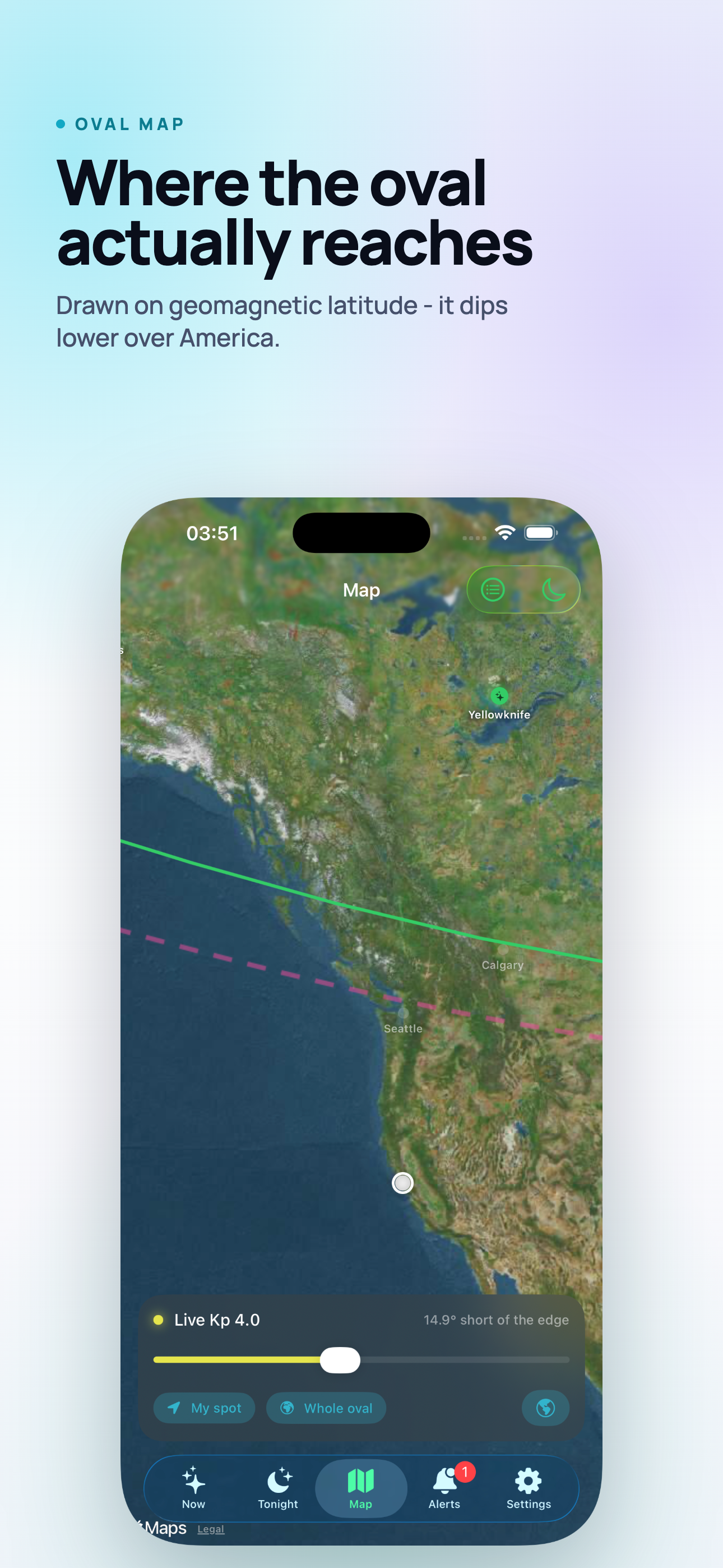
All of this is easier to believe when you can see it. Draw the oval on a map on geomagnetic latitude and the asymmetry is immediately obvious: it hangs much further south over Canada and the northern United States than it does over Russia at the same distance from the top of the globe.
Push a storm slider up a couple of Kp steps and you can watch which places come inside the ring. That is usually the moment the abstraction lands - not the table, but seeing your own town cross the line.
Aurora Forecast computes the chance from your geomagnetic latitude rather than showing a generic percentage, and puts the distance to the edge of the oval - in degrees and in kilometres - next to it. If you want the background first, the glossary has what the Kp index is and what the aurora oval is.