"Face north" is the first thing anyone is told about watching the aurora, and it works well enough in Scandinavia that it never gets questioned. Take the same advice to Scotland, Ireland, Iceland or most of the northern United States and it will point you at a piece of sky where nothing is happening, while the display sits off to your left.
The reason is the same one that makes Kp behave strangely across longitudes: the aurora does not care about the geographic pole.
Two different poles, a thousand kilometres apart
The geographic North Pole is where the axis of rotation meets the surface. The geomagnetic pole - the axis of Earth's magnetic field - is in the Canadian Arctic, and the two are separated by well over a thousand kilometres.
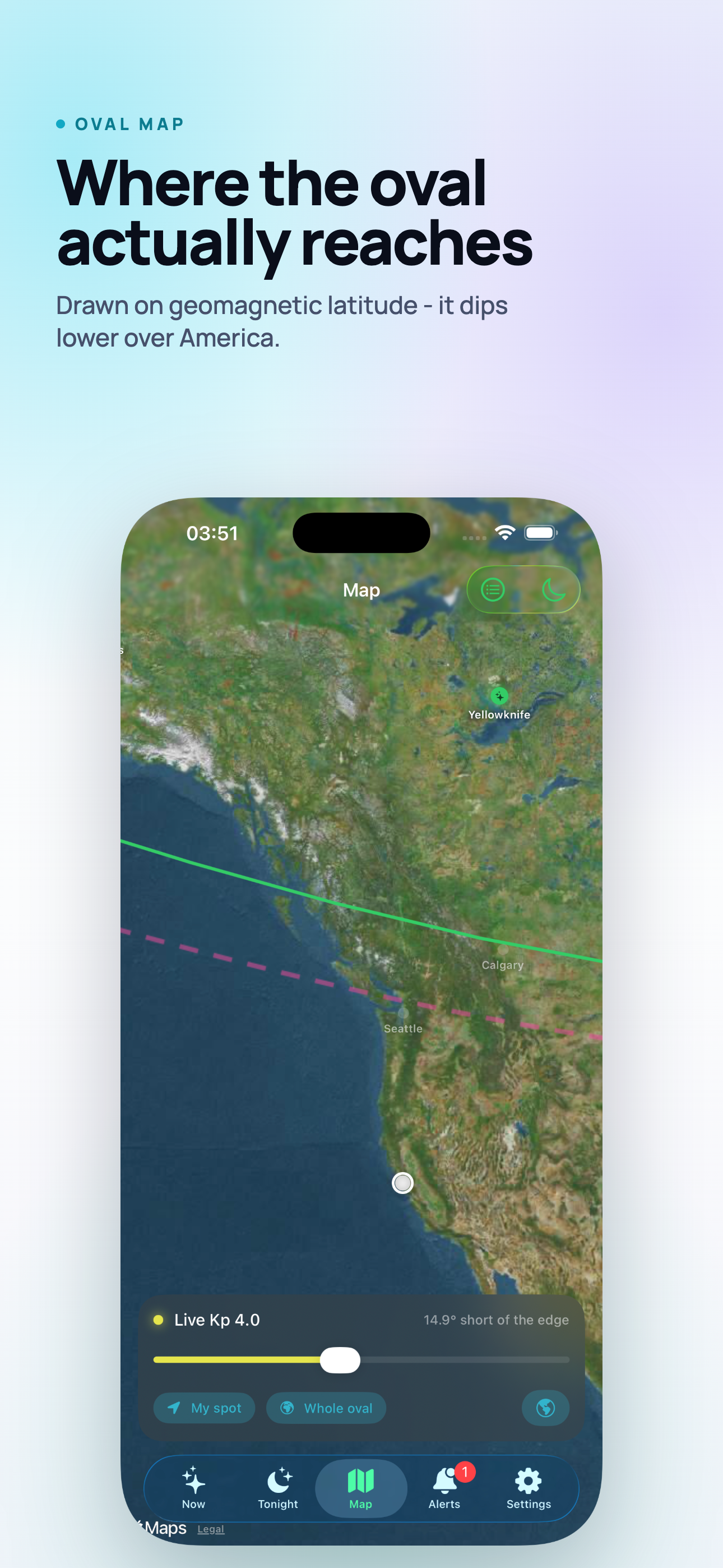
The auroral oval is a ring centred on the magnetic pole. So the direction from you to the nearest part of that ring is the direction from you to a point in northern Canada, not the direction to the top of the globe. From Europe that bearing swings west of north. From eastern Siberia it swings the other way. From central Canada, north is roughly right, which is part of why the advice survives.
Practical version: from Iceland or Scotland, expect to be looking somewhere between north and north-west. From Moscow, north to north-east. From Alaska, north-east. The further you are from the meridian that runs through the magnetic pole, the bigger the error in "look north".
Your compass is wrong in a different way
There is a temptation to solve this by trusting a magnetic compass, on the grounds that it points at the magnetic field and the aurora follows the magnetic field. It is not that simple.
A compass needle aligns with the local horizontal field, which is bent by the geology under your feet and by whatever is in your pocket. The difference between where it points and true north is called magnetic declination, and it is large in exactly the places you want to be: about 10 degrees west in Iceland, 15 or more in parts of Greenland, over 20 in parts of northern Canada.
Declination is real and worth knowing, but it is a correction to compass north, not a bearing to the aurora. The two errors are different sizes and do not cancel. What you want is a bearing to the nearest edge of the oval, computed from where the oval currently is, and then converted into something your compass can follow.
How high to look matters as much as which way
The second half of the question gets asked even less often. People face the right way and then scan the wrong part of the sky.
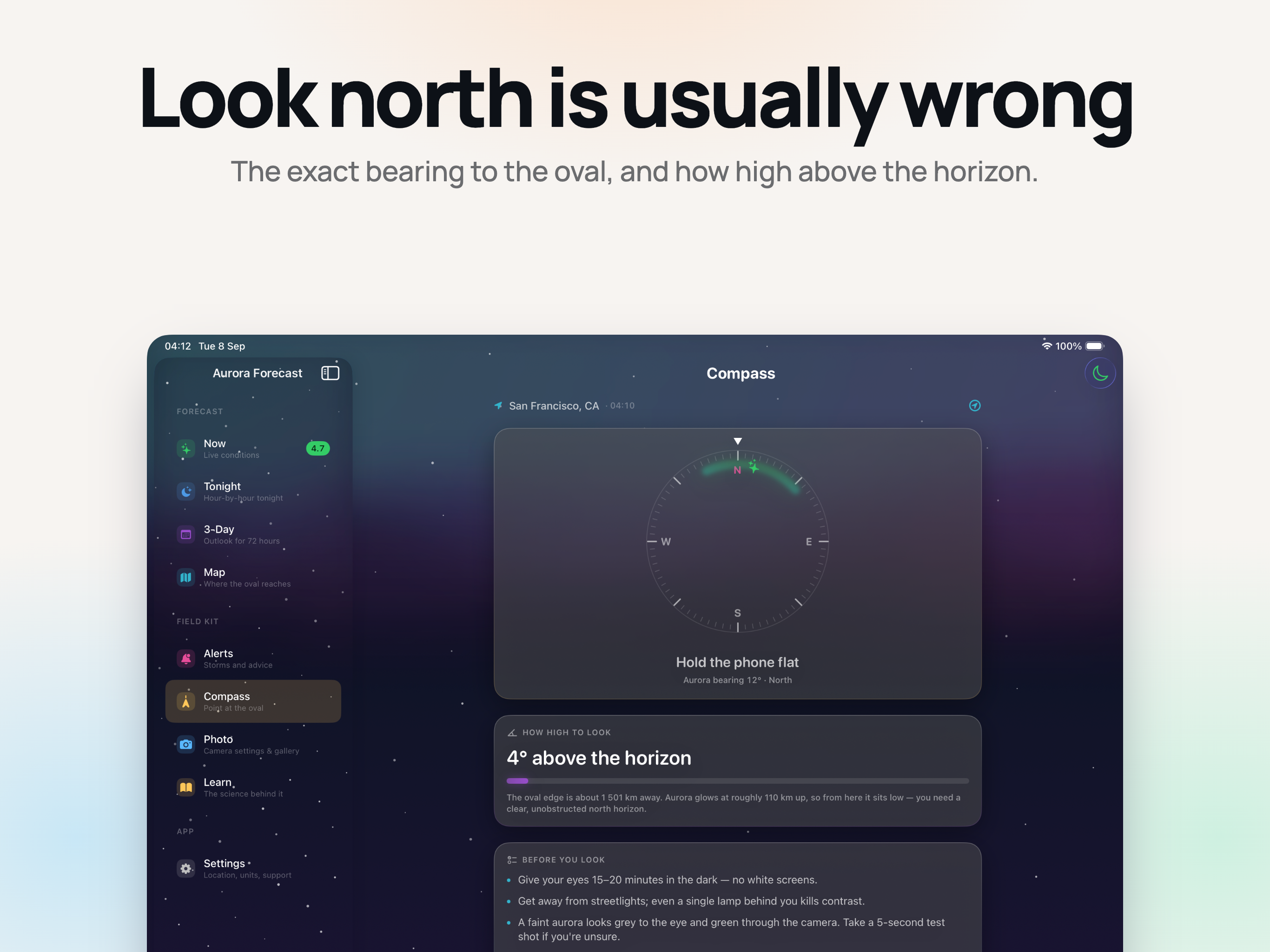
The aurora sits at 100 to 300 kilometres of altitude. If the edge of the oval is directly overhead you look up. If it is 500 kilometres away it sits well up in the sky. If it is 1,500 kilometres away, geometry puts it just a few degrees above the horizon - low enough that a line of trees, a hill or a supermarket hides it completely.
Rough elevations for the bottom edge of a display:
- Under the oval: overhead, and moving fast enough that you notice it in peripheral vision.
- 200-500 km from the edge: 20 to 40 degrees up. Comfortable, no obstruction problem.
- 1,000 km: around 10 degrees. You need a clear horizon.
- 1,500 km and beyond: a few degrees at most, mostly a camera target rather than a naked-eye one.
Ten degrees is about a fist held at arm's length. It is also about the height of a two-storey building at the far side of a car park, which is why so many "I saw nothing" nights happen from car parks.
Picking a spot for the direction, not the view
Once you know the bearing and the elevation, choosing where to stand becomes a concrete problem rather than an aesthetic one:
- Clear horizon on the bearing. Not all round - just the arc you will be looking at. A ridge behind you is fine.
- No light source in that direction. A town 20 km away on your bearing costs you more than a brighter town behind you.
- Water helps. A lake or a fjord on the right bearing gives you an unobstructed horizon and a reflection, which is where most of the good photographs come from.
- Get out of the valley. Valley floors cut ten or fifteen degrees off the horizon in every direction, which is the entire display at long range.
What happens during a big storm
All of the above describes ordinary nights. During a strong geomagnetic storm the oval expands so far that the advice inverts.
If the oval passes over you, the aurora is overhead and to the south as well as to the north, and the brightest structure - the corona, where field lines converge and the rays appear to radiate from a single point - is near your zenith. People at mid-latitudes during a big storm routinely miss it by staring at the northern horizon while the sky is doing something remarkable directly above them.
The tell is simple: if the arc you are watching has climbed well above the horizon and is still rising, stop looking north and start looking up.
Doing it without arithmetic
None of this needs to be worked out in the cold. The bearing to the nearest edge of the oval and the elevation to look at are both computable from where you are and where the oval currently sits, and a compass that already knows the answer is easier to follow than a rule of thumb.
Aurora Forecast points at the nearest edge of the oval rather than at north, and tells you how high above the horizon to look. It also has a deep red night mode, which is worth turning on before you start pointing a phone at your face in the dark - here is why.