Ask anyone who has chased the aurora for more than one season what ruins most nights, and nobody says quiet sun. They say cloud. The geomagnetic side of this hobby is unusually well instrumented and reasonably well behaved. The weather is neither.
Which makes the ordering strange. Aurora apps lead with Kp, put a small cloud icon somewhere below it, and let you work out the interaction yourself. The interaction is the whole thing.
The order the night is actually decided in
Three conditions have to hold at the same time, and they do not have equal weight:
- A gap in the cloud. No gap, no night. There is no Kp that sees through stratus.
- Darkness. Astronomical twilight has to be over, and the Moon should ideally be down or thin.
- Activity. The Kp, the Bz, the substorm - the part everyone leads with.
If you have to give one up, give up the third. A quiet sky in a clear dark place still gives you a chance to be in position when a substorm starts. An active sky behind an overcast gives you nothing at all, all night, with certainty.
Why a single "best time" is usually wrong
The standard output is one recommendation: best viewing tonight, 23:40. It is a comforting format and it hides two things.
First, it hides the width of the window. Twenty minutes of clear sky at 23:40 and three hours of clear sky starting at 23:40 are entirely different plans - one is worth a fifteen-minute drive, the other is worth an hour and a flask.
Second, it hides the alternatives. If 23:40 is a 60% chance and 01:20 is a 55% chance, you have two options and the second may fit your night better. Collapsing that into one number throws away the choice.
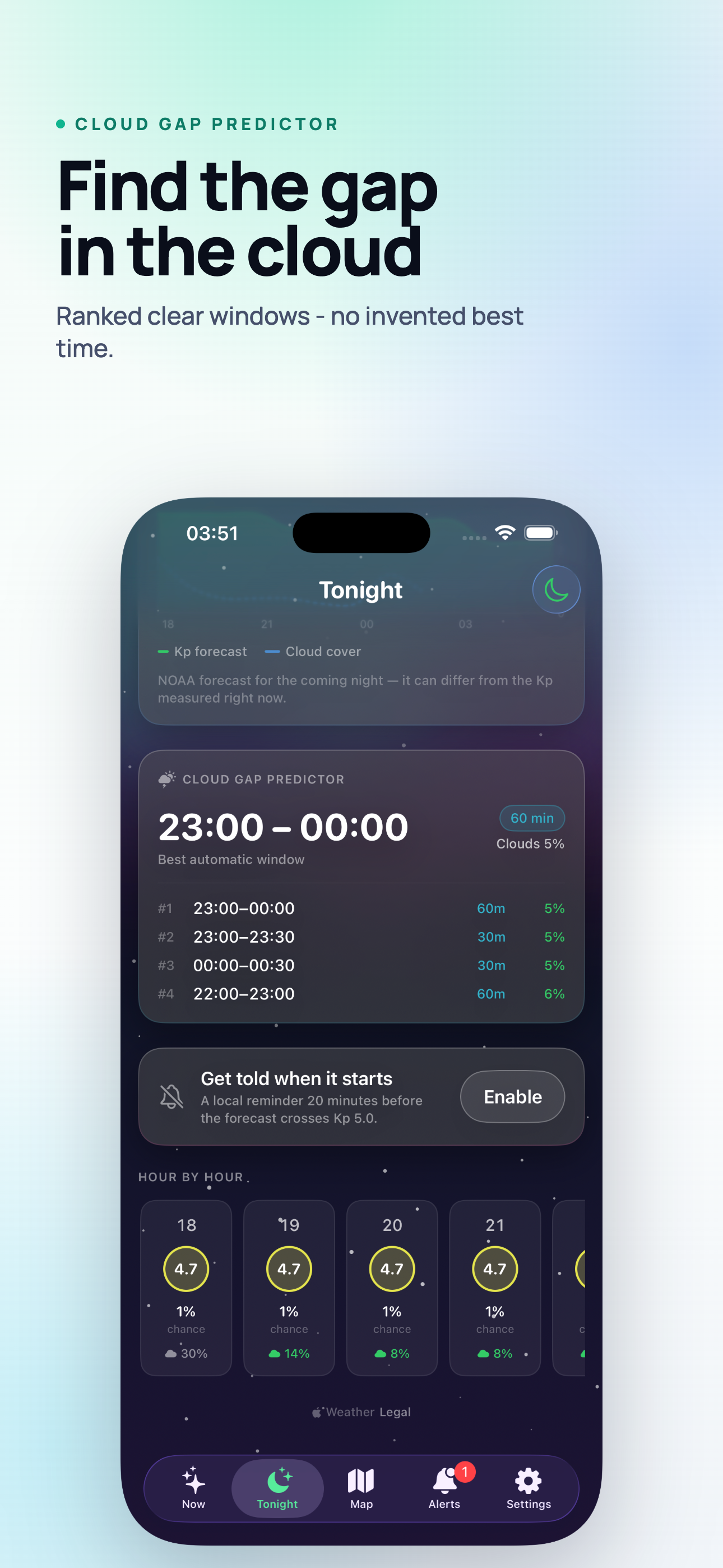
Ranked windows fix both. Give me the clearest half-hour and the clearest hour, in order, with the cloud figure and the Kp behind each, and I can make the decision myself - including the decision to go later because I would rather not leave at ten.
The honest failure case
The reason a ranked list matters more than it sounds is what happens on a bad night.
A system that must always produce a best time will produce one on a night with 96% cloud from dusk to dawn. It will pick the least bad hour, present it in the same typeface as a genuinely clear window, and you will drive out to a car park and stand under an overcast for forty minutes.
The correct output on that night is: there is no window. Stay in. That is not a failure of the forecast, it is the forecast working. An app that cannot say it is teaching you to distrust every recommendation it makes, including the good ones.
Reading an hourly cloud forecast properly
A few things worth knowing once you start looking at cloud hour by hour:
Total cover is a blunt number. Forecasts usually report low, medium and high cloud separately as well as a total. High cirrus at 70% can still let a bright aurora through, hazily. Low stratus at 40% may sit exactly where you would be looking. If you only have the total, treat it as a rough guide, not a verdict.
You only need one direction. Unless the oval is overhead, you are looking north. Cloud sitting to the south is irrelevant. This is the single most common reason a night that looked hopeless on the app turns out fine.
Cloud moves faster than the forecast grid. Hourly resolution smooths over gaps that are twenty minutes wide. If the trend is breaking up, it is worth being outside slightly before the model says so.
The Moon is not cloud, but it behaves like it. A full Moon near the horizon costs you the faint end of the display. It will not stop a substorm from being obvious; it will stop a quiet arc from being visible at all.
Local geography beats the forecast
A cloud forecast is computed on a grid several kilometres wide. Terrain is not.
Coasts, valleys and the lee side of a ridge routinely do their own thing. In Iceland, driving twenty minutes inland or twenty minutes to a different fjord frequently changes the sky completely, and it does so more reliably than waiting for the forecast to improve where you are. On a marginal night, the right move is almost always to drive rather than to wait.
The corollary: pick your spot from the cloud map, not from a list of famous viewpoints. The best viewpoint under cloud is worse than an ordinary field under clear sky.
A workable routine
What this looks like as an actual evening:
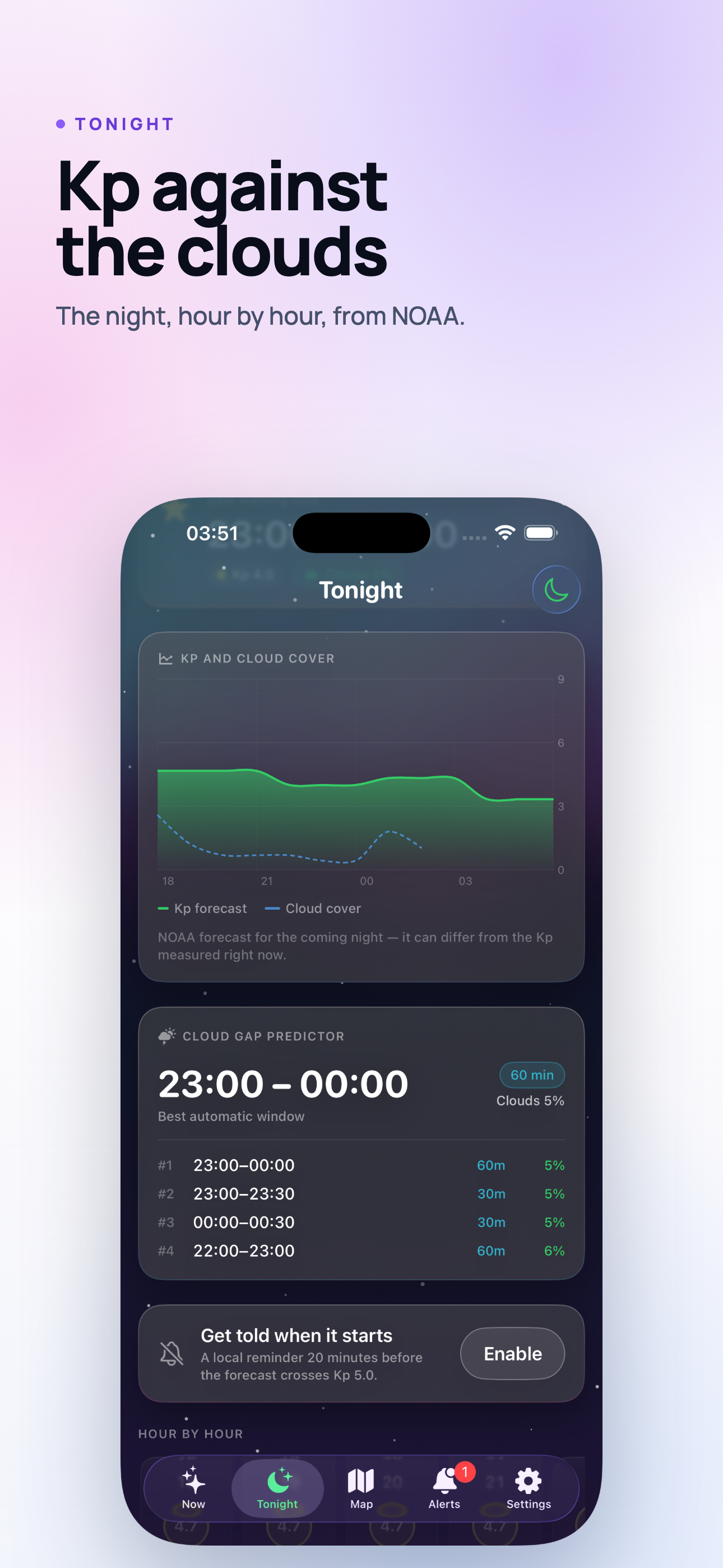
- Late afternoon: look at tonight's hourly chart - Kp curve and cloud layer together - and decide whether the night has a window at all.
- If it does: note the ranked windows and pick one that fits, not necessarily the top one.
- Before leaving: check the cloud in the direction you will be looking, and check whether driving thirty minutes changes it.
- While out: leave the cloud-opening alert on. Gaps arrive earlier and later than forecast, and you want to know while you are still outside.
- When it goes quiet: wait twenty minutes before packing up. Substorms come in waves.
Aurora Forecast lays the cloud layer over the night's Kp chart and ranks the clearest 30- and 60-minute windows - and says plainly when there are none, rather than inventing a best time. Cloud, temperature and moon phase come from Apple Weather; the space-weather side comes from NOAA SWPC. When either goes quiet the app says so instead of showing a plausible number.